Apple has sued OpenAI, and the complaint it filed on Friday in the Northern District of California reads less like a standard corporate dispute and more like a rolling account of two former employees allegedly walking out the door with a company’s engineering playbook. At the center of it are Chang Liu, a senior electrical engineer who spent eight years at Apple before joining OpenAI in January, and Yu-Ting “Alyssa” Peng, who followed him to OpenAI in April after months of allegedly feeding him confidential updates while she was still on Apple’s payroll.
The lawsuit names OpenAI, io Products, Liu, and OpenAI’s hardware chief Tang Tan as defendants, and accuses the company of trade secret misappropriation and breach of contract. Apple is asking the court for an injunction stopping OpenAI from using its technology, along with damages to be determined at trial. But it’s the granular detail in the complaint — screenshots of messages, timelines of file downloads, descriptions of a security vulnerability being quietly exploited for months — that has made this filing stand out even in an industry that has gotten used to talent wars spilling into court.
The laptop that wouldn’t die
According to the complaint, Liu’s alleged misconduct began the moment he left Apple. He departed on January 22, 2026, and like every Apple employee is bound by an Intellectual Property Agreement obligating him to protect the company’s confidential information. Apple says he went dark on the standard exit process — he didn’t confirm return of his devices, didn’t schedule an exit interview, and didn’t sign the confidentiality reminder Apple sends departing staff. At the time he left, Apple alleges, he still had at least one company-owned computer in his possession.
Within hours of walking out, Liu allegedly told Peng, who was still at Apple, that he “still have another computer” he planned to use to access Apple’s confidential information. A few weeks later, on or around February 9, Apple says Liu discovered something he wasn’t supposed to have: continued access to Apple’s network storage, a cloud repository holding engineering files, project documentation, and other proprietary material. The vulnerability, per the filing, was unknown to Apple at the time.
What Apple alleges he did next is the part drawing the most attention. Instead of reporting the flaw, Liu is said to have messaged Peng: “LOL, I found out I can access the [network storage], so funny.” Her reply, according to the complaint, was immediate: “I’m ready.”
Dozens of files, a thousand-page compilation, and a metal-finishing technique
From there, Apple alleges a pattern of deliberate, repeated access rather than a one-off lapse. The complaint says Liu proceeded to select, access, and download dozens of confidential files from Apple’s repository — technical presentations, spreadsheets, PDFs, and internal write-ups, many explicitly marked confidential, including what Apple describes as a compilation of technical files running over a thousand pages documenting work he and others had done at Apple. Among the material named specifically is a presentation on the manufacture and testing of multi-layer main logic boards, detailing manufacturing workflows, testing data interpretation, and the specific equipment used to diagnose issues on Apple’s circuit boards.
Other reportage has noted an additional allegation: that OpenAI had a trusted Apple manufacturing partner carry out one of Apple’s proprietary metal-finishing techniques, having misled the partner into believing the work was authorized. Apple says it discovered the pattern through its own internal investigation and cut off Liu’s access once it did — but argues that what it has found so far is likely only a fraction of what actually happened, stating plainly in the complaint that “discovery will expose that the misappropriation has been occurring on a scale many times greater than the several instances described below.”
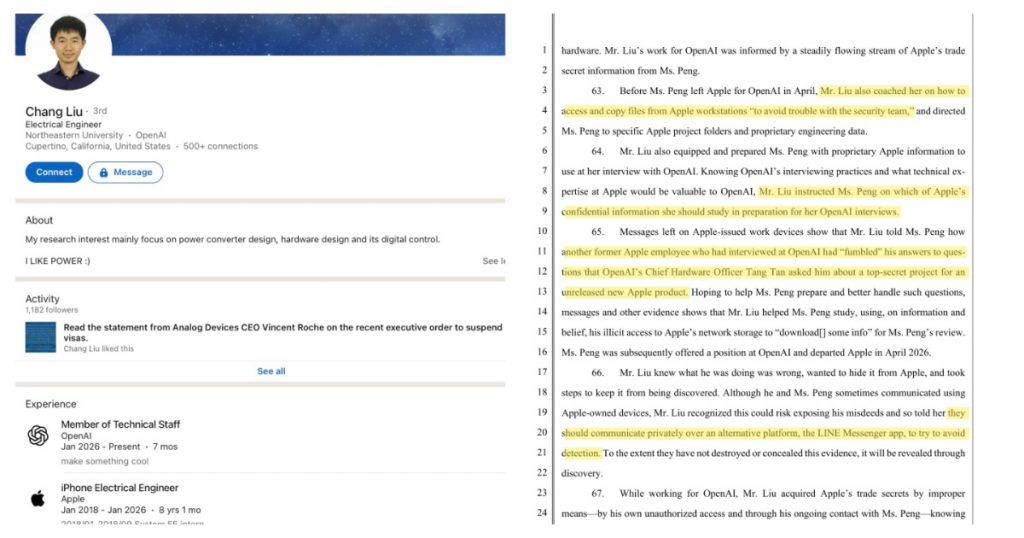
The complaint also alleges Liu didn’t stop at his own access. Before Peng left Apple, he is accused of coaching her on how to pull files off Apple workstations “to avoid trouble with the security team,” and pointing her toward specific project folders and engineering documentation. He allegedly went further still, prepping her for her OpenAI interviews by telling her which of Apple’s confidential material to study, and warning her — using messages left on an Apple-issued device — about how a different former Apple employee had “fumbled” when OpenAI’s Chief Hardware Officer, Tang Tan, questioned him about a secret unreleased Apple project. Apple alleges the two eventually moved their conversations off Apple devices entirely, switching to LINE Messenger specifically to avoid detection.
Tan himself, an Apple veteran who led iPhone and Apple Watch product design before leaving in 2024 to work with Jony Ive, is a named defendant. OpenAI acquired Ive’s hardware startup io for $6.5 billion last year, and Tan now serves as the company’s chief hardware officer — the effort Apple’s complaint alleges was built partly on its own stolen engineering knowledge. Apple says it sent OpenAI a letter raising these concerns back in February and received no response before filing suit. OpenAI, for its part, has denied wrongdoing, with a spokesperson telling reporters the company has “no interest in other companies’ trade secrets.”
A familiar shape
This is not the first time an AI lab has accused OpenAI of running exactly this kind of playbook. Last year, xAI sued OpenAI alleging a coordinated campaign to lift its proprietary code and infrastructure strategy through departing employees, rather than a single rogue hire. That complaint described three separate tracks running at once: engineer Xuechen Li, who xAI says uploaded the company’s entire codebase to personal storage after accepting an OpenAI offer; a second engineer, Jimmy Fraiture, accused of independently harvesting source code onto his own devices; and former xAI CFO Mike Liberatore, alleged to have carried the company’s data center deployment strategy — its “secret sauce” — over to OpenAI after refusing to sign a standard confidentiality agreement on his way out. A judge had dismissed xAI’s case against OpenAI earlier this year.
But the structural overlap with the Apple complaint is hard to miss. In both cases, the theft is alleged to have run through a small number of departing employees with privileged access, rather than through any conventional corporate espionage. In both, the departing employee is accused of continuing to communicate with people still at the old company, using that channel to keep pulling information after they’d formally left. In both, there’s a specific moment where the person allegedly realizes they still have access they shouldn’t, and instead of reporting it, exploits it. And in both, the complaints go out of their way to argue that what’s been uncovered is the visible edge of something considerably larger — xAI framed it as multiple “parallel” schemes it stumbled into while chasing a single lead, and Apple’s filing makes almost the identical claim about Liu being just one name among what it says are over 400 former Apple employees now at OpenAI.
The two cases have arrived at OpenAI from opposite ends of its business — one aimed at the core model and infrastructure work that made the company what it is, the other at a secretive hardware push meant to be its next act. While xAI’s case ended up being dismissed, they do indicate that in a market where a handful of engineers can carry a company’s most valuable knowledge in their heads and on their laptops, the fight over trade secrets could be increasingly fought through the people who move between labs, not the labs themselves.