Jeff Dean’s departure rom Google yesterday came as a bit of a shock to most observers, but he’d dropped hints as to what he was planning just two weeks ago.
At Y Combinator’s Startup School in San Francisco, speaking to a room of roughly 6,000 founders and aspiring founders, Dean laid out an idea that in hindsight reads like a mission statement for a company he hadn’t yet announced.
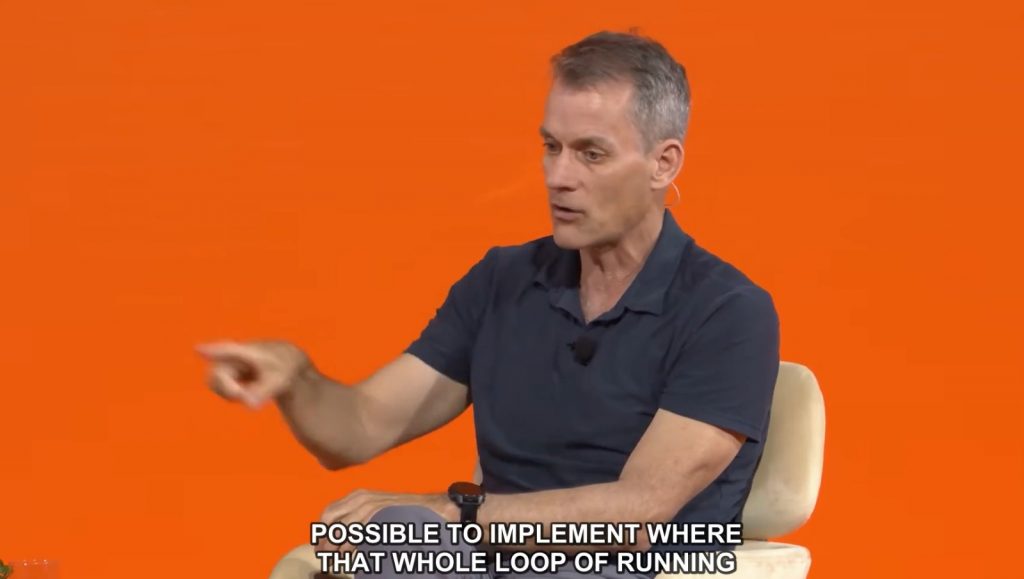
“There’s this sort of the foundation of the scientific method of you propose an experiment, you implement what you need to run the experiment, and you evaluate the experiment, and then you get results from that,” Dean said. “And I think there are more and more problems that are now possible to implement where that whole loop of running not just a few experiments, but running many, many experiments, because you’re able to automate that loop and make the latency of that loop extremely low, is going to be really, really important. It’s going to enable us to tackle lots of different problem domains in science and engineering and machine learning, model design itself, and also in engineering tasks like designing chips,” he added.
At the time, this sounded like Dean doing what Dean has always done at these events: thinking out loud about where the field is headed, dropping a framework, moving on to the next question. Eleven days later, he announced he was leaving Google after 27 years to build exactly that.
The company is called Discovery Loop, and Dean isn’t building it alone. He’s bringing three of his longest-standing collaborators at Google with him: Sanjay Ghemawat, the systems architect who co-built the Google File System, MapReduce and Spanner alongside Dean; Oriol Vinyals, who spent years as a VP at DeepMind; and Quoc Le, one of the co-founders of Google Brain. Between the four of them, much of the modern internet’s plumbing traces back to their work — TensorFlow, TPUs, Bigtable, and a fair share of Gemini itself.
Discovery Loop’s own framing of its mission matches Dean’s YC talk almost sentence for sentence. On its website, the company describes the scientific method as one of humanity’s best inventions, but says the execution of it — proposing an experiment, running it, reading the results, deciding what to try next — has stayed a manual, human-paced process for centuries. Their bet is that this entire loop can be handed over to AI systems that propose, run, and evaluate experiments on their own, at a speed and scale no human research team could match.
That’s a notably narrow and specific pitch for a company founded by four of the most cited researchers in AI and distributed systems. Dean could have built almost anything. He chose to build a company around the idea of compressing the interval between “I have a hypothesis” and “I know if I was right,” and then repeating that compression across thousands of experiments running in parallel.
The scope, at least initially, is machine learning research and engineering itself — using AI to speed up how AI systems get built and improved, a recursive bet that Google is apparently comfortable funding even as the researchers walk out the door to do it independently. Sundar Pichai confirmed that Google will be a founding investor in Discovery Loop and will also serve as its cloud infrastructure partner, which makes this less a clean break and more an amicable spinout. Dean has said the approach isn’t limited to ML, though, and pointed to applications across science and engineering more broadly, chip design among them, which lines up with the “designing chips” line from his YC talk almost exactly.
Whether Discovery Loop can actually deliver on a loop that runs “many, many experiments” at low latency is the open question now, and one that will take actual products to answer rather than slide decks. But the through-line from a casual answer at a founder conference to a company built around that answer, in under two weeks, says something about how deliberately Dean had been thinking about this before he ever said a word about leaving.