Kimi K3 has taken the US tech world by storm by rivaling the top American models on benchmarks, but the seeds for the China-based model were sown in faraway USA.
In August 2019, a young computer scientist named Zhilin Yang defended his PhD thesis at Carnegie Mellon University — and did it in just four years, a pace his advisor still remembers. Russ Salakhutdinov, then CMU professor and later Apple’s Director of AI, posted a photo from that day: a lecture hall, a projector screen reading “Learning From Unlabeled Data,” and a young man in a dark sweater standing at the podium, laptop open, mid-sentence.
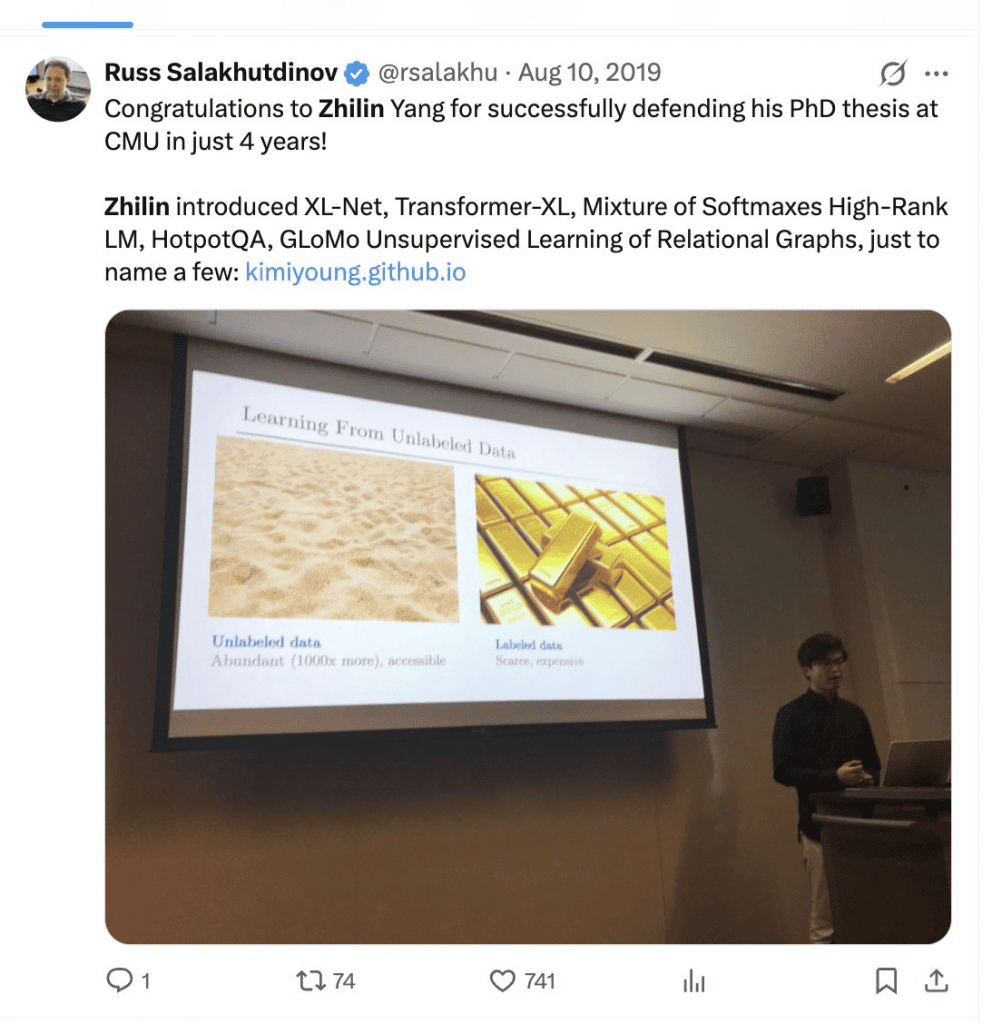
Salakhutdinov’s tweet listed off what Yang had built during those four years almost like a highlight reel: XLNet, Transformer-XL, a Mixture of Softmaxes language model, the HotpotQA dataset, GLoMo. Even in a field crowded with prodigies, it was an unusually dense body of work for a doctoral student — models and datasets that are still cited today, years after transformers went from a niche research topic to the backbone of the entire AI industry.
Six years later, Salakhutdinov was posting about Yang again — this time not as a proud advisor congratulating a graduate, but as a fellow industry figure marking a product launch. “It feels like just yesterday Zhilin was graduating from my lab at CMU,” he wrote, congratulating Yang on the latest release from Kimi, the AI assistant built by Yang’s company, Moonshot AI, and thanking the team “for everything you’re doing for the open-source community.”
That arc — from a CMU lecture hall to running one of China’s most closely watched AI startups — is the story of Zhilin Yang.
From Shantou To Tsinghua To Silicon Valley
Yang was born in 1992 in Shantou, a port city in China’s Guangdong province. He enrolled at Tsinghua University — China’s answer to MIT — in 2011, though not initially in computer science; he was originally admitted into a thermal energy engineering program before transferring into the Department of Computer Science and Technology in his second year, according to a profile. By his own account in a 2024 interview with Chinese journalist Xiaojun Zhang, he had drifted into AI research by his sophomore year and spent over a decade in the field before starting Moonshot.
His early academic work ranged across graph learning and multimodal models before he narrowed his focus, around 2017, onto language models specifically — a decision he now frames as recognizing “the central problem” of AI research, years before the rest of the industry caught on.
Yang went on to Carnegie Mellon for his PhD, co-advised by Ruslan Salakhutdinov — who would later become Apple’s head of AI — and William W. Cohen, then chief scientist at Google AI. During this period he interned extensively at Google, where he says he absorbed a lesson that would define his later research philosophy: “free yourself from infinite polish.” Rather than endlessly refining architectures on small benchmark datasets, Yang says he learned to look for structures that were both universal and scalable — an early, informal brush with what the industry now calls scaling laws.
That philosophy produced results. As first author, Yang co-developed XLNet — a pretraining model that, at launch, outperformed BERT (Google’s dominant language model at the time) on 20 different NLP benchmarks — alongside Transformer-XL, a foundational architecture for handling longer sequences of text. He also published with Turing Award laureates Yann LeCun and Yoshua Bengio during his doctoral years, often as first author, collaborations he attributes simply to academia’s openness to good ideas rather than any particular talent for persuasion. He completed his PhD in four years and went on to work at both Google Brain and Facebook AI Research (Meta) before returning to China, according to Baidu Baike’s biographical entry and other public profiles. He also holds a position as an assistant professor at Tsinghua University.
The Month That Changed Everything
By Yang’s own telling, the idea for Moonshot AI crystallized in the weeks around ChatGPT’s November 2022 launch — a moment he says he’d been anticipating rather than reacting to. In an interview published by Chinese outlet 36Kr in March 2024, Yang described sitting in his apartment in the US in late 2022, running rough calculations on FLOPs, training costs, inference costs, and projected user numbers, and concluding that a serious AGI-focused startup would need to raise at least $100 million within a matter of months just to be competitive.
He was right about the urgency, if not quite the number. Yang has said the funding window for a company like his was startlingly narrow — roughly one month in early 2023 — and that waiting even until April would have meant missing it entirely, while trying in December 2022 or January 2023 would have been too early, before the market had processed what ChatGPT meant. Talent markets moved on a similar delay, he says, with engineers only beginning to treat large language models as the only worthwhile career bet by March or April 2023.
Moonshot AI was formally founded on March 1, 2023, by Yang alongside two Tsinghua schoolmates, Zhou Xinyu (previously a senior researcher at computer-vision company Megvii) and Wu Yuxin (previously a research engineer at Meta AI). The company’s initial funding round, in Yang’s account, drew heavily from Chinese capital despite starting conversations in the US, and closed at well above the $100 million figure he’d calculated — the first of several rounds that would total roughly RMB 2 billion (about $280 million) by the end of 2023, according to figures Yang gave in the interview.
Betting On Long Context While Everyone Else Chased GPT-4
Where many of China’s other large-model startups spent 2023 racing to replicate GPT-3.5 and then GPT-4 feature-for-feature, Yang says Moonshot made an early, deliberate bet on a different technical dimension: long-context processing — essentially, how much text a model can hold and reason over in a single conversation. The company’s consumer product, Kimi (also Yang’s English name), launched with the ability to process roughly 200,000 Chinese characters in a single prompt, positioning it as a way to digest entire documents, research papers, or extended conversation histories rather than short exchanges.
Yang described long context in almost architectural terms — comparing it to the invention of computer memory itself, and arguing it was a prerequisite for AI to become genuinely personalized, since a user’s entire interaction history could become context rather than requiring separate fine-tuning. He was unusually candid that the payoff wasn’t obvious to outsiders: differentiating a Chinese large-model company from its dozens of domestic rivals, he argued, required exactly this kind of “correct non-consensus” bet made early, rather than following the herd once a direction became fashionable.
By February 2024, that bet — plus the broader promise of Moonshot’s trajectory — had pushed the company’s valuation to roughly $2.5 billion in a round led by Alibaba, with Tencent joining a subsequent raise later that year that pushed valuation past $3 billion, according to reporting by the South China Morning Post. At the time, Moonshot was reportedly running on fewer than 100 employees — strikingly lean for a company raising at unicorn valuations, and a deliberate choice, Yang has suggested, to keep the org dense with genuine researchers rather than scale headcount for its own sake.
An AGI Believer Who Insists He Isn’t Building “China’s OpenAI”
Throughout his public interviews, Yang has resisted the framing of Moonshot as a domestic OpenAI clone, arguing that true AGI has to be a global pursuit rather than a regionally protected one, and that the eventual winner in the space will need to combine OpenAI’s early technical idealism with something closer to a great consumer product built together with users. He’s pointed to OpenAI’s own rocky early reputation — a period, in the late 2010s, when top AI talent reportedly preferred Google and viewed Sam Altman’s team with skepticism — as evidence that being dismissed as unrealistic is not, in itself, evidence of being wrong.
He has also been consistently dismissive of the idea that AI startups should be chasing near-term product-market fit above all else, arguing that the real opportunity in AI plays out over ten to twenty years rather than the next product cycle, even while acknowledging that a startup can’t survive on zero revenue and zero users in the meantime. It’s a tension he’s described as needing to run “two wheels” simultaneously: expanding the model’s raw capability while discovering new use cases through actual user behavior, rather than picking one lane and ignoring the other.
From A 200-Employee Startup To One Of China’s “AI Tigers”
The bet appears to have paid off. Moonshot AI has since become one of the companies commonly grouped together as China’s “Six AI Tigers,” and in July 2025 it open-sourced Kimi K2, which became China’s first open-source trillion-parameter model and, according to coverage at the time, briefly overtook DeepSeek’s models in domestic popularity. The company has continued iterating rapidly since — Kimi K2.5 and K2.6 followed through late 2025 and into 2026, with Moonshot pivoting toward open-weight models and agentic coding tools alongside its original consumer chatbot.
By mid-2026, that trajectory had pushed Moonshot’s valuation to roughly $20 billion on the back of a reported $2 billion funding round, with the company said to be preparing for a Hong Kong IPO. Kimi’s K2-series models have reportedly ranked among the world’s most-used AI models on developer platforms like OpenRouter — a notable outcome for a three-year-old company whose founder, in 2024, was still describing his team as having merely “built a rocket prototype and ignited a test flight.”
Yang, notably, has said he isn’t especially anxious about the possibility of failure. Asked in the 2024 interview how he’d feel if the whole venture ultimately didn’t work out, he said he accepted the probability without much distress — the attempt itself, he said, had already changed his life, and he was grateful for it regardless of the outcome. Three years and roughly $19 billion in added valuation later, that outcome looks considerably less uncertain than it did from a dim, heater-warmed meeting room in Beijing’s Quantum Core Tower.