China is breathing down the neck of US frontier labs as far as AI models are concerned, but there’s still a wide gap between what the two countries are spending on AI infrastructure.
A new chart from Goldman Sachs Global Investment Research lays out just how lopsided that gap really is. On one side sit the major US cloud providers — AWS, Microsoft, Google, Meta, and Oracle. On the other sit their Chinese counterparts — Alibaba, Tencent, ByteDance, and Baidu. The numbers, measured in capital expenditure across 2022 through Goldman’s projections for 2027, show two very different investment stories playing out at the same time.
US hyperscaler capex has gone from $156 billion in 2022 to $156 billion again in 2023, before climbing to $254 billion in 2024 and $443 billion in 2025. Goldman projects that figure will nearly double to $764 billion in 2026, and cross the trillion-dollar mark to hit $1.018 trillion in 2027. Chinese cloud providers, by comparison, spent just $8 billion in 2022, rising to $18 billion in 2023, $36 billion in 2024, and $57 billion in 2025. Goldman’s estimates put China at $102 billion in 2026 and $123 billion in 2027.
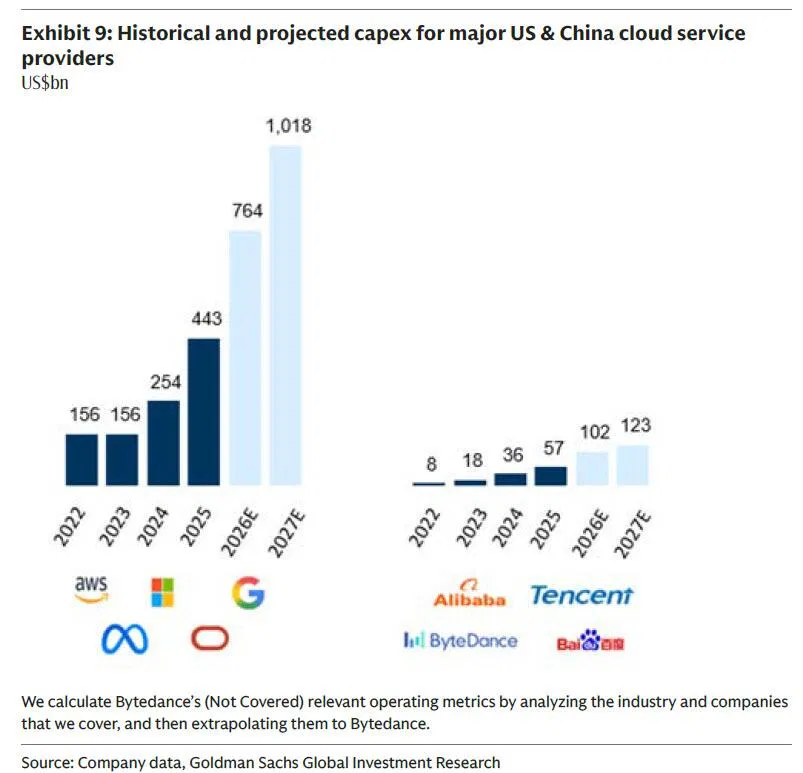
Run the ratio and the story becomes clearer. In 2025, US hyperscalers spent roughly 7.8 times what their Chinese counterparts did on AI infrastructure. By 2027, even as both sides keep growing, that multiple barely narrows — US capex will still be around 8.3 times larger in absolute dollar terms. China’s spending is compounding fast on a percentage basis, but it’s compounding off a much smaller base, and the dollar gap between the two blocs actually widens over the forecast window rather than closing.
A tale of two AI economies
The scale mismatch says something about how differently the two ecosystems are built. US hyperscalers have been engaged in what’s become an AI capex arms race that Goldman itself estimates will total $1.15 trillion between 2025 and 2027 alone, with Amazon, Microsoft, Google, and Meta racing to lock down power, land, and Nvidia GPUs before their rivals do. That spending has gotten large enough that some analysts now frame it as a parallel defence budget run out of corporate boardrooms rather than the Pentagon.
Chinese cloud providers are working under a different set of constraints. US export controls on advanced chips have limited access to the highest-end Nvidia silicon, forcing companies like Alibaba, Tencent, and Baidu to make do with domestic alternatives and older-generation hardware. That’s part of why the capex figures stay comparatively modest even as Chinese labs keep shipping competitive models. DeepSeek’s V4-Pro and V4-Flash release earlier this year came close to frontier-level performance from GPT and Claude at a fraction of the API cost, and Chinese open-source models now command a substantial share of global token volume on platforms like OpenRouter.
That combination — thinner infrastructure spend but competitive model output — is the real puzzle in this chart. Google DeepMind CEO Demis Hassabis has argued that China’s success so far comes from fast-following rather than genuine algorithmic innovation, catching up to published techniques rather than originating new ones. If that assessment holds, cheaper compute-per-model-quality might simply be a function of copying a known destination rather than exploring uncharted territory, which tends to cost more in trial and error.
What the gap actually means
There’s a reasonable case that raw capex isn’t the right yardstick at all. Chinese labs have repeatedly shown they can extract more capability per dollar and per GPU than their spending would suggest, partly out of necessity given chip restrictions and partly through genuine efficiency gains in training methods. DeepSeek’s original R1 release rattled Nvidia’s stock precisely because it demonstrated frontier performance at a sliver of the assumed cost. If that pattern holds at scale, the elevenfold spending gap in 2025 doesn’t translate into an elevenfold capability gap.
At the same time, infrastructure has a way of compounding into things that spreadsheets alone don’t capture — access to power, to advanced fabrication, to the researchers who want to work with the largest available compute clusters. Bystanders watching the trillion-dollar-plus commitments from Amazon, Microsoft, and Google over the next two years are effectively watching a bet that scale itself becomes a moat, regardless of how efficient the other side gets at squeezing more out of less.
The more interesting number in Goldman’s chart might not be the size of the gap, but its shape. China’s spending isn’t flat — it’s growing at a faster percentage rate than the US in most of the years shown, even if the base stays small. Whether that trajectory eventually forces the dollar gap to close, or whether US hyperscalers simply keep raising the ceiling every time China gets close, is the question this chart leaves open rather than answers.