AI is supposed to be the future of warfare, and the US is investing more in it than in conventional warfare.
A new chart from Morgan Stanley, built using Congressional Budget Office data, shows AI capital expenditure by the four biggest hyperscalers overtaking US national defence spending as a share of GDP by 2027, and the gap only widens from there.
The numbers tell a fairly stark story. In 2025, AI capex from Alphabet, Amazon, Meta, Microsoft and Oracle sat at around 1.45% of GDP, well below defence spending at close to 2.85%. By 2026, that gap has narrowed sharply, with AI capex projected at roughly 2.45% of GDP against defence at about 2.6%. The crossover happens in 2027, when AI capex jumps to around 3.25% of GDP while defence spending holds steady at approximately 2.6%. In the space of two years, private AI infrastructure spending goes from being roughly half of defence spending to outpacing it entirely.
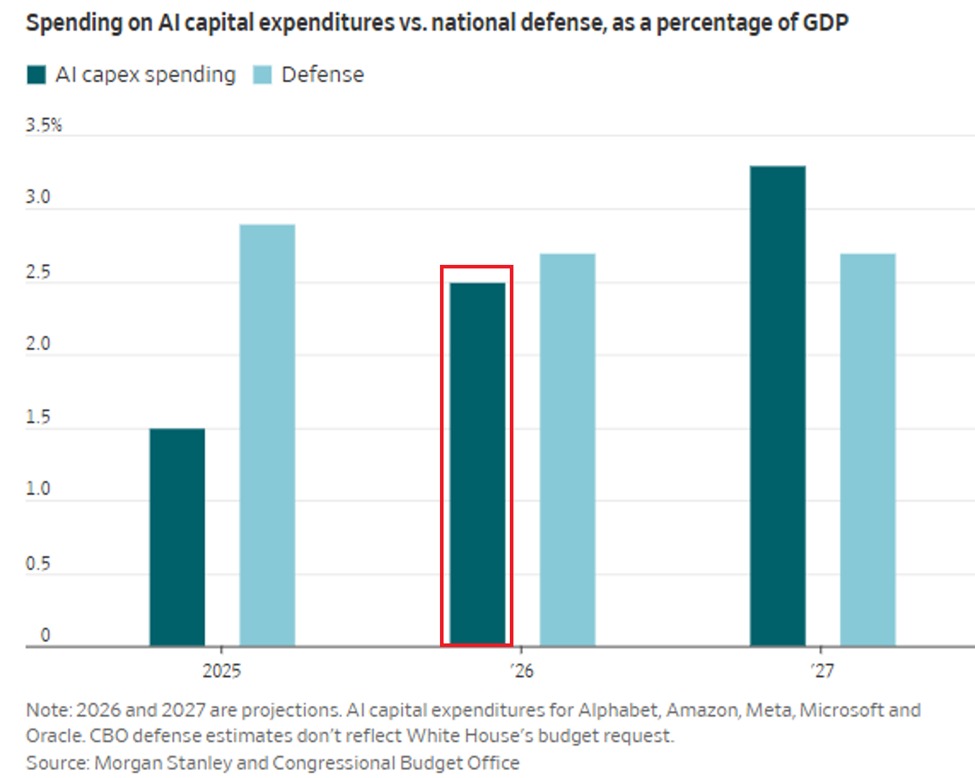
The top four hyperscalers alone are on track to spend around $715 billion on AI infrastructure in 2026, up more than 70% from the roughly $410 billion spent in 2025. Goldman Sachs has pegged the three-year total from 2025 through 2027 at around $1.15 trillion. That is a scale of private capital deployment with no real precedent, and it is happening faster than the defence budget, which moves through congressional appropriations and political cycles, ever could.
The report’s note is worth sitting with too: the CBO’s defence estimates don’t reflect the White House’s own budget request, which suggests the actual gap in future years could look different depending on how Washington chooses to respond. But even without factoring in a potential surge in military spending, the trajectory is clear. Datacenters, GPUs and power infrastructure are absorbing a bigger share of the American economy every year, and the AI boom has already reshaped how that infrastructure spending is talked about. Datacenter construction spending recently overtook public transportation spending in the US, a shift that would have sounded absurd just five years ago.
Why does any of this matter beyond the balance sheets of Amazon, Google, Meta and Microsoft? Because the framing of AI as a national security asset has become explicit in Washington and in Silicon Valley alike. Former Google CEO Eric Schmidt has warned that future conflict will look nothing like the wars people are used to, arguing that battles fought with algorithms and autonomous systems will matter more than aircraft carriers and missiles. If that view holds, then the capex figures in this chart aren’t just a corporate story about cloud infrastructure. They are, in effect, a parallel defence budget, run by five companies instead of the Pentagon, with spending decisions made in boardrooms rather than in Congress.
There’s an obvious tension underneath all this. Private capex is not defence spending in any formal sense. Data centers train large language models and power cloud services; they don’t build submarines or fund troop deployments. Comparing the two as a percentage of GDP tells you about the scale of capital rather than about military capability directly. Still, the connective tissue is real. AI has already become central to intelligence gathering, cyber operations, drone targeting and logistics planning, and every major hyperscaler now has defence contracts sitting alongside its consumer and enterprise business. When Amazon, Microsoft, Google and Meta build the compute layer the whole economy runs on, they are also building the compute layer the military increasingly depends on.
The bigger question, one that shows up repeatedly in analysis of how AI investment is already reshaping US GDP growth, is whether this pace of spending is sustainable. Free cash flow at some of these hyperscalers is already under visible strain, and debt financing has crept into a boom that used to run largely on equity. If AI capex is going to keep outgrowing the defence budget in relative terms, the companies driving it will need the AI they’re building to pay for itself. Judging by how much of the American economy’s growth is now tied to that bet, there isn’t much of a fallback plan if it doesn’t.