India might not yet have AI models at the frontier, but individuals within the country are building models for their own specific use-cases.
Prathosh A P, a professor of Electrical Engineering at the Indian Institute of Science, Bengaluru, has released a tool called Vāgbodhini, which listens to a person chanting a Sanskrit shloka and tells them, syllable by syllable, whether they got it right. Feed it any verse in any Indian script, and it will first chant the verse back to you in a metrically correct rendition, then let you attempt it yourself and grade your recitation in real time.
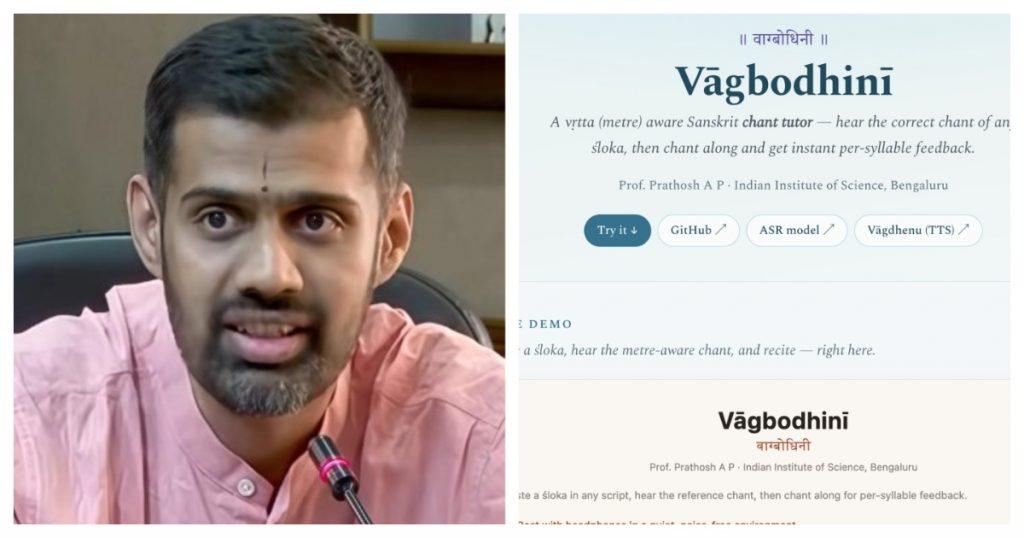
The tool sits on top of two systems Prathosh has built over the last several months. One is Vagdhenu, a text-to-speech engine tuned specifically for Sanskrit chanting. The other is Su-shroota, a speech recognition model that evaluates how closely a person’s chanting matches the correct pronunciation and meter. Vāgbodhini stitches the two together into a single feedback loop — hear the reference, chant along, get corrected, repeat.
Why meter matters here
Sanskrit shlokas aren’t read the way prose is read. They’re composed in specific metrical patterns called vṛtta, where each syllable is classified as laghu (light) or guru (heavy) based on its length and the consonants that follow it, and these patterns dictate the rhythm of the chant. A verse in the Anuṣṭubh meter is stressed differently from one in Vasantatilakā or Śārdūlavikrīḍita, and getting the meter wrong doesn’t just sound off — in a chanting tradition passed down orally for centuries, it changes the character of the recitation entirely.
This is what makes the problem genuinely hard for a machine. A generic text-to-speech model will read out the words of a shloka correctly, but it has no sense of where the chant should lengthen a vowel, where it should pause, or how the underlying gaṇa (the groups of three syllables that meters are built from) should shape the delivery. Prathosh’s system detects the meter of an input verse automatically and generates audio that follows the chant pattern specific to that meter, rather than treating the verse as an unstructured sentence.
Chant tutor, not chant generator
What Vāgbodhini adds on top of that generation capability is the evaluation side. A user pastes in a verse, the interface auto-detects the script and offers a reading-back confirmation, and then splits the shloka into practiceable units — by pāda (quarter), ardha (half), or the full verse. The person chants into their microphone, and the system compares it against the reference at a strictness level they choose, flagging where the pronunciation or timing drifted.
Prathosh has been explicit that this isn’t meant to replace a guru, and has asked that it be used only for non-Vedic texts, given how precise and consequential correct Vedic recitation is considered within the tradition. As a pedagogical aid for the wider corpus of Sanskrit shlokas, though, it fills a gap — there simply hasn’t been a way to self-check chanting the way there is for, say, spoken-language pronunciation apps.
The 15-year dream
Vāgbodhini builds directly on Vagdhenu, which Prathosh open-sourced a few weeks earlier and described as a project he’d been carrying since he began his PhD. He built it as a single-author project and released it under an open license, along with a chant dataset he recorded himself, so that other researchers and Sanskrit practitioners could examine and extend the underlying models. The GitHub repository shows the engineering involved in getting there — routing Sanskrit text through Kannada script to sidestep schwa-deletion issues that crop up when synthesising Devanagari through Hindi-tuned pipelines, and fine-tuning a vocoder because standard ones distort the long vowels that chanting depends on.
Prathosh’s day job has little to do with Sanskrit. He leads the Representation Learning Lab at IISc, where his published work covers things like learning from noisy or scarce data, unlearning in generative models, and LLM fine-tuning, and he holds a parallel faculty position at the Centre for Brain Research. Before IISc he taught at IIT Delhi and worked in corporate research at Xerox and Philips. He’s also co-founded two companies — Cogniable, an autism intervention platform that was acquired by the US-based Frontera Inc. in 2024, and LatentForce.ai, which has raised $1.7 million in seed funding. Vāgbodhini and Vagdhenu, by his own account, are side projects, born out of a chanting practice he’s carried since his PhD years rather than anything tied to his lab’s official research output. That hasn’t stopped them from finding an audience — since he posted the demo on X, the thread has drawn a steady stream of shares and replies from Sanskrit teachers, students, and other researchers who were looking for such tools for their own use-cases.