A major US lab has just released a general-purpose open-source model.
Former OpenAI CTO Mira Murati’s Thinking Machines Lab has put out Inkling, a mixture-of-experts model with the full weights available for download, marking the company’s first foray into general-purpose foundation models after building its reputation around Tinker, its fine-tuning platform, and a preview of real-time interaction models earlier this year.
Inkling has 975 billion total parameters with 41 billion active at any given time, and it supports a context window stretching to 1 million tokens. Thinking Machines trained it on 45 trillion tokens spanning text, images, audio, and video. Alongside the full-size model, the company is previewing Inkling-Small, a 276 billion parameter version with just 12 billion active parameters that the company says matches or beats its larger sibling on several benchmarks, though its full weights aren’t out yet pending further testing.
The company is candid that Inkling isn’t the strongest model available today, open or closed. Instead, it’s positioning the release around a different set of priorities: multimodal input across text, image, and audio, a controllable thinking-effort dial that trades reasoning depth for token cost, and native availability on Tinker for anyone who wants to fine-tune it. Thinking Machines frames this as the opening entry in a model family, with larger and more capable versions expected down the line.

Architecture and training
Inkling departs from the standard mixture-of-experts recipe in a few ways. Each MoE layer runs 256 routed experts plus 2 shared experts, with 6 routed experts firing per token, broadly following the DeepSeek-V3 blueprint. Routing uses a sigmoid-based mechanism with an auxiliary-loss-free load-balancing bias, rather than the more common softmax-and-auxiliary-loss combination.
On attention, the company interleaved sliding-window and global layers at a 5:1 ratio with 8 KV heads, and opted for a learned relative positional embedding over the now-standard Rotary Positional Embedding, arguing it extrapolates better to long sequences. Short convolutions were added after the key and value projections and again on the residual branches before they rejoin the main stream.
Training combined Muon for the large matrix weights with Adam for everything else, alongside a weight-decay schedule tied to the square of the learning rate to keep model weights stable over long training runs. Post-training bootstrapped from synthetic data generated by open-weights models including Kimi K2.5, before the bulk of compute went into large-scale reinforcement learning across math, agentic coding, audio, vision, chat, and safety domains. Thinking Machines says it scaled RL past 30 million rollouts on NVIDIA’s GB300 NVL72 systems, with reasoning performance climbing log-linearly across the entire run. The company also noticed the model’s internal reasoning traces got noticeably terser as RL progressed, shedding filler words and full grammar while still landing on the right answer — a compression effect the Cognition team reported seeing while training SWE-1.7 as well.
Multimodality, thinking effort, and epistemics
Inkling processes audio and vision natively rather than bolting on separate encoders, feeding into Thinking Machines’ broader push toward interaction models that can hold a live voice-and-video conversation. Audio comes in as dMel spectrograms and images as 40×40 pixel patches through a four-layer hMLP, both funneled through a lightweight embedding layer alongside text tokens. On the benchmarks Thinking Machines shared, this puts Inkling ahead of most other open audio models on VoiceBench, MMAU, and AudioMC, though still behind closed specialist systems like Gemini 3.1 Pro.
The model also ships with a controllable effort setting, letting developers dial reasoning up or down depending on latency and cost constraints rather than being stuck with one fixed operating point. Thinking Machines says Inkling reaches a given score on Terminal Bench 2.1 using roughly a third of the tokens Nemotron 3 Ultra needs for the same result.
A good chunk of the release write-up is dedicated to what the company calls the model’s epistemics — calibration, instruction following, and resistance to censorship. Post-training relied on two automated graders working together: a rubric grader checking whether a response hits the right checklist items, and a claims grader that runs agentic web search to verify each factual assertion and penalize ones that don’t hold up. Thinking Machines says pairing the two improved helpfulness and cut hallucination simultaneously. Separately, short-form factual QA training with abstention-aware rewards taught the model to answer only when it’s likely correct, otherwise hedging or declining. On Cognition’s Propaganda and Censorship Eval, Inkling reportedly showed strong non-compliance with censorship pressure.
Tinker integration and self-fine-tuning demo
Inkling is live on Tinker now with 64K and 256K context options, at a 50% discount for a limited time. Thinking Machines has updated its cookbook with new recipes tailored to Inkling’s audio capabilities and released a chat-template renderer for handling tool calls, reasoning content, and multimodal inputs during fine-tuning. A new Inkling Playground inside the Tinker console lets developers chat with the model before committing to a training run, with agentic web search built in for now, free of charge.
To demonstrate what fine-tuning on Tinker looks like in practice, the company had Inkling write, launch, and evaluate its own fine-tuning job, turning itself into a lipogram model that avoids the letter “e” entirely. Deployment partners for fine-tuned checkpoints include Together, Fireworks, Modal, Databricks, and Baseten, with inference support built out across SGLang, vLLM, llama.cpp, and Hugging Face’s transformers library. Weights are posted on Hugging Face in both the original checkpoint and an NVFP4 version for Blackwell hardware.
Inkling Benchmarks
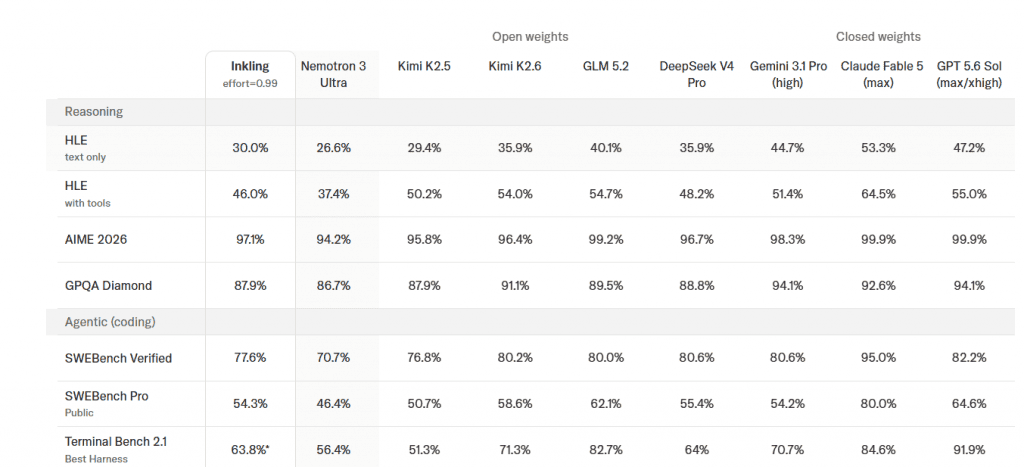
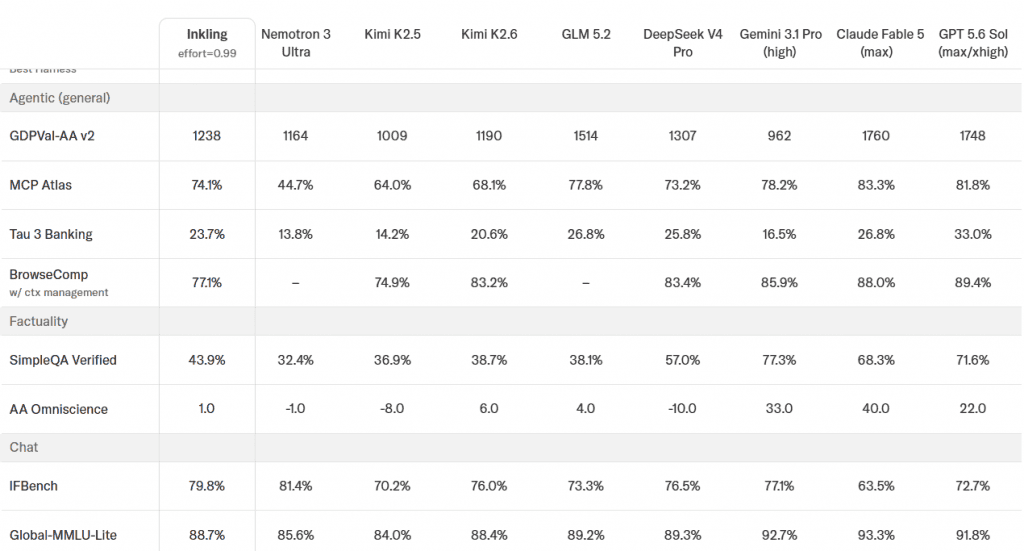
Thinking Machines ran all evaluations at effort 0.99 and temperature 1.0, comparing Inkling against open-weights peers Nemotron 3 Ultra, Kimi K2.5, Kimi K2.6, GLM 5.2, and DeepSeek V4 Pro, alongside closed models Gemini 3.1 Pro, Claude Fable 5, and GPT 5.6 Sol.
Reasoning and agentic coding
Inkling sits mid-pack on raw reasoning scores among open models, trailing GLM 5.2 and Kimi K2.6 on Terminal Bench 2.1 by a wide margin, though the company’s point about token efficiency at lower effort settings is meant to offset that gap for cost-sensitive deployments.
Agentic tasks and factuality
Factuality is where Inkling’s calibration training shows up most clearly relative to other open models — it posts a positive AA Omniscience score while Nemotron 3 Ultra, Kimi K2.5, and DeepSeek V4 Pro all land in negative territory, an indicator of hallucination rate on the benchmark.
Multimodal and safety
On safety, Thinking Machines highlights Inkling’s FORTRESS adversarial score of 78% as the best among the open-weights models it tested, beating Nemotron 3 Ultra, Kimi K2.5, Kimi K2.6, GLM 5.2, and DeepSeek V4 Pro on that specific measure.
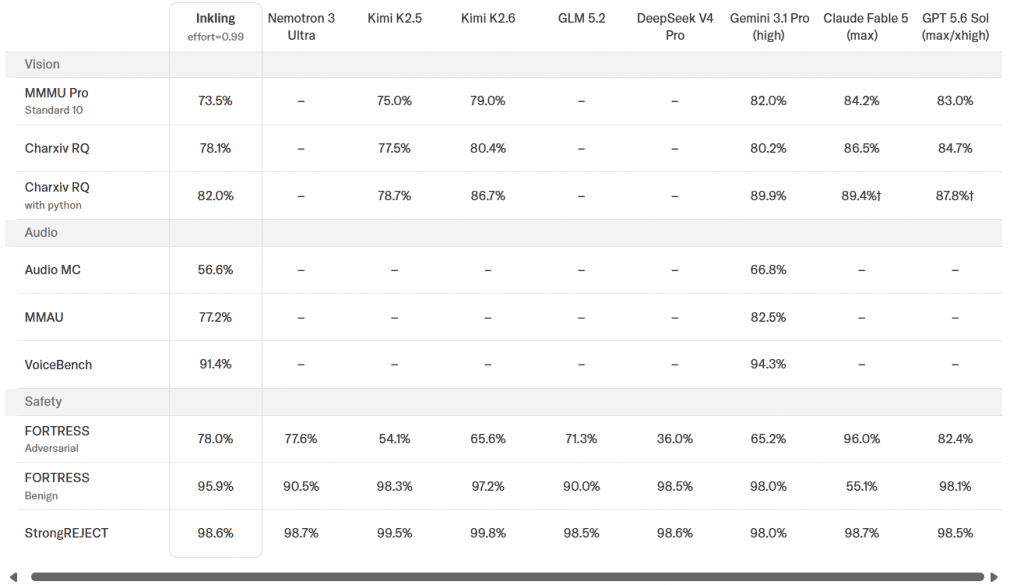
*Thinking Machines assigns a score of 0 to Terminal Bench 2.1 rollouts where the model’s solution shows contamination from web search access. †Claude Fable 5 and GPT 5.6 Sol were benchmarked on Charxiv RQ with python using Thinking Machines’ internal harness rather than official reported numbers.
Full model weights, the technical report, and the Inkling Playground are available through Thinking Machines’ Tinker console and on Hugging Face.