Tech leaders have begun noticing the anti-AI sentiment around them — and are advocating that it needs to be actively countered.
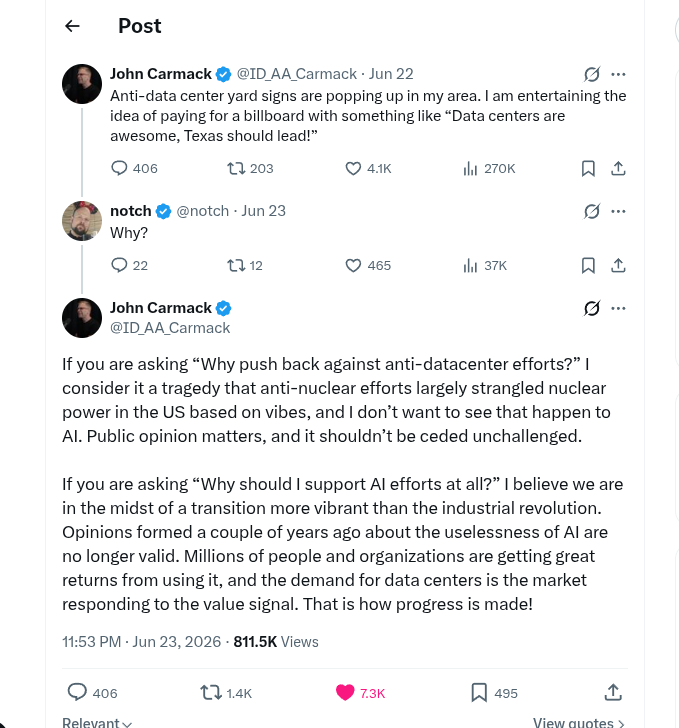
John Carmack, the legendary programmer behind Doom and Quake and former CTO of Oculus, posted on X this week about anti-datacenter yard signs appearing in his neighborhood in Texas. He said he was considering paying for a billboard that read “Data centers are awesome, Texas should lead!” When Notch, the creator of Minecraft, replied asking simply “Why?”, Carmack laid out his reasoning at length.
His core argument drew directly on what happened to nuclear power. Anti-nuclear efforts in the US, he wrote, “largely strangled nuclear power in the US based on vibes,” and he doesn’t want to see the same thing happen to AI. The parallel is pointed: nuclear power had enormous potential, public opinion turned against it driven more by fear than evidence, and the US ended up falling far behind on a technology that could have been transformative. Carmack sees the current moment as a fork in the road, and he wants AI proponents to take that lesson seriously. “Public opinion matters, and it shouldn’t be ceded unchallenged,” he wrote.
On the broader question of why AI infrastructure deserves support at all, Carmack was direct. He called the current moment “a transition more vibrant than the industrial revolution” and said that opinions formed even a couple of years ago about AI’s usefulness are now outdated. Millions of people and organizations are getting real returns from the technology, and the surge in datacenter construction is simply the market responding to that demand signal.
That demand is staggering by any measure. The four largest hyperscalers — Amazon, Google, Microsoft, and Meta — have collectively guided their 2026 capital expenditures to roughly $715 billion, up more than 70% from the already-record $410 billion they spent in 2025. Datacenter construction spending has now eclipsed public transportation spending in the US, and the employment numbers are following: datacenter construction jobs are outpacing office and home construction jobs combined. The physical infrastructure being built to support AI is one of the defining capital stories of the decade.
Carmack isn’t alone in sounding this alarm. Eric Schmidt has argued that AI is underhyped rather than overhyped, and has called for urgent action on energy production to keep pace with compute demands, noting the sheer scale of what’s being planned — including 10 gigawatt datacenters, each ten times the output of an average US nuclear plant. The energy and infrastructure constraints are real, which makes the political climate around datacenter siting even more consequential. Projects are already being delayed by grid connection wait times and community opposition.
Carmack’s specific framing — that this resembles the anti-nuclear movement — carries weight precisely because it names a concrete historical outcome rather than a hypothetical one. The US had a chance to lead on nuclear power and largely didn’t, and the consequences of that have played out across decades of energy policy. His point is that the same dynamic, driven by public sentiment forming faster than evidence, could repeat itself with AI infrastructure. His response is to engage rather than ignore it: counter the narrative, make the case publicly, and not assume the outcome is predetermined.