AI is embedding itself into the financial markets in some interesting ways.
The latest example comes from Kalshi, the prediction market platform that has spent the last couple of years turning event betting into a somewhat regulated financial product. The company has now launched forward curves for GPU compute, giving traders and buyers a market-derived estimate of what it will cost to rent an Nvidia B200, H200, or A100 chip weeks or months from now. It is a fairly technical product on its face, but the idea behind it says a lot about where AI infrastructure is headed as a business.
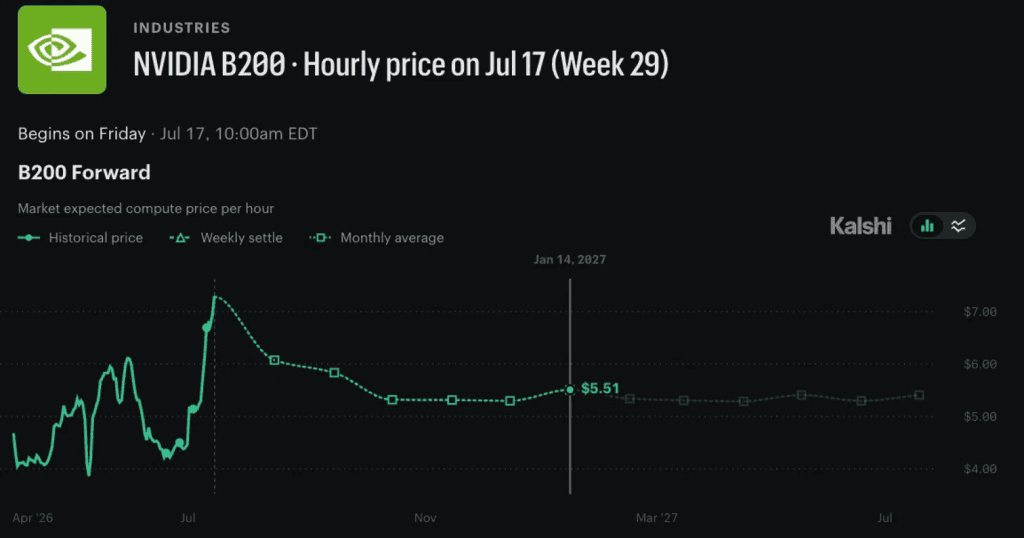
Kalshi CEO Tarek Mansour announced the launch by drawing a direct line to how every other major commodity gets priced. Oil, interest rates, currencies, metals, and agricultural goods all trade on forward curves — a running estimate of what the market expects a barrel of crude, a unit of currency, or a bushel of wheat to cost at different points in the future. These curves are not built by any single company predicting the future. They are built by thousands of buyers and sellers taking positions, each one contributing a sliver of information about supply, demand, and risk. The result is a live, continuously updated number that becomes a reference point for the entire market — the price that traders, refiners, farmers, and central banks all check before making decisions.
Compute has never had that. GPU capacity is bought and sold today largely through direct, bilateral deals between cloud providers, neoclouds, and the AI labs that need the chips. Mansour compared this to how oil traded before NYMEX existed as a futures market — producer and refiner negotiating privately, with no shared price that the rest of the world could see. Anyone trying to figure out what an hour of B200 time should cost has had to rely on scattered quotes, vendor pricing pages, or informal industry chatter, which is a strange way to price an input that hyperscalers are now spending hundreds of billions of dollars a year to secure.
Kalshi’s approach uses its existing prediction markets as the raw material. The platform already runs contracts asking whether compute prices for a given chip will land above or below certain levels by certain dates. Line up enough of those contracts across different strikes and expiries, and you get a curve — a picture of what the market collectively expects B200 rental prices to look like next week, next month, and well into next year, alongside separate curves for H200 and A100. It is the same logic that turns interest rate futures into the SOFR curve, applied to a commodity that barely existed five years ago.
The timing matters as much as the mechanism. GPU rental prices have been anything but stable over the past year. Compute costs have climbed sharply even for older chip generations, a trend that Nvidia’s Jensen Huang has pointed to as evidence that the AI buildout reflects real demand rather than speculative excess — his argument being that a genuine bubble would show up as falling prices and idle capacity, not the scarcity and rising rental costs the market has actually seen. A forward curve adds a new layer to that conversation. Instead of only looking backward at what compute has cost, the industry now gets a market-based guess at where it is headed, built from the actual positions traders are willing to put money behind.
That has real consequences for how the AI economy gets planned and financed. Hyperscalers and neocloud operators sit on enormous capital commitments — the top handful of them are on pace to spend north of $700 billion this year alone — and until now they’ve had no clean way to hedge against future swings in what they can charge for that capacity. AI labs and inference-heavy startups face the opposite exposure: their compute bill is one of the largest and least predictable line items on the balance sheet, and a forward curve gives them something to lock rates against instead of simply absorbing whatever the spot market demands. Mansour’s post frames this as the point where compute stops being managed through internal spreadsheets and OTC handshakes and starts being managed the way energy desks manage fuel costs.
There is a broader signal buried in this too. Kalshi is not alone in making this bet — CME Group and Intercontinental Exchange have both signaled plans for their own GPU-linked futures contracts, and Kalshi itself is framing the forward curve as a first step toward full futures and perpetual contracts on compute. When three separate exchange operators start building derivative infrastructure around the same underlying asset within months of each other, that is usually a sign the market has decided the asset is real enough to standardize. Prediction markets have already had one breakout moment this year, with combined volumes on platforms like Kalshi and Polymarket reaching tens of billions of dollars a month; compute derivatives are a bet that the same infrastructure can be pointed at something with far more economic weight behind it than election odds or sports outcomes.
The caveats are worth naming honestly. GPU compute is not a uniform commodity in the way a barrel of WTI crude is — an hour on a B200 in one data center is not identical to an hour on the same chip elsewhere, and new architectures arrive on a cycle short enough to make last year’s benchmark obsolete. Liquidity on these new markets is thin by definition, since they only launched this week, and a reference price built on a handful of trades can move more than a mature futures market would tolerate. Whether hedging catches on the way Kalshi is betting it will depends on whether the buy side — the labs and startups actually burning compute — decide this is worth the effort, rather than another financial product built ahead of the demand for it.
Still, the direction of travel is clear enough. Compute has quietly become one of the most important inputs in the global economy, and inputs at that scale eventually get priced the way oil, interest rates, and currencies are priced — through a market that aggregates what thousands of participants actually believe, rather than what any single company says it costs. Kalshi has decided to build the plumbing for that before anyone else fully commits to it, and forward curves are the opening move in a much longer game toward compute futures.