Kimi K3 has beaten all AI models in the world on another benchmark.
Vercel CEO Guillermo Rauch posted results from the company’s Next.js evals showing Moonshot AI’s newest model outperforming Claude Fable 5 and GPT 5.6 Sol on code generation and migration tasks, matching their accuracy while finishing the job noticeably faster.
The Next.js evals are Vercel’s own benchmark suite, built specifically to test how well AI coding agents handle real Next.js work, everything from writing fresh components to migrating an old codebase to newer framework conventions. Rauch, who also created Next.js, launched the evals as an open scoring system for the wider agent ecosystem, running each model inside actual coding harnesses like Claude Code, Codex, Cursor and OpenCode rather than in a sandboxed chat window.
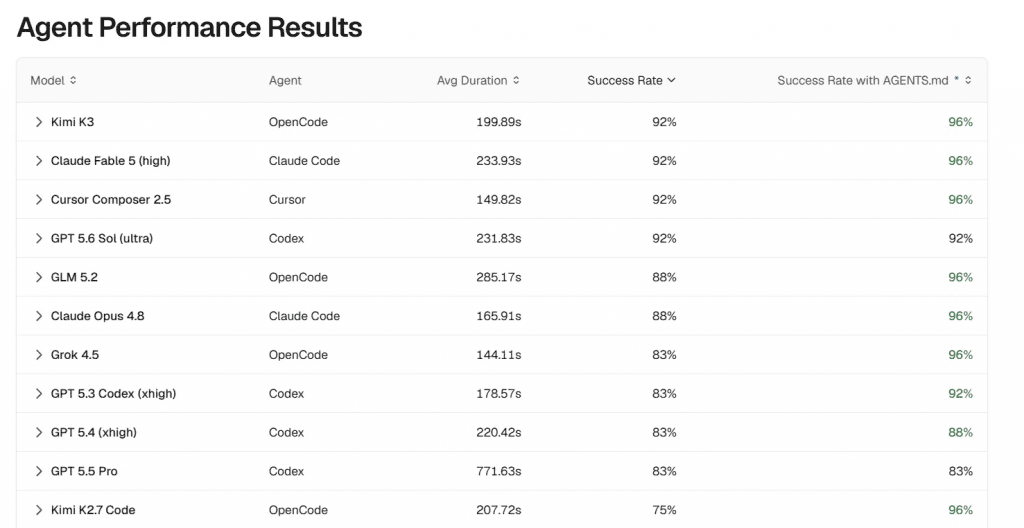
On this run, Kimi K3, paired with the OpenCode harness, completed its tasks in 199.89 seconds with a 92% success rate. Claude Fable 5, running on high effort inside Claude Code, matched that 92% but took 233.93 seconds. GPT 5.6 Sol, on Codex at ultra effort, also landed at 92% in 231.83 seconds. Cursor Composer 2.5 was actually the fastest of the four at 149.82 seconds, tied at the same 92% mark. Rauch’s framing was about K3 hitting the same bar as the two leading proprietary models while spending noticeably less time doing it, and the numbers back that up.
Further down the table, GLM 5.2 and Claude Opus 4.8 both scored 88%, followed by Grok 4.5, the older GPT 5.3 Codex and GPT 5.4, and GPT 5.5 Pro, all clustered at 83%. GPT 5.5 Pro stood out for taking a staggering 771.63 seconds per task, more than three times slower than most of the field for the same accuracy. Kimi K2.7 Code, the predecessor to K3, came in lowest among the group at 75%.
One column in the results table is doing a lot of quiet work. Vercel also scored every model with an AGENTS.md file present, essentially a written instruction sheet telling the agent how the codebase is structured and what conventions to follow. Nearly every model jumped to 96% success with that file in place, including Kimi K3, GLM 5.2, Claude Opus 4.8, Grok 4.5 and Kimi K2.7 Code. GPT 5.6 Sol was the outlier, staying flat at 92% even with the extra guidance, which suggests OpenAI’s model leans less on external instructions and more on figuring the codebase out on its own. GPT 5.3 Codex and GPT 5.4 improved to 92% and 88% respectively but stayed below the pack.
None of this means the problem is solved. As Rauch pointed out, no model on the leaderboard has reached 100% completion, and even the strongest performers are peaking at 92% unassisted and 96% “with help.” That gap between raw model capability and guided performance is arguably the more interesting story here, since it says as much about the value of good documentation as it does about any single model.
The result also arrives right after Kimi K3 placed third on the Artificial Analysis Intelligence Index, sitting behind Fable 5 and GPT 5.6 Sol on that broader composite ranking. The Next.js evals tell a narrower but more practical story for developers actually shipping code: on the specific job of writing and migrating a real framework’s worth of components, Moonshot’s open model is now trading blows with the best closed systems money can buy, and doing it faster.
Moonshot has kept up this pattern release after release. Kimi K2 launched a year ago as the strongest open model of its time, and every version since has chipped away at the gap with OpenAI, Anthropic and Google’s flagship systems. Rauch called it the first time an open model has led the field on this particular benchmark, and treated it as a signal worth flagging publicly rather than a fluke buried in a leaderboard update. Whether that holds up as more teams run their own workloads through K3 remains to be seen, but for a coding-specific, real-world benchmark built by the people who make Next.js itself, it is a difficult result to wave away.