Even some of the most technically complex coding projects in the world are not averse to using AI for their development.
Linus Torvalds, the creator of Linux, has weighed in on a mailing list debate over how much AI tooling should be allowed near kernel development, and he did so in the bluntest terms possible: Linux is not an anti-AI project, and anyone unhappy with that is free to fork the kernel or walk away.
The remarks came in a thread about Sashiko, an agentic LLM-based patch review system built by Google engineer Roman Gushchin, and whether it should be linked with Patchwork, the tool kernel maintainers use to track patches submitted to mailing lists. Gushchin argued that making the integration more complicated would defeat the entire purpose of Sashiko, which is to help maintainers manage their workload. He also pushed back on what he saw as an “anti-LLM position” from one of the people involved in the discussion.
Torvalds did not mince words in his reply. “I realize that some people really dislike AI, but this is an area where I’m willing to absolutely put my foot down as the top-level maintainer,” he wrote. “Linux is not one of those anti-AI projects, and if somebody has issues with that, they can do the open-source thing and fork it. Or just walk away.”
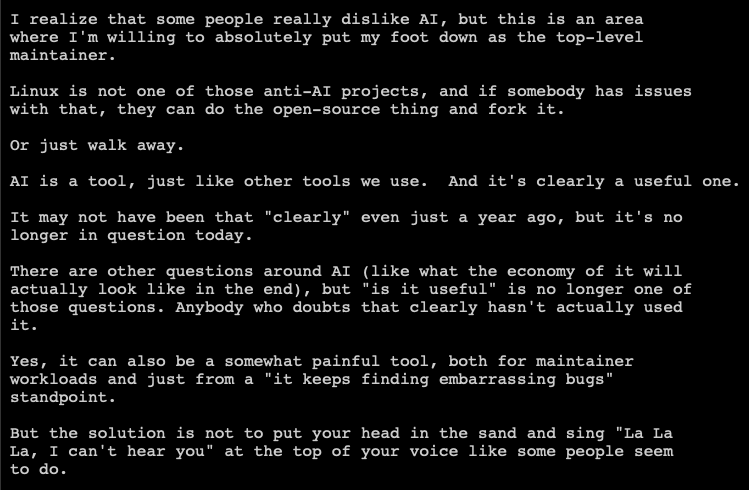
He went on to describe AI as a tool, no different in kind from the other tools kernel developers already rely on, and said its usefulness is no longer a question worth debating. “It may not have been that ‘clearly’ even just a year ago, but it’s no longer in question today,” Torvalds wrote. “Anybody who doubts that clearly hasn’t actually used it.”
That framing tracks with how Torvalds has talked about AI coding tools in recent months. Back in January, he was reported to be vibe coding a guitar pedal effects project using Google’s Antigravity, describing himself as a Python newbie who was happy to let AI generate code for a domain outside his expertise. More recently, he took aim at the industry habit of crediting AI with writing the majority of a company’s code, pointing out that compilers have been doing exactly that job for decades without anyone bothering to mention it.
None of this means Torvalds thinks AI review tools are painless. In the same email, he acknowledged that LLMs can add to maintainer workload and have a habit of surfacing embarrassing bugs. He made a similar point in May, when he warned that a flood of AI-generated security reports was making the kernel’s vulnerability list unmanageable, with different people running the same tools against the same code and independently reporting identical findings. His fix then, as now, was not to reject the tooling but to insist people use it responsibly: read the documentation, write an actual patch, and add value beyond what the AI already found.
That is essentially the position he restated in this thread. “The solution is not to put your head in the sand and sing ‘La La La, I can’t hear you’ at the top of your voice like some people seem to do,” he wrote. “The solution is to make sure those LLM tools help maintainers instead of just causing them pain.”
Torvalds also used the moment to draw a sharper line around what the kernel project is and is not. He rejected the idea that Linux carries some kind of ideological mission beyond writing good software. “This is NOT some kind of ‘social warrior’ project, never has been, and never will be,” he wrote, adding that decisions in the community are made on technical merit rather than “fear of new tools.”
Sashiko itself has been gaining traction inside the kernel community since Gushchin formally announced it in March. The system ingests patches from mailing lists and runs them through a multi-stage review protocol, and Google has been footing the compute bill for reviews on the Linux Kernel Mailing List. In testing against a set of 1,000 recent upstream commits with “Fixes:” tags, Sashiko reportedly caught around 53% of bugs, all of which had originally slipped past human reviewers. Konstantin Ryabitsev’s b4 patch management tool is already adding support for it.
Whether Patchwork and Sashiko end up formally linked is still an open technical question the mailing list thread has not resolved. But Torvalds’ position on the broader debate is now about as unambiguous as it gets.