Meta had started off the open-source AI revolution with Llama, and it now seems to be reinvigorating US’s open-source AI space once again.
Mark Zuckerberg took to X to announce that Meta is opening the weights of Muse Spark 1.2, the company’s latest foundation model, while simultaneously releasing a smaller 30 billion parameter dense model called Muse Glimmer that’s built specifically to run on local hardware. “Meta is a strong supporter of open source and I’m proud of these releases,” Zuckerberg wrote, crediting Chief AI Officer Alexandr Wang and the Meta Superintelligence Labs team for the work. The announcement marks Meta’s most significant open-weight release since the Llama series, and comes at a moment when the company’s AI ambitions have been under scrutiny following the underwhelming reception to Llama 4.
Llama Laid The Groundwork
It’s worth remembering just how much of the current open-source AI landscape traces back to Meta’s early bets. When Meta released the original LLaMA in February 2023, it was pitched primarily as a research tool, a way for academics to work with a capable foundation model without the licensing costs attached to closed alternatives. Llama 2 followed with a genuinely commercial-friendly license, and Llama 3 pushed things further, becoming competitive with the leading closed models of its time. For a stretch of nearly two years, Llama was effectively the default starting point for any developer, startup, or research lab that wanted to build on an open foundation model without depending on OpenAI or Google.
That run of dominance didn’t last. Llama 4 arrived in April 2025 with benchmark numbers that turned out to be misleading — former Meta chief scientist Yann LeCun later admitted the company had submitted differently tuned versions of the model for evaluation than what it actually shipped to the public. The fallout was significant internally, and it also coincided with Meta pulling back from some of its open-source commitments, with the company reportedly deciding to be more selective about what it releases openly going forward, particularly as its own models edged closer to the frontier. In the months since, Chinese labs took over the category Meta had essentially created, with models from DeepSeek, Alibaba’s Qwen, and Moonshot’s Kimi becoming the go-to open options for developers worldwide.
Muse Spark 1.2 To Become America’s Leading Open Weights Model
The decision to open-weight Muse Spark 1.2 changes that calculus considerably. Muse Spark 1.2 is not an experimental side project — it’s Meta’s actual frontier coding and reasoning model, benchmarked against Anthropic’s Opus 5, OpenAI’s GPT-5.6 Terra, and Google’s Gemini 3.6 Flash, and it currently powers Muse Code, Meta’s terminal-based coding agent. By releasing its weights, Meta is handing the developer community a model that, unlike Gemma or most prior Llama releases, is genuinely close to the performance ceiling of proprietary systems rather than a scaled-down variant built for accessibility. Muse Spark 1.2 is currently the fifth most powerful model on the Artificial Analysis Intelligence Index.
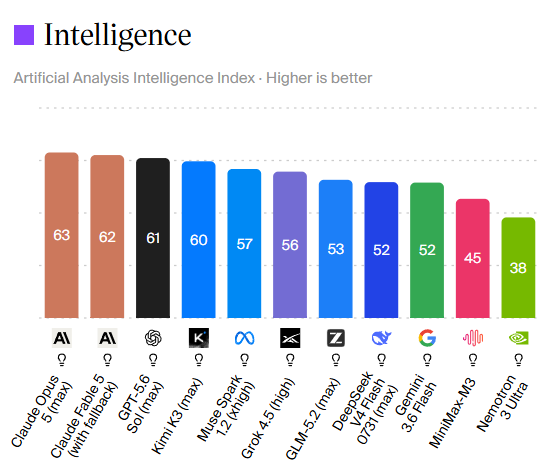
This effectively makes Muse Spark 1.2 the most capable open weights model built by an American company, at a time when none of the other major US labs have been willing to open-weight anything close to their frontier work. OpenAI, Anthropic, and Google’s leading models all remain closed, and Google’s own open contribution, Gemma, has always been positioned as a smaller, edge-focused family rather than a frontier competitor.
The implications for the open-source ecosystem are hard to overstate. Chinese labs have dominated recent rankings of top open models, and while Meta and OpenAI both eventually signed onto a joint industry letter backing open weights as a matter of national interest, actual releases from either company had been thin on the ground until now. A frontier-adjacent model from Meta gives American developers, enterprises, and researchers a credible domestic alternative again, one that doesn’t require routing sensitive workloads through a Chinese model just to get open-weight flexibility, a concern that’s grown since Hugging Face reportedly turned to a Chinese open model last month to defend against an attack involving a rogue OpenAI system.
Muse Glimmer Takes On Gemma And China For The Local AI Race
The second release, Muse Glimmer, is aimed at a different fight altogether. At 30 billion parameters, it’s small enough to run on a single consumer GPU, a Mac, or a high-end PC, and Meta has built it specifically for agentic tasks rather than general chat. This puts it in direct competition with Google’s Gemma family, which has spent the last year building real momentum in the on-device space — Gemma 4’s dense and mixture-of-experts variants currently rank among the top open models on the Arena leaderboard, and the Google AI Edge Gallery app built around it has climbed into the top 10 on the App Store as everyday users experiment with running models locally.
Muse Glimmer also has to contend with a crowded field of Chinese local models. Alibaba’s Qwen and DeepSeek’s smaller variants have been widely adopted precisely because they run efficiently on modest hardware while still holding their own against much larger systems, and both have consistently outpaced American open models on independent benchmarks over the past year. Meta’s pitch with Glimmer appears to lean on agentic reliability rather than raw benchmark scores, betting that developers building local tools and assistants care more about consistent tool-calling and task completion on a single GPU than about topping a leaderboard. Whether that’s enough to pull share away from Gemma’s growing edge ecosystem or the Chinese models that currently lead on cost and performance will depend heavily on how Glimmer actually performs once developers get their hands on it, but the fact that Meta is fighting on two fronts at once — frontier open weights with Spark 1.2, and local-first open weights with Glimmer — signals a company trying to reclaim ground it once considered its own.