The last decade or so was defined by the proliferation of the smartphone, but it appears that we’ve already passed the phase of peak smartphone.
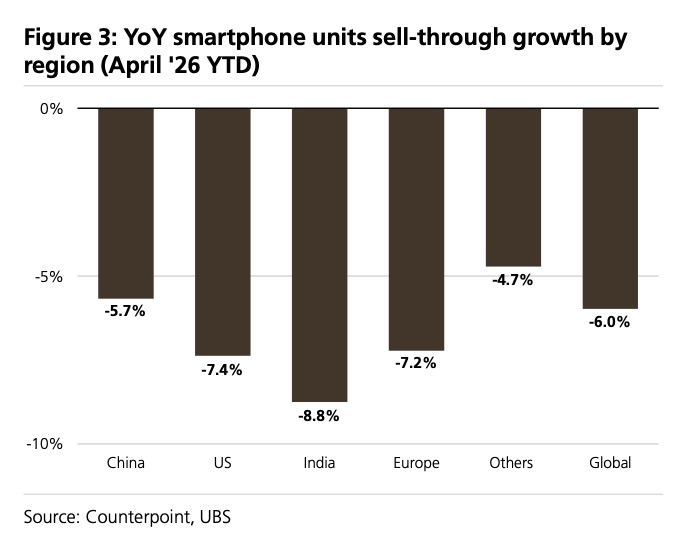
New data from Counterpoint Research and UBS, covering April 2026 year-to-date sell-through figures, shows that global smartphone unit sales are down 6% year-over-year. Every major region is in the red: the US is off 7.4%, Europe 7.2%, China 5.7%, and India — the market the industry once counted on as its next great growth engine — leads the decline at a painful 8.8%.
The forces behind this reversal are structural, not cyclical, and at the center of most of them is an unlikely culprit: artificial intelligence.
The Memory Crunch Is Squeezing Consumers Out
The most immediate driver is a global shortage of DRAM and NAND flash memory chips. The root cause is straightforward: hyperscalers are spending $715 billion on AI infrastructure in 2026 alone, up more than 70% from 2025, and all of it is hungry for memory. Samsung, SK Hynix, and Micron — the three companies that together control global memory supply — have diverted manufacturing capacity toward high-bandwidth memory (HBM) for AI servers, leaving smartphone makers to fight over scraps.
The impact on pricing has been severe. DRAM prices rose roughly 90% in the first quarter of 2026 alone, and memory now accounts for up to 20% of the cost of a low-end smartphone — a figure that could approach 40% by mid-year. Manufacturers have been forced to either absorb losses, pass costs to consumers, or exit budget segments entirely. Most chose the latter two. SK Hynix and Micron, for their part, have both crossed $1 trillion in market capitalization on the back of this dynamic — a remarkable illustration of how the same AI boom that is enriching chipmakers is pricing ordinary consumers out of new phones.
IDC, which had initially forecast a 12.9% decline in global smartphone shipments for the full year 2026, has since revised that number upward. The firm describes the situation as “not a temporary squeeze, but a tsunami-like shock originating in the memory supply chain.” IDC expects the average selling price of smartphones to surge 14% to a record $523 this year.
India’s Collapse Is Telling
Nowhere is the damage more visible than in India. The sub-$100 smartphone segment — historically the backbone of the world’s second-largest phone market — collapsed 59% year-on-year in Q1 2026. Sharp rises in DRAM and NAND prices increased device costs for sub-₹15,000 handsets to the point of being economically unviable for many brands. Brands like Oppo, Vivo, and Xiaomi have slashed shipment targets by double digits. What analysts are calling “forced premiumization” has pushed the Indian market toward higher-priced devices; the mid-premium segment ($400–$600) grew 29%, and the premium segment expanded 32% — but those gains are far too small to offset the volume collapse at the bottom.
The India story matters because it was supposed to be the next chapter of smartphone growth. For years, the upgrade cycle in China had driven global volumes. As that matured, the industry pivoted to India as the next mass market. That playbook now looks stalled, with a 10–12% full-year decline projected for India in 2026.
The Upgrade Cycle Was Already Slowing
The memory crisis didn’t arrive in a vacuum. Even before chip prices spiked, upgrade cycles had been quietly lengthening. The average American smartphone lifecycle reached 3.84 years through the first three quarters of 2025, up from 2.4 years in 2013. Consumers are holding on to devices longer for a simple reason: each new generation offers incrementally less reason to upgrade. The camera is marginally better. The chip is faster, but not obviously so in daily use. The design has barely changed.
The industry has bet that AI features would rekindle that excitement. So far, the evidence is thin. A 2026 survey found that only 17% of Americans say AI features are a major influence on their phone-buying decisions. Battery life, storage, and durability rank far higher.
A Market That Sorted Itself Into Two Tiers
What’s emerging from the wreckage is a bifurcated market. At the top, Apple and Samsung are holding — and in some cases gaining — share. Apple’s US volumes were up 1.3% in Q1 2026 even as the overall US market fell 5.7%. Samsung reclaimed the global top spot thanks to strong Galaxy S26 Ultra demand. Both companies benefit from long-term supply agreements with chipmakers, stronger balance sheets, and customers who are less sensitive to price increases.
Below them, the picture is grim. Chinese Android vendors — Honor, Oppo, Vivo, Xiaomi — have seen double-digit shipment cuts. Budget-focused regional brands are exiting markets or being acquired. The competitive landscape is thinning fast.
The Irony at the Heart of It
There is a particular irony in how this has played out. The AI industry — whose promise includes smarter, more capable devices — has, in the short term, made the most basic devices unaffordable for the people who most depend on them. The massive capital expenditure programs at Meta, Google, Microsoft, and Amazon are, in effect, competing directly with the smartphone supply chain for the same chips.
IDC doesn’t expect a meaningful recovery until 2027 at the earliest, once memory supply constraints begin to ease. Until then, the era of cheap, abundant smartphones — the era that put a powerful computer in the pocket of billions of people — appears to be over. What comes next will cost more, do more, and reach fewer people.