The AI revolution is creating all kinds of winners, if one knows where to look.
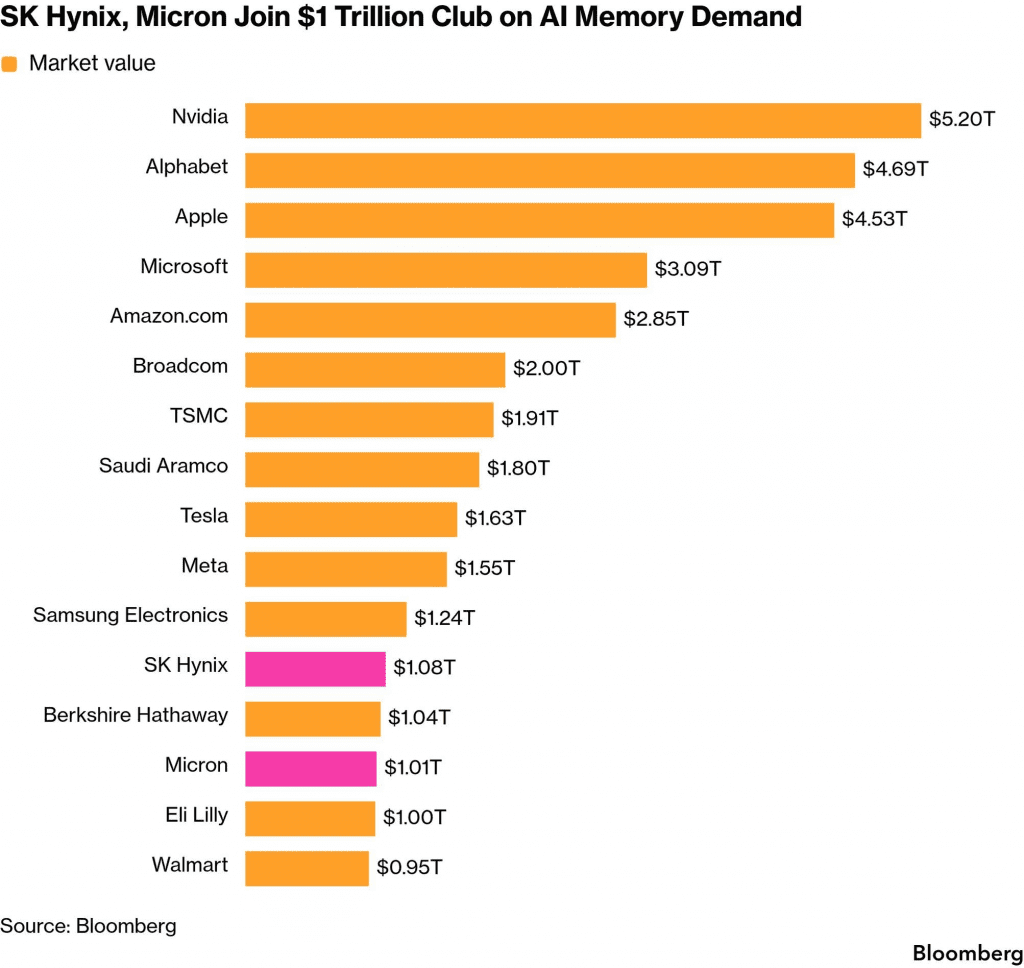
This week, two names that rarely make headlines outside semiconductor circles crossed a threshold that very few companies in human history have ever reached. SK Hynix, the South Korean chipmaker, hit a $1.08 trillion market valuation on Wednesday after its shares surged more than 9% in a single session. Micron Technology, its American counterpart, got there a day earlier, soaring 19% — its biggest single-day gain since 2011. May 2026 now belongs to memory chips.
What These Companies Actually Do
SK Hynix and Micron are, at their core, memory chip manufacturers. Their bread and butter has long been DRAM — the kind of short-term memory that lets your computer juggle open applications — and NAND flash storage. For decades, this was a brutally cyclical business: boom, bust, repeat. Margins swung wildly with global supply and demand, and neither company was considered a high-growth bet.
That changed with AI.
The specific product driving their ascent is called High-Bandwidth Memory, or HBM. Unlike conventional DRAM, HBM is engineered to sit directly alongside AI accelerators inside data center servers, stacked in tight vertical layers to enable the kind of blazing fast, high-volume data transfer that training and running large language models demands. Think of it as the short-term workbench next to the processor — an AI server can only run as fast as it can pull data off that surface. More HBM, faster AI.
SK Hynix moved first and moved hard. The company commands roughly 57% of global HBM revenue, making it Nvidia’s single most important memory partner. It has already sold out its entire DRAM, NAND, and HBM production capacity through 2026. Micron, the only U.S.-based memory manufacturer, has done the same — every chip it can make this year is already spoken for.
Why AI Changed Everything
For years, the biggest buyers of memory chips were smartphone makers and PC assemblers. AI flipped the hierarchy. Hyperscalers — Amazon, Google, Microsoft, Meta — are now projected to spend roughly $715 billion on AI infrastructure in 2026 alone, up more than 70% from an already-record 2025. All of them need servers. All those servers need HBM.
The result is a structural squeeze. Producing HBM requires approximately three times the manufacturing resources of conventional DRAM. As SK Hynix, Micron, and Samsung have diverted their fab capacity toward AI customers, supply for everyone else has dried up. Goldman Sachs analysts dubbed it “the great memory crunch.” Memory chip prices are expected to rise more than 50% through the first half of 2026, and IDC has warned this is not a temporary glitch — it is a structural shift that signals, in their words, the end of an era of cheap, abundant memory.
That scarcity is pure pricing power for companies holding the supply.
The Numbers Tell the Story
The stock performance over the past year borders on the extraordinary. SK Hynix shares have risen more than 200% year-to-date in 2026, on top of a 274% rally the year before. Its 12-month gain stands above 1,000%. Micron has surged roughly 245% so far this year. On the fundamentals side, Micron reported fiscal Q2 2026 revenue of $23.86 billion with a gross margin of 74.4% — and guided Q3 revenue to approximately $33.5 billion at margins approaching 81%. SK Hynix posted record Q1 2026 sales of KRW 52.57 trillion with operating profit of KRW 37.61 trillion, again driven overwhelmingly by HBM demand.
UBS has set a Street-high price target of $1,625 on Micron, arguing that AI has permanently revalued the memory industry. The bank expects Micron’s EPS to remain “comfortably” above $100 through at least 2029.
SK Hynix vs. Micron: Different Horses, Same Race
The two companies are now in direct competition for the most lucrative contracts in tech — but they come at the opportunity from different angles.
SK Hynix is the incumbent leader in HBM, having been Nvidia’s primary supplier through the HBM3 and HBM3E generations. It has reportedly secured close to 70% of Nvidia’s HBM4 orders for the upcoming Vera Rubin AI platform — well above earlier estimates of 50%. Its singular focus on memory gives investors a clean, direct bet on AI infrastructure spending.
Micron is broader. It offers DRAM, NAND, and HBM across consumer, enterprise, and data center markets, making it more diversified but also more exposed to cycles outside the AI boom. It is also betting big on domestic manufacturing: the company announced plans to invest approximately $200 billion in U.S. semiconductor manufacturing and R&D, including a second leading-edge fab in Idaho, facilities in New York and Virginia, and advanced HBM packaging capabilities — a move that aligns it tightly with Washington’s push for domestic chip resilience.
The Bigger Picture
China’s own AI chip ambitions have accelerated this dynamic further. As China’s self-sufficiency in AI chips climbed from 20% in 2023 to over 40% in 2026, the global competition for leading-edge memory has intensified — not eased. Nvidia alone has secured over $500 billion in orders for its current-generation Blackwell processors, each of which depends on HBM to function. The global HBM market, estimated at $35 billion in 2025, is forecast to reach $100 billion by 2028.
Memory was supposed to be a commodity. AI made it a chokepoint. And right now, SK Hynix and Micron sit squarely on top of it.