Meta has a popular AI agent in Muse, and it now has a model that can power it for long hours at cheap rates.
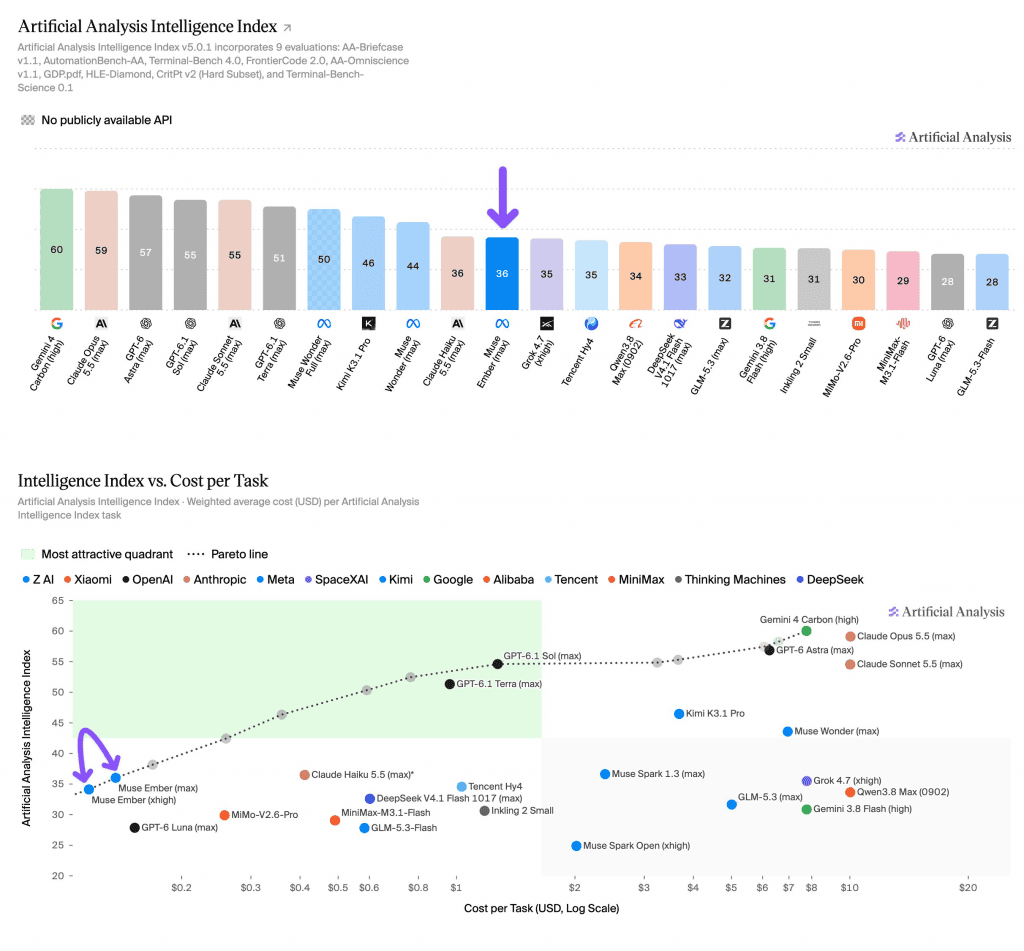
Independent benchmarking firm Artificial Analysis has put Meta’s new Muse Ember through its Intelligence Index, and the small model scores 36 at max effort, the same as Claude Haiku 5.5 (max). The difference is cost: Muse Ember runs an Intelligence Index task for about $0.14, while Haiku 5.5 costs $0.41 for the same score.
Artificial Analysis says that makes Muse Ember the cheapest model on its leaderboard scoring 36 or higher, and places both its max and xhigh settings on the Intelligence Index vs. Cost per Task Pareto frontier.
Muse Ember On The Artificial Analysis Intelligence Index
Muse Ember (max) scores 36 on the Artificial Analysis Intelligence Index v5.0.1, level with Claude Haiku 5.5 (max) and ahead of a crowded group of efficient models, including Grok 4.7 (xhigh) and Tencent Hy4 at 35, Qwen3.8 Max at 34, DeepSeek V4.1 Flash 1017 (max) at 33, GLM-5.3 (max) at 32 and Gemini 3.8 Flash (high) at 31. GPT-6 Luna at max scores 28.
At xhigh effort, Muse Ember scores 34 at $0.12 per task.
The scores sit on the newer Intelligence Index v5, which is why Haiku 5.5 shows up at 36 here rather than the 43 it scored on the previous version of the index.
How Much Cheaper Is Muse Ember?
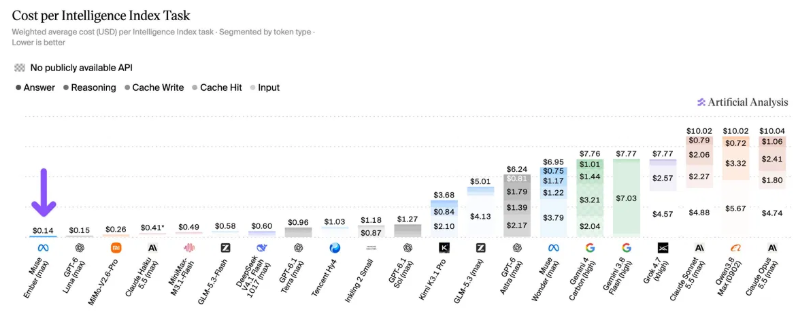
Against Haiku 5.5, Artificial Analysis says Muse Ember costs almost three times less for the same score. It’s also about four times cheaper than DeepSeek V4.1 Flash 1017 and GLM-5.3-Flash, which both score lower.
Compared with Meta’s own Muse Wonder, Ember is eight points behind (36 versus 44) for roughly one-fiftieth of the cost per task.
Same Token Prices, Lower Bill
Muse Ember’s pricing is $0.10 per million input tokens, $0.004 per million cached input tokens and $0.50 per million output tokens. Its input and output prices match both Claude Haiku 5.5 and GPT-6 Luna, so the savings come from elsewhere.
Artificial Analysis points to two reasons. Cached input, which makes up most of the cost in its agentic evaluations, is 60% cheaper than on Haiku 5.5 and Luna. And Muse Ember uses far fewer output tokens: about 84,000 per Intelligence Index task, against roughly 226,000 for Haiku 5.5 at max, or about a third as many. GPT-6 Luna uses around 75,000.
Where Muse Ember Does Well
Agentic workflows. Muse Ember’s standout result is AutomationBench-AA, where it scores 68.1%, level with Muse Wonder (max) and GPT-6 Astra. It also edges Haiku 5.5 on GDP.pdf, a benchmark of professional work over long documents, 22.8% to 20.8%.
Terminal use. On Terminal-Bench 4.0, it beats Haiku 5.5 (max) by 40.9% to 32.8% in Artificial Analysis’s testing.
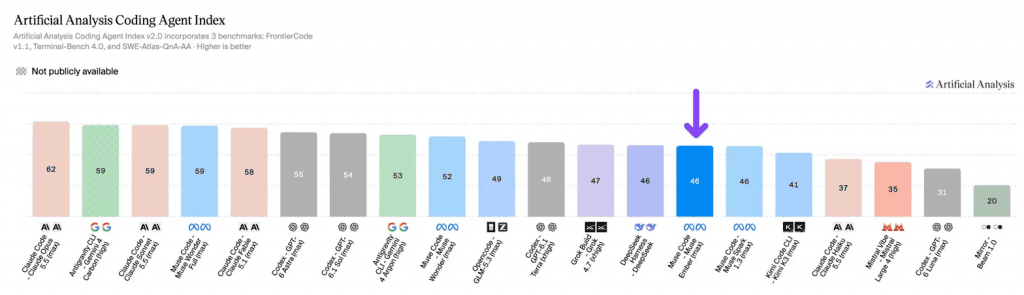
Coding agents. When run inside its own coding agent, Muse Code, Muse Ember (max) scores 46 on the Artificial Analysis Coding Agent Index. That’s ahead of Claude Haiku 5.5 in Claude Code at 37 and GPT-6 Luna in Codex at 31, and level with Muse Spark 1.3 in Muse Code. The lead comes from SWE-Atlas-QnA-AA and Terminal-Bench 4.0.
Larger models are still well ahead on that index, with Claude Opus 5.5 in Claude Code at 62 and Muse Wonder Full in Muse Code at 59.
Where Muse Ember Falls Short
Artificial Analysis describes Muse Ember’s agentic coding as mixed. It trails Haiku 5.5 on FrontierCode 2.0, 27.2% to 34.9%, and on AA-Briefcase, 1521 Elo to 1574.
Knowledge is the model’s main weakness. Its AA-Omniscience accuracy is 21.1%, the lowest among the similarly intelligent models Artificial Analysis compared, against 34.7% for Haiku 5.5 (max) and 50.5% for Gemini 3.8 Flash (high).
That’s largely because Muse Ember declines to answer 64% of questions. The upside is a low hallucination rate of 17.4%, about half of Haiku 5.5’s. For agent workloads built around tool calls, extraction and routing, a model that says “I don’t know” rather than guessing may be a reasonable trade, but it’s a poor fit for anything that leans on recall.
Why The Numbers Differ From Meta’s
Readers comparing Meta’s launch table with Artificial Analysis’s figures will see a few differences. Meta reported AutomationBench-AA at 37.8% using strict pass@1, while Artificial Analysis’s headline score is 68.1%. Meta also showed Haiku 5.5 at 39.2% on Terminal-Bench 4.0, using each model’s best published harness, whereas Artificial Analysis ran all models under its own setup and got 32.8%. The Intelligence Index score of 36 is the same in both.
Meta’s Efficient-Tier Push
Muse Ember is the cheapest tier in a model family that Meta Superintelligence Labs has been expanding at speed since Muse Spark launched in April, followed by Muse Spark 1.3 and the Muse Wonder models in October. Meta is positioning Ember as the high-volume model for the repetitive steps agents run all day, with Wonder doing the planning.
That cost profile matters as Meta pushes its Muse agent into more products, and as Anthropic and OpenAI compete on small models with Haiku 5.5 and GPT-6 Luna.
Muse Ember is available on Meta’s first-party API and in Muse Code.