Meta has made a big comeback in AI, and in doing so, is currently ahead of the pioneer in the space.
Meta’s new Muse Spark 1.1 model has scored 51 on the Artificial Analysis Intelligence Index, placing it above both of Google’s current flagship offerings, Gemini 3.5 Flash and Gemini 3.1 Pro Preview, which score 50 and 46 respectively.
Muse Spark 1.1 arrives just three months after the original Muse Spark, and the jump between the two releases is substantial. The first version scored 43 on the index. The new one is at 51, an eight point gain in a single quarter, which is a pace few labs have managed to sustain over that short a window. The model is now effectively tied at the top of the mid-tier pack with GLM-5.2 (max) and GPT-5.6 Luna (max), also at 51, and sits three points behind Grok 4.5 (high) at 54. The leading edge of the index remains occupied by Claude Fable 5 at 60, GPT-5.6 Sol (max) at 59, and Claude Opus 4.8 (max) at 56.
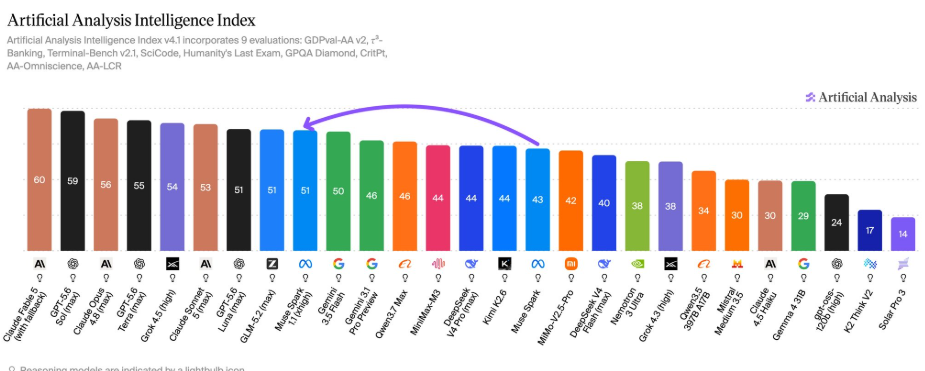
Artificial Analysis, which was given early access to the model ahead of its public release, credited the gains largely to improvements in scientific reasoning, coding, and general knowledge, while noting that agentic knowledge work — measured through GDPval-AA v2 — remains an area where the model trails the frontier. On Humanity’s Last Exam specifically, Muse Spark 1.1 hit 45%, within a point of Claude Opus 4.8 (max) at 46%, and ahead of both GPT-5.5 at 44% and Grok 4.5 (high) at 40%.
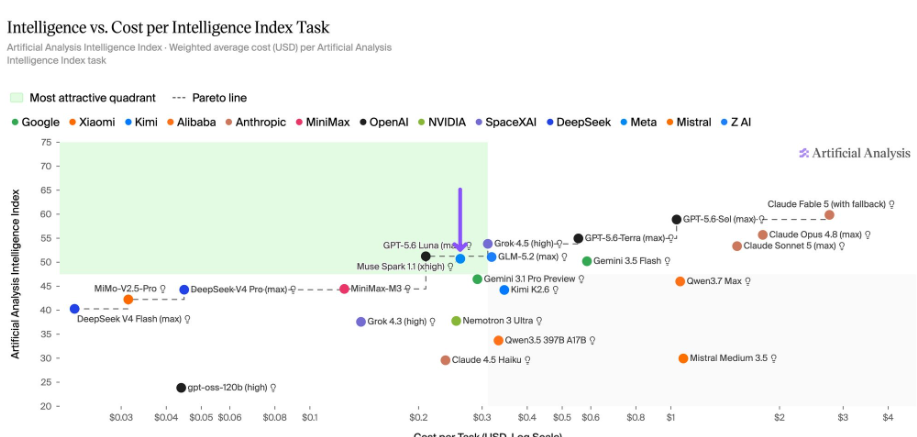
What stands out about the release isn’t just where it lands on the leaderboard, but what it costs to get there. Muse Spark 1.1 used 94 million output tokens to run the full Intelligence Index, fewer than GLM-5.2 (max) at 141 million and GPT-5.6 Luna (max) at 125 million. Artificial Analysis pegs the cost at roughly $0.26 per Intelligence Index task on Meta’s public pricing of $1.25 per million input tokens and $4.25 per million output tokens, undercutting GLM-5.2 and running well below several of the other models it’s tied with on raw intelligence score. For a model priced this competitively to also sit at the top of its tier is a combination Meta hasn’t managed before.
The most interesting result in the release is on AA-Omniscience, the benchmark Artificial Analysis uses to track hallucination alongside raw accuracy. Muse Spark 1.1’s score on that metric more than quadrupled, from 4 to 18. But the reason behind that jump is worth sitting with: it isn’t that the model got meaningfully better at knowing things. Its accuracy on questions it chose to answer held roughly flat, moving from 45% to 41%. What changed is that the model got far more comfortable saying it didn’t know. Its attempt rate dropped from 95% to 82%, and its hallucination rate fell 35 percentage points, from 73% to 38%. Artificial Analysis noted this is close to the inverse of what happened with Grok 4.5, whose Omniscience gains came from answering more confidently and getting more of those answers right, even as its hallucination rate rose alongside it. Two different paths to a better number, and neither is obviously the wrong one — abstaining more often is a defensible strategy for a model meant to be trusted in agentic settings, where a wrong answer stated with confidence tends to cost more than an honest pass.
On the infrastructure side, Muse Spark 1.1 now runs on a context window of 1 million tokens, up from 262,000 on the original Muse Spark. Meta is pricing it at $1.25 per million input tokens and $4.25 per million output tokens, with cache hits discounted down to $0.15 per million. Output speed on Meta’s first-party API comes in at around 114 tokens per second median, with roughly 21 seconds to the first answer token. The model is available now through Meta’s API, with no third-party hosting confirmed at launch.
The context behind this release matters as much as the numbers themselves. Meta’s last major model launch before this current run was Llama 4, which turned into one of the rougher chapters in the company’s AI history after it emerged that benchmark numbers for the release had been assembled using different model versions than what was actually shipped. That episode led to a reshuffling of Meta’s AI organization, the acquisition of a large stake in Scale AI, and Alexandr Wang taking over as the head of what’s now called Meta Superintelligence Labs. Muse Spark 1.1 is the clearest evidence yet that the rebuild is producing results independently verified by a third party, rather than numbers Meta is putting out about itself.
For Google specifically, this is a notable shift in position. Gemini 3.1 Pro Preview had itself only recently reclaimed the top spot on the Intelligence Index earlier this year before newer releases from Anthropic and OpenAI moved past it again. Now, even Meta’s mid-tier model sits ahead of both of Google’s current mainline offerings on the same index, a reminder of how quickly rankings move in this market and how little room any single lab has to stand still.