Meta hasn’t only made the weights of its top-of-the-line Muse Spark 1.2 model open, but it’s also opened a front in the local models space.
The company’s Superintelligence Labs has released Muse Glimmer, a 30B-parameter model built specifically to run as an always-on local agent on a single consumer GPU, and the early benchmark numbers put it ahead of both Gemma4-31B and Qwen3.6-27B on the majority of tests Meta ran it against. The weights are up on Hugging Face under an Apache 2.0 license, which means anyone can download, modify, and deploy the model commercially without asking Meta for permission first.
Muse Glimmer Benchmarks
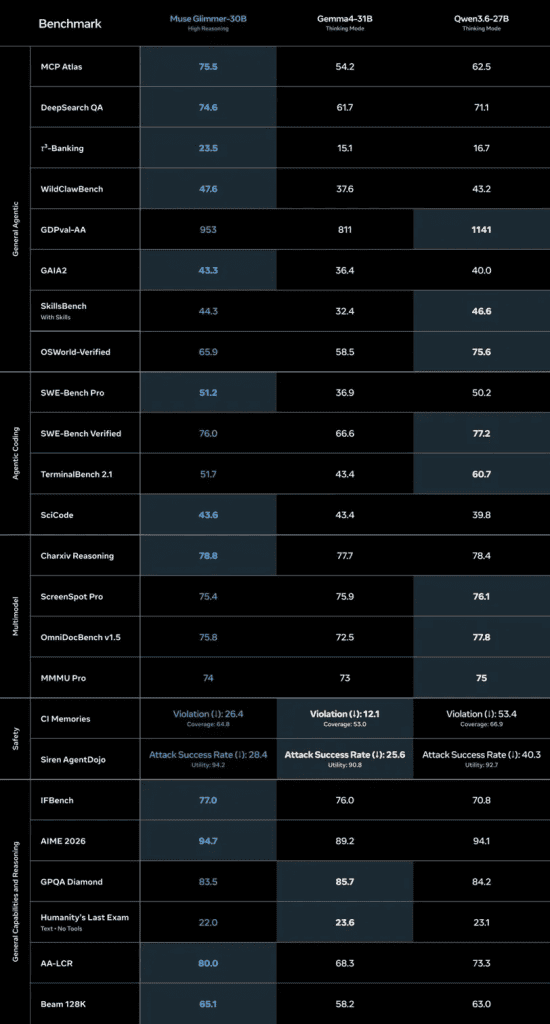
The headline number is on MCP Atlas, where Muse Glimmer scores 75.5 against Gemma4-31B’s 54.2 and Qwen3.6-27B’s 62.5, a gap wide enough that it isn’t close on paper. It carries a similar lead on DeepSearch QA (74.6 vs 61.7 and 71.1), on the WildClawBench agentic suite (47.6 vs 37.6 and 43.2), and on GAIA2 (43.3 vs 36.4 and 40.0). Across the general agentic category, which is really the category this model was built for, Muse Glimmer wins nearly every row on the table Meta published, and the wins aren’t marginal.
Coding is where the story splits. Muse Glimmer takes SWE-Bench Pro at 51.2 against Gemma4-31B’s 36.9, comfortably ahead there too, and it edges out both rivals on SciCode with a score of 43.6. But on the tasks that lean on sustained terminal work and computer control, Qwen3.6-27B pulls back in front. On TerminalBench 2.1, Qwen scores 60.7 to Muse Glimmer’s 51.7. On SWE-Bench Verified, Qwen posts 77.2 against Muse Glimmer’s 76.0, a narrow gap but a real one. And on OSWorld-Verified, the benchmark that tests whether a model can actually operate a desktop, Qwen leads 75.6 to 65.9. The pattern holds across most of the multimodal rows too, where Qwen3.6-27B has a slight but consistent edge on ScreenSpot Pro, OmniDocBench, and MMMU Pro.
On general capabilities and reasoning, Muse Glimmer looks strong again, topping AIME 2026 at 94.7, IFBench at 77.0, and posting a wide lead on AA-LCR at 80.0 against Gemma’s 68.3. Gemma4-31B claws back some ground on GPQA Diamond and Humanity’s Last Exam, where it edges both competitors, but those are narrow margins rather than a trend. The safety numbers are worth a mention too: Gemma4-31B posts the lowest violation rate on CI Memories and the lowest attack success rate on Siren AgentDojo, meaning the Google model is harder to manipulate into breaking its own guardrails even if it trails on raw capability.
None of this would matter much if the model couldn’t actually fit on the hardware people own. At full precision, a 30B-parameter model needs upwards of 55GB of memory, which rules out pretty much every consumer GPU on the market. Meta compressed Muse Glimmer down to roughly 4-bit precision, bringing the language model itself under 20GB. That leaves enough headroom inside a 24GB or 32GB card, an RTX 5090 being the obvious target, for the KV cache, a perception encoder that reads screenshots, and a speculative decoding drafter to run alongside it without spilling into system RAM.
That drafter is the more interesting engineering decision here. Meta calls it DFlash, and instead of generating the reply one token at a time, it lets a small helper model guess an entire block of tokens ahead. The full Muse Glimmer model then checks that block in a single pass, keeping whatever the drafter got right and correcting whatever it got wrong. It’s a variation on speculative decoding that other labs have experimented with, but Meta appears to have tuned it specifically for the memory-bandwidth constraints of consumer cards rather than datacenter GPUs.
The gains from that setup are substantial on Nvidia hardware and considerably more modest on Apple silicon. On an RTX 5090, DFlash lifted decode speed from 74.9 tokens per second to 233, a 3.1x jump, measured through llama.cpp. On an M5-Max, the gain drops to 1.8x, reaching 50 tokens per second, and on an M4-Max it’s 1.5x, topping out at 38 tokens per second. The likely explanation is that Apple’s unified memory architecture is already less bandwidth-constrained in the baseline case, so there’s less headroom for a speculative decoding scheme to reclaim.
What Meta is chasing with Muse Glimmer isn’t really a frontier-model showdown, it’s a bet on where inference happens next. An agent that has to phone a datacenter every time it needs to read a screen, click a button, or search a local folder is slower and more expensive to run continuously than one that lives entirely on the machine in front of it. A 30B model that beats larger closed alternatives on agentic benchmarks while fitting on a single GPU a serious enthusiast or small business already owns changes the economics of running an AI assistant all day rather than in short bursts.
It also puts pressure on Google and Alibaba’s open releases at a size class that’s become increasingly contested this year. Gemma4-31B and Qwen3.6-27B were both positioned as the strong options for local, on-device deployment when they launched, and Muse Glimmer’s release doesn’t erase either model’s advantages so much as split the field along task lines: general agentic reasoning and search now favor Meta, while hands-on computer use and terminal-heavy coding still favor Alibaba’s model. Anyone picking a local model for a specific workload will need to weigh which of those columns matters more to them than treating this as a straightforward win.