Moonshot AI has made good on its promise of release the weights of its breakout model Kimi K3.
The Beijing lab put out the full model on Hugging Face on July 27, along with a technical report and three infrastructure tools it used to train the model in the first place. Kimi K3 is a 2.8-trillion-parameter Mixture-of-Experts model, nearly triple the size of Kimi K2.5, the model it succeeds. It comes with native visual understanding and a context window stretching to one million tokens. Moonshot says the jump in size didn’t come from simply adding parameters. A set of architectural changes, including what it calls Kimi Delta Attention and Attention Residuals, along with its MoonEP communication library, delivered a 2.5x gain in scaling efficiency over the previous generation.
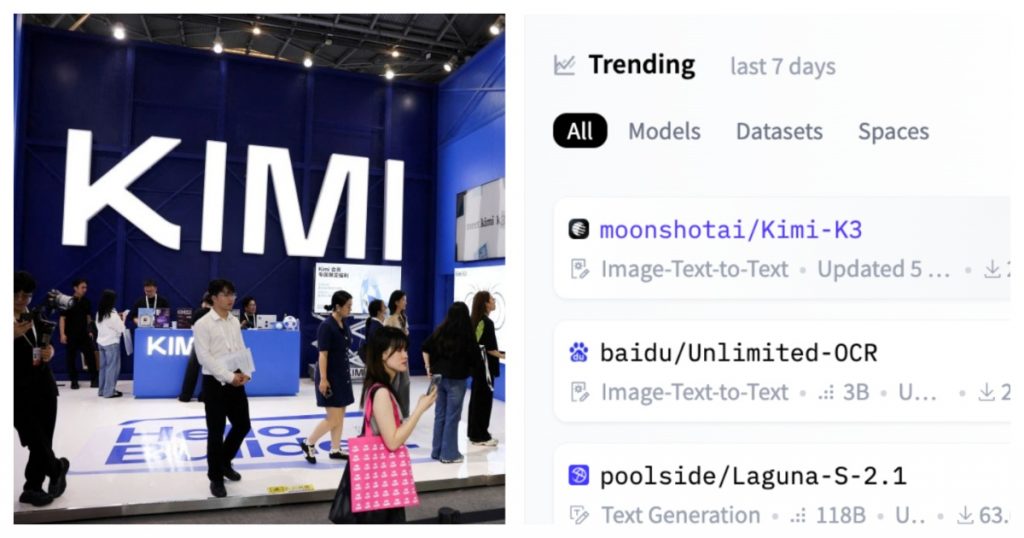
The reception has been unusually fast. Hugging Face CEO Clem Delangue posted that K3 hit the top of the platform’s trending chart with more than 4,000 likes within 30 minutes of going live, calling it the fastest release growth the platform has seen. Kimi K3 arrives roughly two weeks after Artificial Analysis had already placed the model third on its Intelligence Index, behind only Fable 5 and GPT-5.6 Sol, so the weights landing on Hugging Face was less a surprise than an event people had been waiting for.
What’s under the hood
The technical report lays out four pieces doing most of the work. KDA + AttnRes combines Kimi Delta Attention with Gated MLA in a 3:1 hybrid for long-context processing, paired with block-wise Attention Residuals that control how information flows across the network’s depth. Stable LatentMoE runs 896 routed experts with only 16 active per token, a 56x sparsity ratio that Moonshot says it managed to keep stable using a technique it calls Quantile Balancing alongside SiTU-GLU and normalization.
The vision side, MoonViT-V2, is a 0.4-billion-parameter encoder trained from scratch on next-token prediction rather than the contrastive pre-training most vision encoders rely on, and Moonshot claims it still matches SigLIP-initialized baselines while training more predictably. Rounding it out is Joint RL + MOPD, a post-training recipe that trains nine separate policies specialized by domain and effort level, then merges their capabilities into the single released model.
The infrastructure release
Alongside the weights, Moonshot open-sourced three tools from its own training stack. FlashKDA is a CUTLASS-based kernel implementation of Kimi Delta Attention that the company says runs 1.72x to 2.22x faster at prefill than the flash-linear-attention baseline on H20 hardware, and it’s built as a drop-in replacement for that library. MoonEP is the communication layer behind its Mixture-of-Experts setup, aimed at cutting the communication overhead that tends to bottleneck MoE systems at scale. AgentEnv, developed with kvcache-ai, is a distributed system for running agent environments, built with fast snapshot, resume, and fork support for large-scale parallel training runs. It’s the infrastructure that powered the agentic reinforcement learning behind K3 itself.
A license with strings attached
Kimi K3 ships under a license Moonshot describes as MIT-inspired but not commercially permissive in the way MIT actually is. Anyone can use, modify, fine-tune, or redistribute the software freely. The catch shows up once a company’s revenue, or its affiliates’ combined revenue, crosses $20 million over any 12-month stretch while operating a Model-as-a-Service business — at that point, a separate commercial agreement with Moonshot becomes mandatory before continued use. There’s also a branding clause: any commercial product built on K3 that reaches 100 million monthly active users or $20 million in monthly revenue has to display “Kimi K3” somewhere in its interface. Internal use, and anything run through Moonshot’s own official products or certified inference partners, is exempt from both conditions.
It’s a structure that lets startups and researchers build on K3 without friction, while making sure that if the model ends up powering something genuinely large, Moonshot gets a seat at the table. Whether that model holds up as adoption scales is the next thing worth watching, but going by the numbers coming out of Hugging Face in the first half hour, plenty of people are already trying.
Pressure builds on Anthropic and OpenAI
K3’s release lands at a pointed moment for the two US labs sitting just ahead of it on the leaderboards. Artificial Analysis has K3 in third place overall, behind only Fable 5 and GPT-5.6 Sol, which means a model anyone can download and run on their own hardware is now within a few points of the best closed systems money can buy. Anthropic and OpenAI still hold the capability edge, but that edge has been shrinking release after release, and Moonshot is giving away for free what the American labs charge a premium for.
That gap is exactly what a group of roughly 25 US tech companies argued should stay open when they published a letter titled “Open Weights and American AI Leadership” on July 24. Nvidia CEO Jensen Huang used his first-ever post on X to share it, and the signatories eventually grew to include Microsoft, Meta, IBM, Palantir, Hugging Face, Dell, Mistral, Andreessen Horowitz, Y Combinator, and the Linux Foundation, among others, all pushing back against reports that Washington was weighing restrictions on open-weight models and distillation. Google, OpenAI, and xAI voiced support without formally signing at first, and OpenAI added its name a few hours later. Anthropic never did, and it remains the most prominent holdout among major American AI companies, a position that’s hard to separate from the fact that its business depends on enterprises paying to access models it doesn’t release. Releases like Kimi K3 are precisely what that letter was written to defend, and precisely what a company like Anthropic has the most to lose from.