AI only seems to be extending its lead in competitive programming.
A day after OpenAI’s model ran away with the AtCoder World Tour Finals Heuristic contest, the company followed it up by sweeping the Algorithm track too, solving all five problems in the seven-hour finals while the best human competitor in the room managed just three.
The two tracks test very different skills. Where the heuristic contest rewards grinding toward an approximate answer over many hours, the algorithm finals are built around problems that demand a correct, provably exact solution, and AtCoder’s onsite finals are notorious in competitive programming circles for problems that are brutal on the thinking side even when the actual code needed to solve them is short. Twelve of the world’s best algorithmic coders qualified for Tokyo based on their 2025 results, including Peking University’s jiangly and ITMO’s tourist, widely regarded as one of the greatest competitive programmers of all time.
Psyho, the human who beat OpenAI’s model in last year’s heuristic finals and has been covering this year’s rematch closely, live-posted the algorithm contest as it played out. Humans actually opened with the lead. Half an hour in, jiangly was the only competitor with a submission on the board, prompting Psyho to note that “humans” were ahead, even if only briefly. Within minutes OpenAI’s system caught up, and by the 38-minute mark it had already solved three of the five problems alongside one failed attempt.
Then the contest stalled. Psyho’s updates around the two-hour mark described OpenAI stuck on problems D and E, both unusually difficult even by AtCoder finals standards, with the model unable to crack either despite repeated tries. None of the human finalists had more than one problem solved at that point either. It took OpenAI roughly three hours to break through on D, still with four hours left on the clock, a pace Psyho described as evidence the system was no longer operating in the mode where it either solves a problem almost immediately or gives up entirely.
Borys, an OpenAI researcher who appeared on AtCoder’s livestream during the contest, offered some color on how the model was performing relative to internal expectations. He said the team had tested the system against previous AtCoder finals beforehand and it had solved everything, usually in under an hour, comparable to how quickly it handled this year’s A, B, and C problems. D and E, he said, were harder than anything the model had seen in earlier AtCoder contests, which was why they took so much longer. He also described the setup underneath the model as close to OpenAI’s GPT-5.6, paired with a harness built to extend test-time compute, something he suggested any developer could replicate to get similar results. Asked about internet access, he said the model didn’t need to search for anything mid-contest since it already carries most of what it would look up.
Psyho later pointed out that the real solving window may have been shorter than the roughly six hours the timestamps suggested, since Borys was the one manually submitting every OpenAI solution to the platform and stepped away for about an hour to do the livestream interview. E, the hardest problem in the set, went in almost as soon as he returned.
By the end of the seven-hour contest, OpenAI’s system had cleared all five problems for a total of 8,300 points. The best human result came from tour1st of MIT, who solved three problems for 4,300 points, roughly half of OpenAI’s score. Nobody in the human field managed to solve C or E. Reflecting on the result afterward, Psyho didn’t mince words, writing that he doesn’t expect to see OpenAI back as a sponsor for the 2027 edition of the contest, a pointed way of saying there may not be much competitive drama left to sponsor.
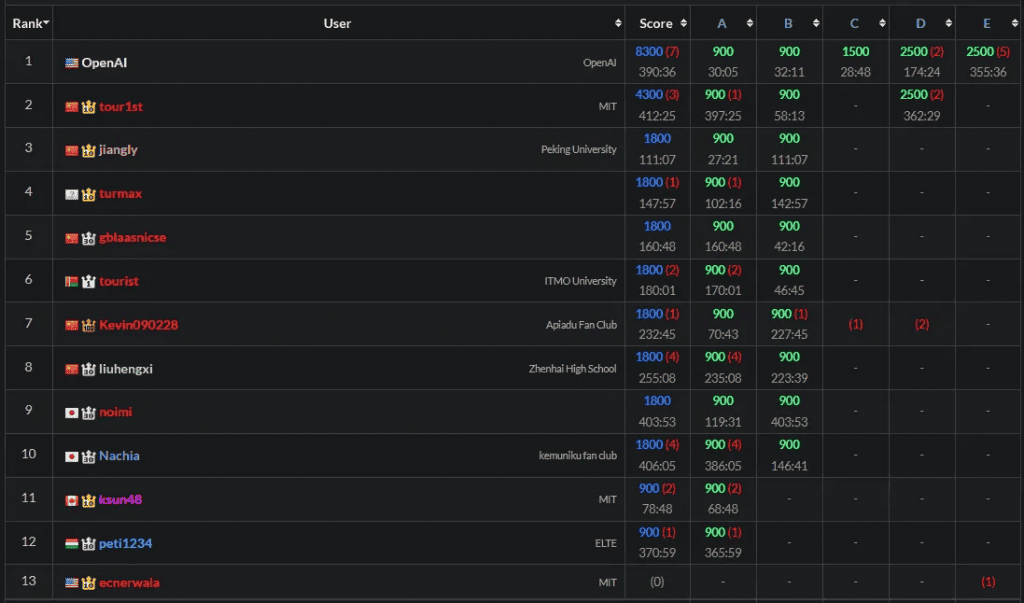
Taken together with the heuristic result from a day earlier, OpenAI has now beaten the world’s top competitive programmers across both AtCoder disciplines in the same week, a year after narrowly losing the heuristic finals and sitting out the algorithm track entirely. The company has spent much of 2026 pushing its models on measurable, public benchmarks, from GPT-5.5’s coding scores in the spring to GPT-5.6’s terminal and agentic coding results in June. AtCoder’s finals add a different kind of evidence to that pile, one measured not against a benchmark suite but against the specific humans who spent all of 2025 earning the right to be called the best in the world at this.