A new paper claims the theoretical speed limit for matrix multiplication is much lower than anyone had proven. It hasn’t been peer reviewed, and it won’t speed up your chatbot tomorrow.
OpenAI has published a paper claiming a big step forward on one of the oldest problems in computer science: how fast can a computer multiply two big grids of numbers?
The paper, titled “Complex Matrix Multiplication Below 2.258 and Rectangular Bounds,” is dated September 24, 2026. It is one of 722 manuscripts in a huge batch of mathematical results OpenAI released this week, which the company says were produced by an unreleased internal model. A follow-up paper dated October 2 pushes the number even lower, to 9/4, or 2.25.
If the proofs hold up, it would be the biggest jump in this field in decades, and it lands in the one area of math that AI depends on most.
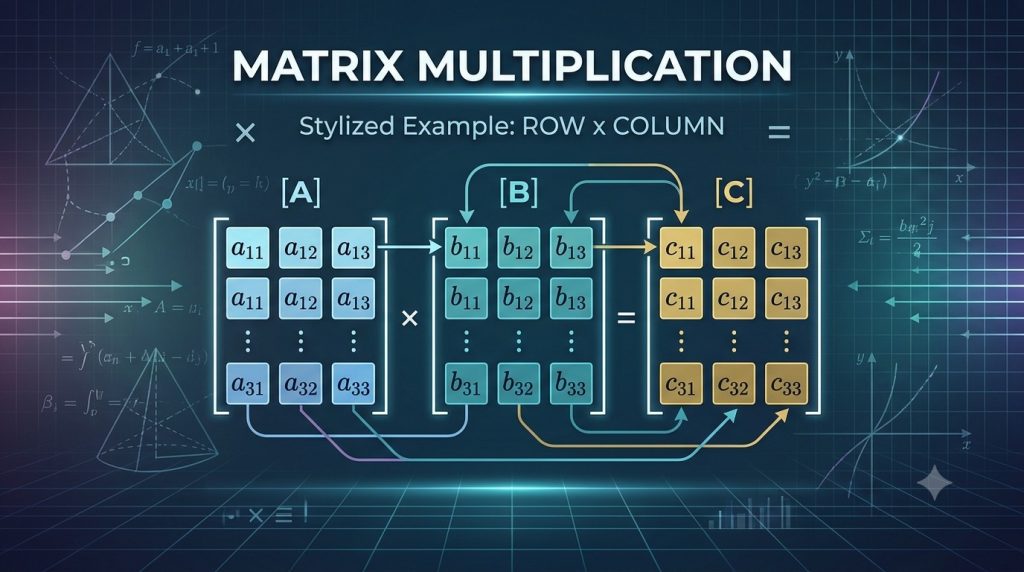
What is matrix multiplication, and why does AI run on it?
A matrix is just a grid of numbers, like a spreadsheet. Multiplying two matrices means combining their rows and columns in a set pattern to produce a third grid.
It sounds like homework, but it is the workhorse of modern AI. Every layer of a neural network, including the ones inside ChatGPT, Claude and Gemini, is at heart a giant matrix multiplication. Training and running these models involves doing a staggering number of them, which is why GPUs, which are very good at this one operation, became some of the most valuable chips in the world. As Google DeepMind put it when it lowered the theoretical bound for matrix multiplication with AlphaEvolve, this is the basic operation that powers modern computing, AI included.
What’s the “exponent” everyone keeps talking about?
The method most of us learned in school takes a number of steps that grows with the cube of the matrix size. Double the size of the matrices and the work goes up eight-fold.
In 1969, mathematician Volker Strassen showed this wasn’t the best you could do. By finding a clever trick for multiplying small 2×2 grids with seven multiplications instead of eight, he showed the work could grow more slowly. Since then, researchers have been chipping away at the exponent, a number called omega (ω) that describes how fast the work grows. The standard method has ω = 3. The absolute floor is 2, since you at least have to read every number in the grids. Nobody has ever proven that 2 is achievable.
For decades, progress was painfully slow. The record sat around 2.3729 in 2020, and was nudged to roughly 2.3716 in 2024. This August, DeepMind’s team used AlphaEvolve to push it to 2.371177, an improvement of about 0.00016 over the previous record. AlphaEvolve had earlier made headlines for finding a way to multiply 4×4 complex matrices with 48 multiplications, the first improvement on Strassen’s approach in that setting in 56 years.
What OpenAI is claiming
According to the abstract, OpenAI proves three things over any number system where counting up never wraps around to zero (which includes the ordinary real and complex numbers):
- ω < 2.258. This is the headline number for multiplying two square matrices. Compared with the previous 2.371, it is a drop of about 0.11, hundreds of times larger than the most recent improvement.
- The “dual exponent” α is greater than 0.465. This one measures how lopsided a multiplication can get before it stops being nearly free. Take a big square matrix and multiply it by a skinnier one. The dual exponent is how skinny that second matrix can be while the total work stays as low as theoretically possible. Earlier research had this at around 0.32.
- ω(1, 0.709, 1) < 2.092. A bound for multiplying a square matrix by a rectangular one, which is a common situation in practice.
The paper also says the square and rectangular bounds hold in other number systems too, with the possible exception of one finite set of cases.
A second paper goes further
OpenAI’s repository also includes a later paper, dated October 2, titled “An Upper Bound of 9/4 for the Matrix Multiplication Exponent.” It proves ω ≤ 9/4, or 2.25, edging below the 2.258 figure.
The 9/4 paper is short and the idea can be described in plain terms. Earlier record-setting work refined a decades-old technique (the “laser method”) and tuned it with ever more computing power. OpenAI’s argument takes a different route. It studies how fast a related, simpler operation, multiplying polynomials, can be done, and shows that this puts a ceiling on how slow matrix multiplication can be. The key trick is a way of splitting a problem into independent pieces that the paper says was missing from earlier approaches.
The reality check
None of this makes your AI faster today. These are “asymptotic” results, meaning they describe what happens with astronomically large matrices. The algorithms they imply involve enormous hidden overheads, and OpenAI’s own paper says its proof doesn’t give a competitive matrix size. Real AI hardware will keep using the simple methods that GPUs are built for. Researchers have long noted that improvements of this type are mostly of theoretical interest.
The proofs aren’t peer reviewed. The September 24 paper isn’t part of the set the company has had formally verified. OpenAI says the collection includes results at different stages of verification and that some of the unformalized ones could have issues. The 9/4 result does come with a machine-checkable proof in Lean, which is a good sign. Still, Terence Tao has warned that AI-generated proofs can look flawless while hiding subtle mistakes, and the field’s specialists will take time to go through the work.
The claim is plausible, not yet settled. A jump this large in a problem that has resisted decades of effort will draw heavy scrutiny. It also fits a pattern. OpenAI recently shared a claimed solution to the Navier-Stokes problem from a model it says is more capable than its public one, and that claim is also awaiting outside review.
Why it matters
Even as a purely theoretical result, the fact that an AI model may have found a better way to do the operation that AI itself runs on has a pleasing loop to it. A faster route to multiplying matrices could, in time, feed back into cheaper training and inference for the very models doing the math.
For now, the number to watch is 2. If the 2.258 and 9/4 results hold, the gap between where we are and the theoretical floor has shrunk by roughly two thirds in a single week.