OpenAI has terminated three researchers from its safety team for allegedly sharing sensitive company information with an external AI safety organization.
”We have parted ways with three individuals for violating our policies on accessing and handling sensitive company information,” an OpenAI spokesperson said in a statement. “Our investigation confirmed that these individuals mishandled sensitive information outside established company procedures, violating our policies and breaking the trust essential to our work.”
According to a report by The Wall Street Journal, OpenAI recently informed employees that it had fired three researchers on its safety team after finding that they had shared confidential data with an outside AI safety entity.
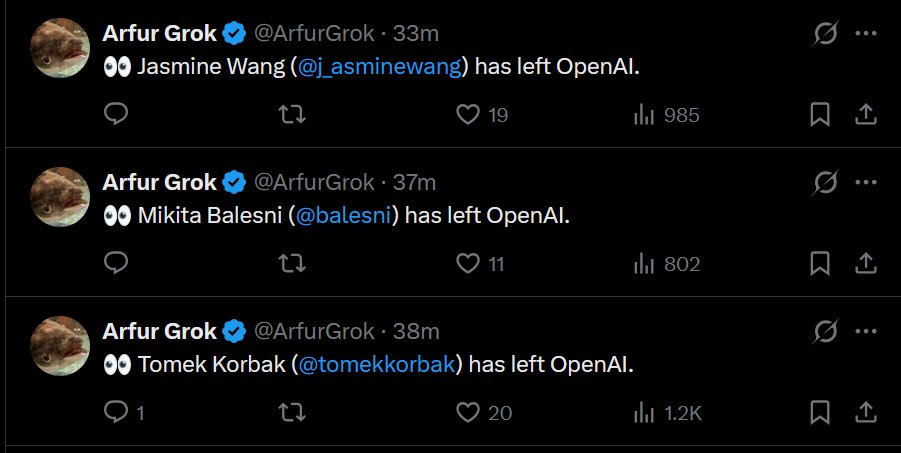
The news of these dismissals coincides with updates posted by X account Arfur Grok that monitors employee movements across major AI laboratories. Within minutes of each other, the account noted the departures of three OpenAI researchers:
- Jasmine Wang
- Mikita Balesni
- Tomek Korbak
While the tracking account flagged the exit of these three individuals from OpenAI around the same time, neither OpenAI nor the researchers have publicly commented on whether these specific departures are connected to the internal investigation.
The development comes during a period of heightened internal security and operational restructuring across top frontier labs. The AI industry has seen increased scrutiny over intellectual property, corporate espionage, and data handling. Recently, tech giant Apple filed a lawsuit against former employees alleging trade secret theft tied to OpenAI hires, highlighting the high stakes surrounding proprietary research and confidential lab data.
At the same time, OpenAI has been undergoing significant organizational shifts and executive turnarounds. Earlier this year, several top executives departed OpenAI, including former Chief Product Officer Kevin Weil, B2B Applications CTO Srinivas Narayanan, and Sora lead Bill Peebles. OpenAI has also seen several high profile hacking incidents by its AI models, including breaches of Hugging Face, Ruby Gems and 4 separate Australian government websites.
As frontier models become more capable, the boundary between open safety research, cross-lab collaboration, and internal corporate secrecy remains one of the most fraught lines for researchers working inside major AI companies.