OpenAI has issued a statement addressing the credit dispute that has consumed the mathematics world over the past two days, saying that neither its researchers nor its AI agents saw any of mathematicians Tristan Buckmaster and Levent Alpöge’s work before the pair released it publicly, and that no specific user data belonging to them was accessed to arrive at its own Navier-Stokes result.
“We congratulate Levent Alpöge and Tristan Buckmaster on their remarkable mathematical work,” the company wrote. “We (the researchers and the agents) did not see any of their work through any means until they released it publicly — in particular, no specific user data was accessed in order to solve this problem.”
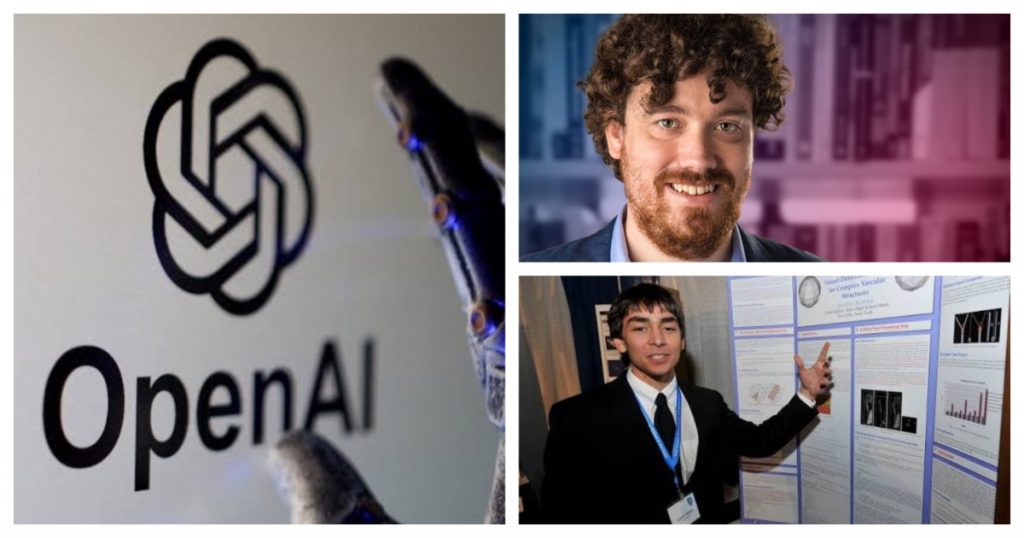
The statement is OpenAI’s first formal response since Buckmaster went public on the morning of September 8 with a four-page account accusing the company of learning about his and Alpöge’s unpublished research and moving to scoop it. Buckmaster and Alpöge, a mathematician who works at Anthropic, had spent roughly a year using large language models to chase a proof strategy for Navier-Stokes blow-up, and had quietly closed in on results for the incompressible porous media equation, the Boussinesq equations, and 3D incompressible Euler, all before OpenAI’s version of the story surfaced.
According to Buckmaster’s statement, he learned on September 3 that information about his and Alpöge’s work had reached OpenAI. Three days later, he spoke twice with OpenAI’s Sébastien Bubeck and another company representative, who told him an internal OpenAI model had produced its own proof of finite-time blow-up, this time for the forced version of Navier-Stokes. Buckmaster said the approach sounded close enough to his own that it raised immediate concerns, and that the ensuing conversation over publication and authorship, including a push to leave Alpöge off the paper because he works at a rival lab, turned contentious.
Notably, Buckmaster himself has been careful not to allege data misuse outright. He wrote that he does not know whether their private sessions were used and said he is “not accusing anyone of anything” on that specific point. OpenAI’s statement leans on that same uncertainty rather than closing the door on it entirely: the company says it “cannot rule out” that de-identified data derived from Buckmaster and Alpöge’s usage of its products helped improve its models generally, even while maintaining that no one at OpenAI, human or agent, actually saw their unpublished work.
OpenAI also used the statement to draw a technical line between the two results, noting that its proof and Buckmaster and Alpöge’s differ significantly, and that even the specific problem solved is not the same in the Euler case: OpenAI’s version is for forced Euler, while Buckmaster and Alpöge’s is for the unforced case. That distinction matters more than it might sound. OpenAI’s own Navier-Stokes announcement credited the proof to an unreleased internal model described as significantly more capable than GPT-6 Astra, and unlike Buckmaster and Alpöge’s Lean-verified results, that fuller proof has not yet been examined by independent mathematicians outside the company.
The dispute lands in the middle of an unusually active stretch for AI-assisted mathematics, one that has already produced friction over how credit should be assigned when a model does the bulk of the intellectual work. Fields Medalist Terence Tao has warned that a lack of transparency around these results could end up being a net negative for the field, even as labs race to rack up solved problems on public trackers that now count OpenAI and Anthropic’s respective tallies in the hundreds.
For now, the Clay Mathematics Institute still lists Navier-Stokes among its unsolved Millennium Prize problems, and any formal recognition of either result will require the kind of broad expert acceptance that takes considerably longer than a company blog post.