Peter Steinberger is one of the figureheads of the AI revolution, and he sure is dogfooding his own products.
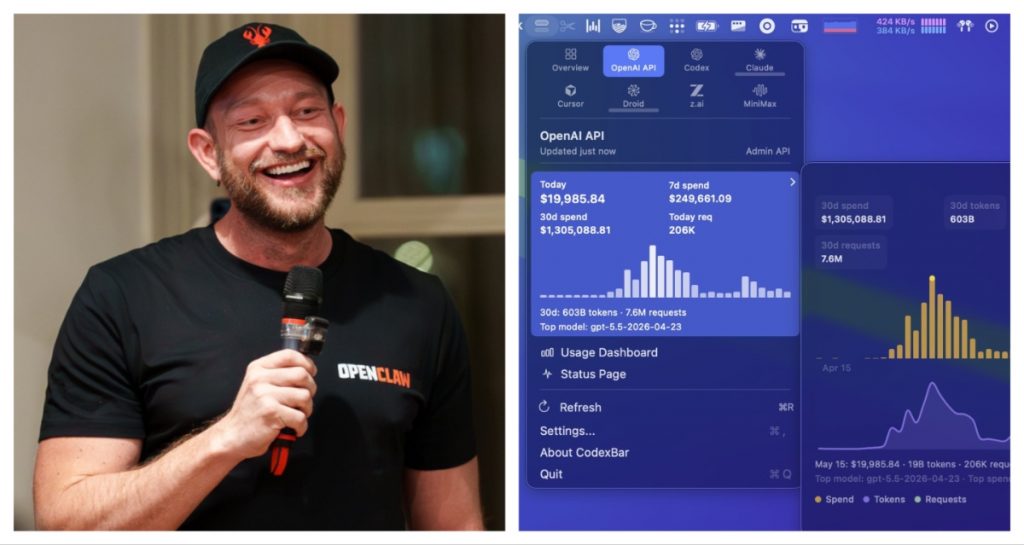
Steinberger, the creator of OpenClaw, recently shared a screenshot that raised more than a few eyebrows. His CodexBar menu bar app — which tracks AI API usage across providers like OpenAI, Claude, Cursor, and others — dashboard showed a 30-day spend of $1,305,088.81, burning through 603 billion tokens across 7.6 million requests. On a single day (May 15), he clocked $19,985.84 in spend, 19 billion tokens, and 206,000 requests. The top model driving the bill: gpt-5.5-2026-04-23.
To put that in perspective, $1.3 million a month is the annual salary of a group of senior engineers in San Francisco — spent not on salaries, infrastructure, or equity, but on tokens.
What X Users Had To Say
When the screenshot circulated, the reaction on X was pointed. One user, Jonathan, wrote: “Bro, you better show something that $1MM worth of engineers’ couldn’t do or this might be the beginning of the advertising for the frontier lab bubble bursting. That is also subsidized pricing, holy. If it was the actual cost, it would be much higher.”
It’s a sharp observation. AI API pricing is heavily subsidized by the labs, which are themselves burning through capital at a staggering pace in a land-grab for users and market share. The real cost of compute behind those 603 billion tokens would be substantially higher.
Steinberger pushed back — but not in the way one might expect. His response wasn’t to reveal some moonshot product or transformative output. Instead, he noted: “I can disable fast mode and it’s 70% cheaper. So it’s more like one employee.”
A Symptom of Something Larger?
Steinberger’s numbers are extreme, but they’re not entirely anomalous. Across the industry, AI spend is accelerating faster than the value being created can be clearly measured. Former Google CEO Eric Schmidt has argued that the real constraint on AI is cash, not energy — and he’s right, but that cuts both ways. Capital is flowing in, but the question of what’s flowing out remains awkward.
Proponents of AI’s transformative value point to cases like Citadel CEO Ken Griffin, who recently described AI completing months of PhD-level financial work in days. That’s a concrete, measurable productivity gain — work that previously required expensive human capital being done faster and cheaper.
The Steinberger case is harder to map onto that narrative. CodexBar is a useful tool. OpenClaw has its fans. But neither is a product that plausibly generates $1.3 million a month in revenue — which means the spend is either deeply experimental, the result of building at a scale not yet matched by output, or a proxy for a developer community testing at such volume that the costs are shared across many users piped through his keys.
Even so, the arithmetic is uncomfortable. If the actual, unsubsidized cost of those tokens were passed on in full, the spend would be considerably higher. The entire AI API ecosystem is built on pricing that is, to varying degrees, a bet on future scale — labs absorbing near-term losses to lock in usage patterns and distribution.
The Bubble Question
The AI industry has successfully avoided the “bubble” label largely because the technology demonstrably works — it writes code, drafts documents, and handles white-collar tasks at a pace that was unimaginable five years ago. But a working technology and a rational market are not the same thing.
What Steinberger’s dashboard illustrates is the gap between token consumption and value creation that sits at the heart of the current AI moment. Spending $1.3 million on tokens in a month is only defensible if the output is worth at least that — in revenue, in saved costs, or in some compounding strategic advantage. For the vast majority of developers running similar experiments, it almost certainly isn’t.
That doesn’t mean the technology is worthless. It means the pricing signals are distorted. And when pricing signals are distorted at this scale — subsidized by labs racing to grow, funded by investors betting on an AI-driven future — you get behaviour that looks, from the outside, a lot like a bubble.
Steinberger’s “one employee” defence might be technically accurate if he chose to use slow mode. But it’s also a glimpse into how warped the economics of AI have become — employees are spending an equivalent of an employee’s salary on tokens, and now always with much to show for it.