There are now some questions around whether cheaper AI is still leading to proportionally more AI use, and OpenRouter has now weighed in with its own data.
OpenRouter, the platform that routes AI traffic across hundreds of models for developers and businesses, has published an analysis of token usage, token prices and overall spending on its platform across 2026. Its conclusion: Jevons paradox — the idea that making a resource cheaper increases total consumption of it — is still holding for AI. But the effect has become noticeably weaker in recent months than it was at the start of the year.
“We looked into OpenRouter data on token usage, token prices, and overall spending across 2026 for an answer,” the company posted on X. “We found that yes, Jevons paradox has held so far. But it has been weaker in recent months than it was at the start of the year.”
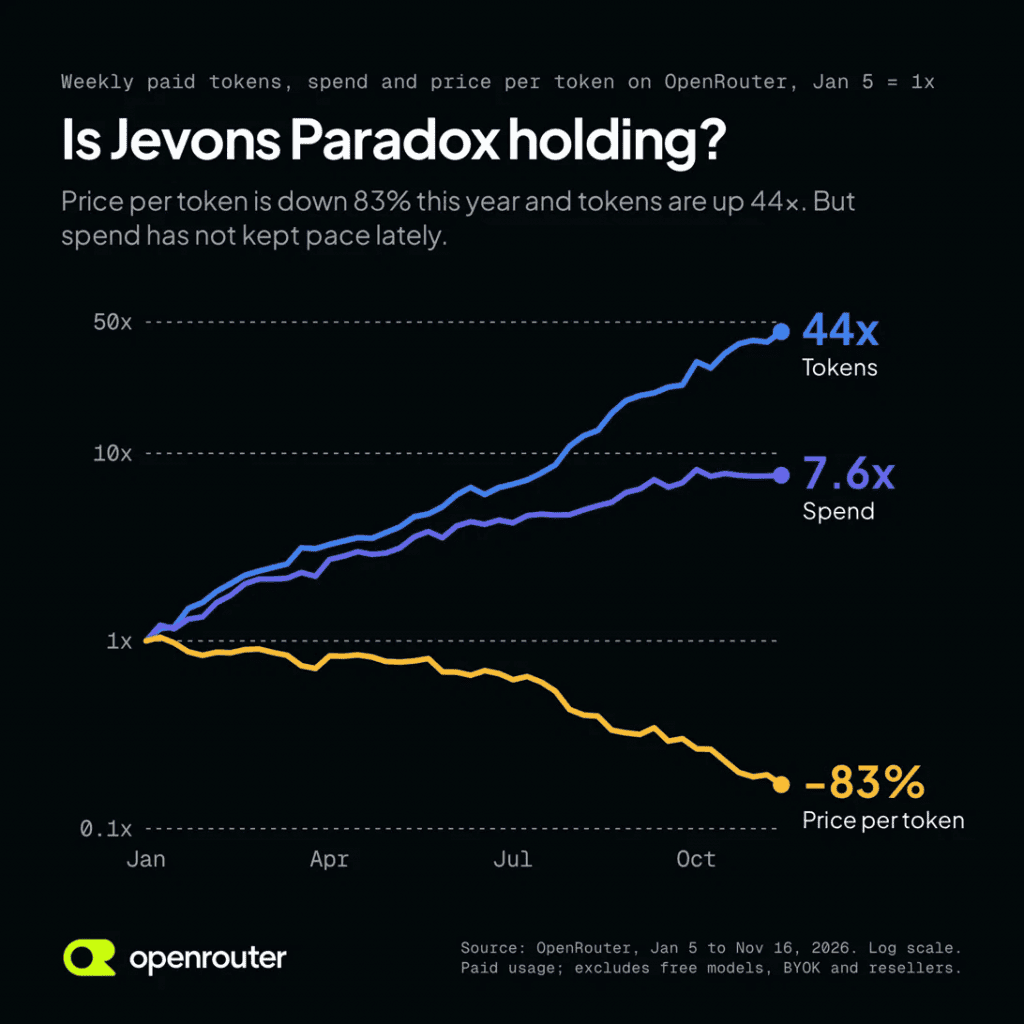
What The Data Shows
OpenRouter’s chart tracks weekly paid tokens, spend and price per token on its platform from January 5 to November 16, 2026, with all three indexed to 1x at the start of the year. The figures cover paid usage only, and exclude free models, bring-your-own-key (BYOK) usage and resellers.
The headline numbers are striking. Over the course of the year price per token is down 83%. Tokens consumed meanwhile are up 44x, and spend is up 7.6x
On those year-to-date numbers, Jevons paradox is clearly at work. Prices fell to roughly a sixth of where they were in January, but token consumption rose far more than enough to offset that — which is why total spend on the platform is up more than sevenfold. Cheaper AI didn’t just mean people paid less for the same usage; it meant they used dramatically more of it.
But the shape of the chart tells a more nuanced story. For the first several months of the year, tokens and spend rose almost in lockstep, with price per token falling only gradually. From around July, prices started falling much faster, and token usage accelerated sharply — climbing from under 10x to 44x by mid-November. Spend, however, did not follow. It has largely flattened out since around October, hovering in the 7-8x range even as tokens kept climbing and prices kept dropping.
That’s the “weaker” part of OpenRouter’s finding. In recent weeks, increases in usage have roughly just offset the falling prices, rather than outpacing them. Consumption is still rising as AI gets cheaper — the core of Jevons paradox is intact — but the extra usage is no longer translating into more money being spent on AI.
“This Has Happened In Our Data Before”
OpenRouter’s Head of Insights Peter Walker said the slowdown wasn’t unprecedented.
“Our take on Jevons Paradox right now: Yes, it’s holding. But it’s noticeably weaker than at the start of 2026,” Walker wrote. “This has happened in our data before (actually this time last year) and new, major launches / use cases turned it around. Will that be true again?”
It’s a fair point. A similar seasonal lull showed up in other datasets last year too — Ramp’s AI Index recorded a pause in AI spend growth between August and October of last year, which was followed by a renewed surge. Since then, the industry has seen the rise of coding agents and long-running autonomous workflows that consume orders of magnitude more tokens than simple chat use, and these new use cases were a big part of what kept the growth going.
A Counterpoint To Ramp
OpenRouter’s analysis comes just days after Ramp co-CEO Eric Glyman made a stronger claim: that Jevons paradox recently broke for AI, with consumption no longer rising enough to offset falling prices. Speaking to Y Combinator president Garry Tan, Glyman said the effect had been “very clear in the data” over the last two months, and suggested that for many business tasks, models may already be smart enough that further improvements don’t unlock much new demand.
Ramp’s own data had already pointed in that direction. Its AI Index showed that business spend on OpenAI and Anthropic grew just 2% and 1% respectively in October, a sharp slowdown from the double- and triple-digit monthly jumps earlier in the year, even as token volumes kept rising.
In a sense, OpenRouter and Ramp are describing the same phenomenon from slightly different angles. Both see spend flattening out in recent months while usage keeps growing. The difference is in the interpretation: Ramp’s Glyman sees it as Jevons paradox breaking, while OpenRouter sees it as Jevons paradox weakening — and points out that the same pattern has reversed before.
Prices Keep Falling
The steep decline in price per token on OpenRouter’s chart reflects an aggressive year of price cuts across the industry. A few months ago, OpenRouter’s data showed that token usage jumped after OpenAI discounted GPT-5.6 Terra and Luna, with Luna’s daily volume rising 13.8x after an 80% price cut — a textbook Jevons response that lines up with the inflection in the chart around late summer. Since then, GPT-6 Sol and GPT-6 Luna launched at roughly half the price of their predecessors, and GPT-6.2 Astra came in 20% cheaper than GPT-6 Astra while claiming to do more with fewer tokens.
Not every lab is cutting prices, though. Google has said that Gemini 4 Carbon and Argon will move from their introductory $2/$10 pricing to $4/$20 per million tokens on December 1, which could become an interesting test of how price-sensitive demand really is.
Will It Turn Around?
Jevons paradox has been something of a foundational assumption for the modern AI industry. Google DeepMind CEO Demis Hassabis has argued that the cost of inference will fall but won’t go to zero, because people will simply use whatever compute they can get, while OpenAI CEO Sam Altman has said that the cost of last year’s intelligence falls by about a factor of ten every year. The massive infrastructure investments being made across the industry rest, in part, on the expectation that falling prices will keep driving more-than-proportional growth in demand.
If spend stays flat while prices keep falling, that assumption starts to look shakier — and AI labs could find themselves serving vastly more tokens without much more revenue to show for it. Microsoft CEO Satya Nadella has already argued that marginal productivity improvement has to match the marginal costs of tokens for AI spending to be sustainable.
OpenRouter’s data, though, suggests it’s too early to call the end of the trend. Tokens are still up 44x this year, spend is still up 7.6x, and the last time growth stalled like this, new launches and use cases brought it roaring back. Whether the next wave of models and agents can do the same, as Walker asks, is now one of the more important open questions in AI.