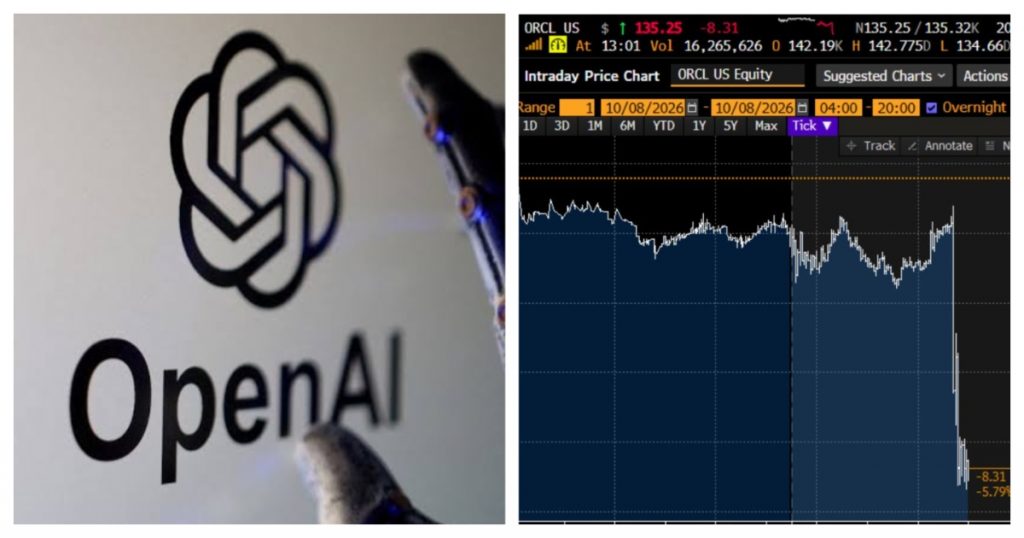
Oracle shares fell nearly 5% on Thursday, with NVIDIA, Microsoft and AMD also trading lower, after the Financial Times reported that OpenAI’s annualized revenue is about $20 billion lower than what had been widely reported in recent weeks.
By around 1:50 pm ET, Oracle was down 4.72% at $136.82, having dropped sharply from the $142 range it had held for most of the session. AMD was down 4.55% at $616.48, NVIDIA had slipped 2.89% to $230.60, and Microsoft was down 1.69% at $520.82. Broader market indicators also weakened: the Nasdaq fell about 1% on the report.
What the FT reported
According to the FT, which cited financial documents shared with investors, OpenAI’s annualized revenue stood at roughly $50 billion at the end of September. That is well short of the roughly $70 billion figure that had been reported by multiple outlets late last month, also based on information provided to investors.
The gap appears to come down to how revenue is counted rather than a sudden collapse in business. Per the report, the discrepancy stems from differences in how OpenAI and rival Anthropic calculate annualized revenue: Anthropic includes sales made through cloud partners like AWS and Google Cloud, while OpenAI does not. Investors trying to compare the two companies on a like-for-like basis made adjustments to OpenAI’s numbers, which first produced a $40 billion figure for August. Applying OpenAI’s stated growth of more than 70% to that inflated base then led to the $70 billion estimate that made the rounds. The question of how Anthropic and OpenAI’s run-rates should be compared has been a live debate for months.
The $70 billion number had itself moved markets. Oracle’s shares rose 5.3% after it was reported, which means Thursday’s drop is in large part the market unwinding that excitement.
It’s worth noting that the report doesn’t say OpenAI’s revenue shrank. A $50 billion run-rate would still be roughly double where OpenAI ended 2025, but it is a meaningful reset against the figure many investors had in their models.
Why Oracle took the biggest hit
Few public companies are as tied to OpenAI’s fortunes as Oracle. In September 2025, the Wall Street Journal reported that OpenAI had agreed to buy $300 billion of computing power from Oracle over five years, starting in 2027. That works out to an average of about $60 billion a year, several times OpenAI’s revenue at the time. Oracle disclosed that its remaining performance obligations had jumped by $317 billion in a single quarter to $455 billion, and its stock surged more than 40% in a day, making Larry Ellison briefly the world’s richest person.
The deal is part of the Stargate buildout, under which Oracle is developing around 4.5 gigawatts of data center capacity for OpenAI, including the flagship site in Abilene, Texas. To deliver it, Oracle has had to borrow heavily to buy chips and build infrastructure, which makes the arrangement a bet that OpenAI’s revenue will grow fast enough to pay for it.
That is why Oracle trades as a barometer of confidence in OpenAI. The stock has fallen sharply on OpenAI-related worries before: it dropped more than 40% from its September 2025 peak by December as investors worried about the company’s reliance on a single customer, and slid again earlier this year when the Wall Street Journal reported that OpenAI had missed internal revenue and user targets. Any sign that OpenAI’s income is lagging its commitments lands directly on Oracle’s balance sheet story.
Why NVIDIA, AMD and Microsoft fell too
The report doesn’t mention any of these companies directly, so the reasons for their declines are a matter of inference. A few likely factors:
Circular financing worries. OpenAI has built a web of deals with its suppliers. NVIDIA agreed to invest up to $100 billion in OpenAI alongside a commitment to deploy at least 10 gigawatts of its systems. AMD agreed to supply 6 gigawatts of GPUs and issued OpenAI a warrant for up to 160 million AMD shares. Critics have long asked whether the money flowing between OpenAI, Oracle and NVIDIA can sustain itself, as Elon Musk put it when he called it an “infinite money glitch”. A lower revenue base makes it harder to argue that OpenAI can fund these commitments out of its own sales.
Forward demand, not current sales. Semiconductor stocks trade on expectations of future orders. If OpenAI’s growth looks a bit slower than assumed, analysts may trim their forecasts for chip and server demand, and richly valued stocks tend to react sharply. AMD, which has the most direct near-term exposure through its first gigawatt of MI450 deployments slated for the second half of this year, fell the most among the chipmakers. NVIDIA, which was trading not far below its 52-week high of $243.37, had more room to give back gains.
Microsoft’s own exposure. Microsoft is one of OpenAI’s largest backers and a major cloud provider to the company, so softer OpenAI numbers can ripple into assumptions about Azure demand and the value of its stake. Microsoft’s fall was also the smallest of the group, and the company had separate news weighing on it: reports said the Labor Department suspended it and other tech firms from an immigration program.
Anthropic as the comparison point. The report also arrives as Anthropic’s run-rate has been reported ahead of OpenAI’s. Anthropic was said to have overtaken OpenAI on annualized revenue earlier this year, and Bloomberg reported a run-rate above $65 billion for Anthropic at the end of July. Investors who had been treating OpenAI’s $70 billion as proof that the AI boom was broad-based may now be asking whether demand is concentrating in a different place, and whether the companies tied to OpenAI’s spending are the right ones to own.
A crowded trade. Finally, AI infrastructure stocks have had a big run, and when positioning is stretched, a single negative headline can trigger broad selling regardless of whether the underlying news changes the long-term picture.
What to watch
The FT’s account is based on documents shared with investors, and neither OpenAI nor its partners have publicly detailed how the $50 billion figure compares with earlier numbers. Much will depend on whether this is read as an accounting clarification or as evidence that OpenAI’s growth is cooling. OpenAI is also reportedly raising capital at a valuation above $800 billion, so scrutiny of its numbers is only likely to intensify. For Oracle, whose contract revenue depends on OpenAI being able to pay, the next earnings call will be the first real chance to address those concerns.