These are strange times in AI, and some of the strangeness is leaking out into the real world.
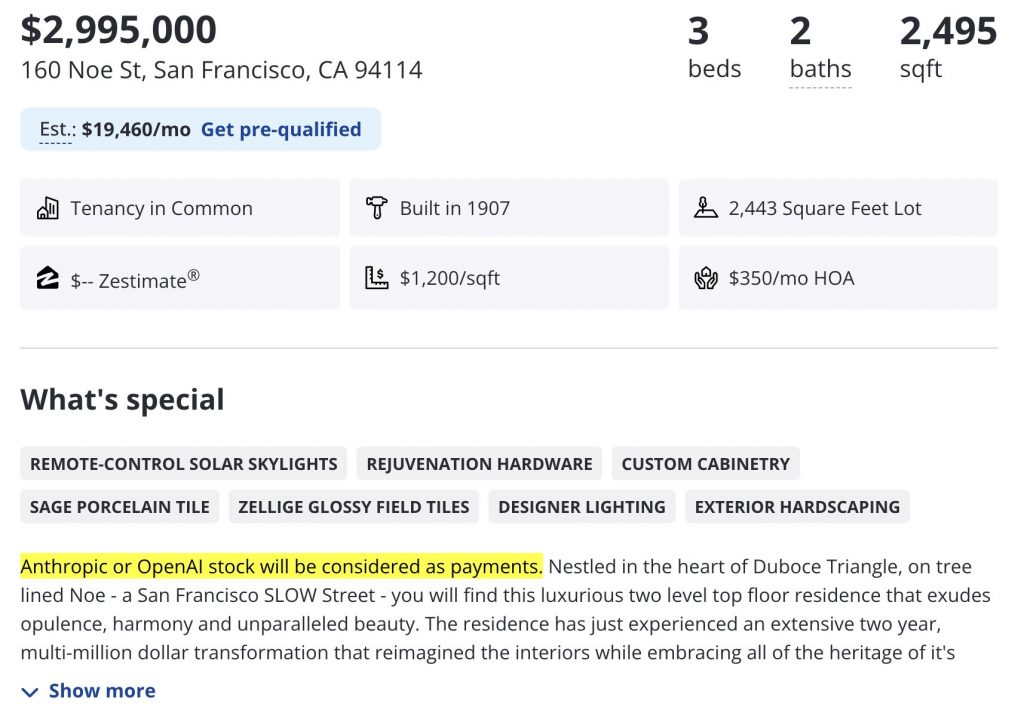
A Zillow listing for a $2,995,000 residence at 160 Noe Street in San Francisco’s Duboce Triangle neighborhood has a line buried in the description that would have seemed absurd just a few years ago: “Anthropic or OpenAI stock will be considered as payments.” No further explanation is given. No caveats. Just a matter-of-fact acknowledgment that in San Francisco in 2026, the shares of two private AI companies are apparently worth treating like currency.
The home itself is genuinely impressive. A two-level top-floor residence built in 1907, it has undergone what the listing describes as an “extensive two year, multi-million dollar transformation” — 10-foot ceilings, custom Calacatta Cremo marble countertops, Zellige glossy field tiles, solar skylights on remote control, and a primary bath with a deep soaking tub and Calacatta Viola marble vanities. The price works out to roughly $1,200 per square foot. There’s also a ~900 sq ft flex room and a garage with two-car parking. At $350/month in HOA fees, it’s not a cheap home to hold, either.
But it’s the payment clause that makes it a story.
The AI Wealth Boom Hits Real Estate
The listing is a direct product of what’s happening in San Francisco right now. Luxury home sales in the city climbed 22.2% in March 2026 year-over-year — the fifth consecutive month of double-digit gains and among the strongest in the country. The city’s overall median home price hit a record $2.15 million in March, an 18% jump from the prior year. The driver, per nearly every data source, is the same: AI wealth. The rapid expansion of firms like OpenAI and Anthropic has created a class of highly compensated employees whose equity packages are, at current private-market valuations, worth extraordinary sums.
OpenAI engineers at senior levels have been reported to receive stock grants worth millions annually. Anthropic, which recently closed a $65 billion Series H at a $965 billion valuation — leapfrogging OpenAI’s $852 billion valuation — has similarly minted a generation of paper millionaires. The problem, as commentators have noted, is that neither company is public. The stock is real in the sense that it represents genuine ownership in companies generating tens of billions in revenue, but it isn’t easily converted to cash. Anthropic’s illiquidity has even been cited as a reason fewer employees leave to start new companies — their wealth is locked up.
A seller willing to accept that stock as payment is essentially betting on the same thing the investors are: that these companies will eventually go public, or at least allow enough secondary market liquidity, to make the trade worthwhile.
Betting on the Most Valuable Startups in History
It’s not an outrageous bet. Anthropic’s revenue run-rate has reportedly touched $47 billion, growing at roughly 10x annually. The company went from a $61.5 billion valuation in early 2025 to nearly $1 trillion in a little over a year. OpenAI, despite being surpassed in paper valuation, is itself growing at 3x annually with over $13 billion in 2025 revenue and is reportedly preparing for what could be one of the largest IPOs in history. By any measure, these are two of the most valuable companies ever created at this stage of their development.
The seller is essentially asking: would you rather have $3 million in cash, or $3 million worth of Anthropic or OpenAI shares? For a buyer sitting on a large equity grant that they can’t easily sell, this is actually a reasonable transaction. For the seller, it means converting a home — a liquid, tangible asset — into a stake in a private company trading on optimism and momentum.
The Mechanics Are Genuinely Unusual
Real estate transactions requiring private company stock as payment are not standard. Mortgages don’t work this way. Title companies aren’t set up for it. The legal and tax complexity alone would require significant structuring. The listing doesn’t address any of that — it simply states the possibility, presumably leaving the details to negotiation.
It’s also worth noting this is a Tenancy in Common (TIC) property, a structure common in San Francisco that comes with its own financing quirks: conventional mortgages are harder to obtain for TICs, which may be exactly why the seller is opening the door to non-cash consideration in the first place. The lower unit in the same two-residence building recently closed at $3 million, so the pricing appears well-supported by comparables.
A Symptom of Something Bigger
What makes this listing notable isn’t the home — it’s what it signals about the economy of San Francisco in the AI era. The city has been fundamentally reshaped by the boom. One in four square feet of office space leased in San Francisco over the past two and a half years went to an AI company. Rents in neighborhoods near OpenAI’s Mission Bay headquarters have climbed sharply. The city’s median home price has set records. And now a seller on a tree-lined slow street in Duboce Triangle is matter-of-factly treating shares in two of the world’s most valuable private companies as an acceptable form of payment for a luxury home.
In 2000, a San Francisco seller might have accepted dot-com stock. That didn’t end well. Whether the AI era is different — whether Anthropic at $965 billion and OpenAI at $852 billion are building something durable enough to justify these valuations — is the trillion-dollar question that the entire tech industry is arguing about. One San Francisco home seller, at least, has placed their bet.