For twenty-five years, “Google” and “search” have been nearly interchangeable. The company built a $2.4 trillion business on one box where people typed what they wanted and ten blue links appeared below it. That box funded Gmail, Android, Maps, YouTube, Chrome, and eventually an entire cloud and AI empire.
As of this quarter, that box no longer brings in the majority of the money.
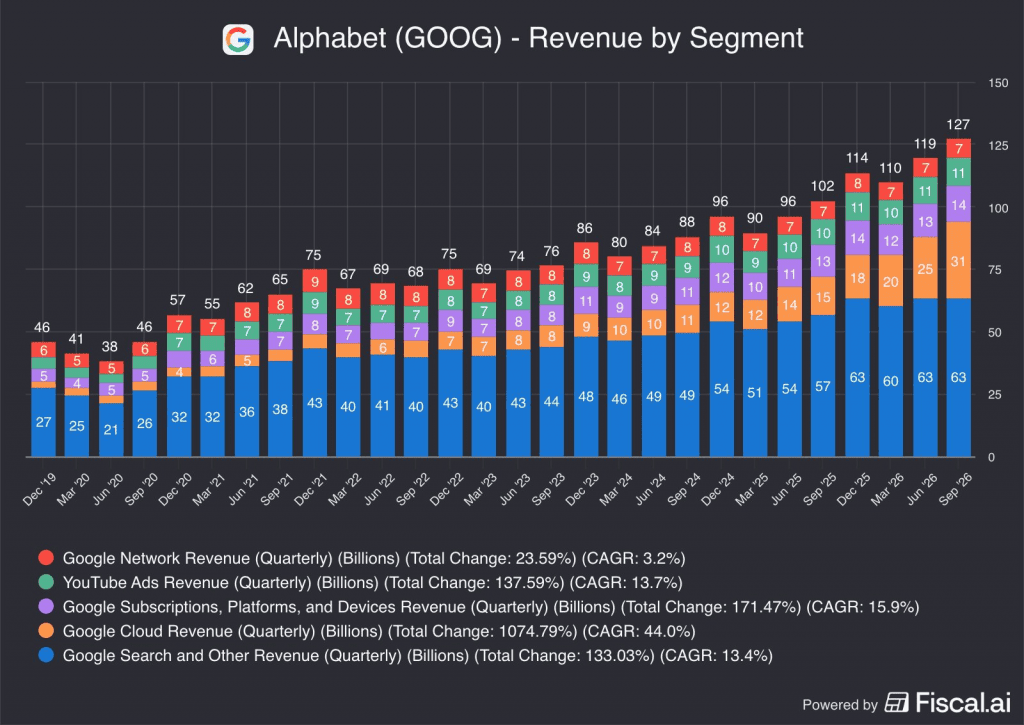
Alphabet’s results for the quarter ended September 30, 2026, show Google Search & Other revenue at $63.35 billion against total company revenue of $127.58 billion — 49.7% of the total. It’s a small number to cross, but a symbolically enormous one. This is the first time in Alphabet’s history as a public company that Search has fallen under the halfway mark.
How Google Got Here
The chart making the rounds, compiled from Alphabet’s own quarterly filings going back to late 2019, tells the story in five colored bands stacking up every quarter: Search, Google Network, YouTube ads, Subscriptions/Platforms/Devices, and Google Cloud.
Search is still the single largest band on the chart, and it’s still growing — up 12% year-over-year this quarter, with Pichai noting that query growth is at its highest rate in five years. The issue isn’t that Search is shrinking. It’s that everything stacked around it is growing faster.
Cloud is the one that changed the math. Google Cloud posted $30.7 billion in revenue this quarter, up a staggering 103% year-over-year — the segment’s strongest growth ever, driven by enterprise AI infrastructure demand and, for the first time, direct sales of Google’s TPU chips to outside customers. A year ago, Cloud was $15.2 billion. It has essentially doubled in four quarters. YouTube ads ($11.2 billion), subscriptions and devices ($14.3 billion), and the Google Network ($7.5 billion) each grew too, chipping away further at Search’s share of the pie.
Zoom out across the chart and the trend is unmistakable. In late 2019, Search made up roughly 59% of Alphabet’s revenue. By Q2 2026, that had slipped to 53%. One quarter later, it’s under half. The last three quarters alone — 55%, then 53%, then 50% — show just how fast the compression has happened.
The Bull Case: Google Doesn’t Need Search To Win Anymore
For a company that spent two years fielding “is Google dying” headlines, this is close to a dream outcome. Alphabet now has a second engine — Cloud — that’s compounding faster than Search ever did at this scale, plus a genuine subscriptions business (YouTube Premium, YouTube TV, Google One) that recently crossed 150 million paid subscribers. None of that existed in a meaningful way a decade ago.
This diversification happens to arrive at the exact moment Search faces its most serious existential threat since Google itself displaced Yahoo and AltaVista. ChatGPT, Perplexity, and Google’s own Gemini have pulled meaningfully ahead in AI chatbot traffic share over the past year, and independent studies have repeatedly found that AI Overviews and AI Mode depress click-through rates to the open web — in some measurements, by more than half. If search queries are increasingly being answered inside a chat window instead of a results page lined with ads, a company whose balance sheet no longer hinges on that page is in a far less precarious position than one that does.
Cloud’s 103% growth isn’t a fluke built on accounting games, either — it’s riding the same AI infrastructure boom that’s inflating valuations across the industry, with Google’s TPU chips now a credible alternative to Nvidia GPUs for training and inference. Alphabet has leaned hard into capital spending to make sure of it, pushing 2026 capex guidance up to $195–205 billion, part of a broader surge in AI infrastructure investment that has pulled the US’s share of global compute up to 78% in the first half of 2026. Google also holds one of the largest cash reserves of any company on earth, trailing only Berkshire Hathaway among non-Google companies by one recent count — Anthropic itself ranks third, with Google ahead of it. That war chest gives Alphabet room to keep funding Cloud’s infrastructure buildout, Waymo’s robotaxi expansion, and Gemini’s consumer push simultaneously, without Search having to carry all of it alone.
The Bear Case: Nothing Replaces Search’s Economics
The counterargument is that percentages can be misleading, and that losing share of the mix isn’t the same as losing the business that made Google, Google.
Search advertising remains the best business model ever invented in media. It converts intent directly into revenue at close to 80% gross margins, requires no inventory, no shipping, no customer service, and scales globally with almost no marginal cost per query. Cloud, by contrast, is a capital-intensive, infrastructure-heavy business that requires billions in continuous spending on data centers, chips, and power just to keep growing — its operating margin, while expanding, is still roughly half that of Search advertising. Google Cloud’s operating income this quarter was $11.1 billion on $30.7 billion in revenue; Search alone likely generated more profit on roughly double the revenue, at a fraction of the capital intensity.
There’s also a real question about how durable the “AI isn’t cannibalizing Search” narrative actually is. Pichai has repeatedly argued that AI Overviews and AI Mode are “expansionary” — that they drive more total queries rather than fewer clicks — and the query-growth numbers back him up for now. But outside data tells a less comfortable story: multiple industry studies have found that click-through rates on queries triggering AI Overviews have dropped by as much as 50-60%, and that AI Mode sessions end without a single external click more than 90% of the time. Publishers, who depend on that referral traffic for their own ad revenue, have been vocal about the damage. If that compression eventually shows up in Search’s own ad economics rather than just third-party sites, the segment that still throws off the overwhelming majority of Alphabet’s profit could face real margin pressure — something Cloud’s cheaper-margin growth can’t fully offset.
And Cloud’s blowout quarter comes with its own asterisk: a meaningful chunk of the 103% growth is now TPU hardware sales booked for the first time, a new and less-proven revenue line than subscription-based cloud consumption. Whether that growth rate is sustainable once the current AI infrastructure buildout matures — or whether it’s riding the same capex supercycle that has analysts worried about an AI spending bubble across the entire industry — is still an open question.
Where This Leaves Alphabet
The headline number is real and the underlying chart checks out against Alphabet’s own SEC filings. Search’s revenue hasn’t declined in absolute terms — it just stopped being the majority of a company that’s growing faster around it than within it.
That’s arguably the best-case scenario for Alphabet shareholders worried about AI disruption: rather than Search shrinking while Cloud grows to fill the gap defensively, both are growing, just at very different speeds. But it also means Alphabet is now, for the first time, a company whose largest single business isn’t its most profitable one by a mile — and whether that’s a sign of successful diversification or a hedge against a slow-motion threat to the core franchise will depend on what the next few quarters of click-through and margin data actually show.