There’s lots of information to be gleaned from how GPUs are being priced in markets around the world.
H100 spot prices have been falling and are now sitting at around $2.42 per hour, roughly 40% below the peak they hit in May. For many observers, that chart looks like a warning sign — a market cooling off, enthusiasm running out of steam.
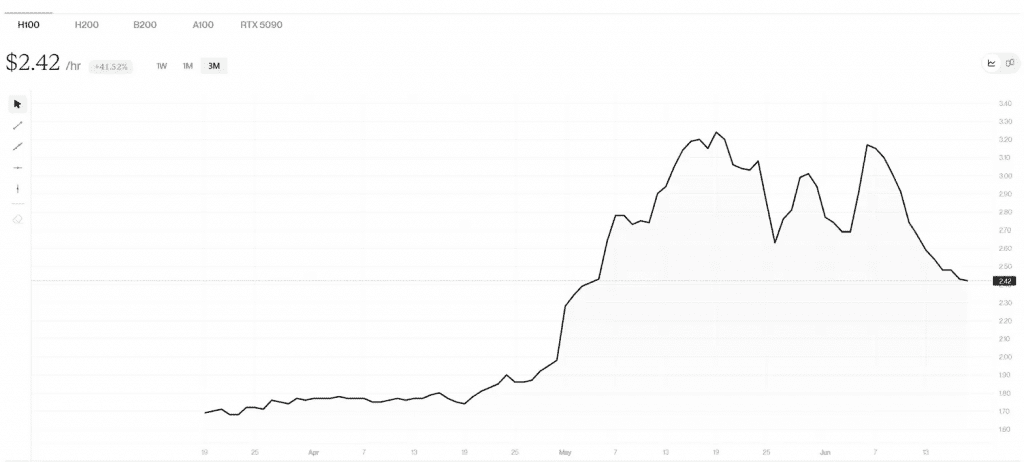
Research firm SemiAnalysis thinks that reading misses something important about how GPU markets actually work. The distinction they’re drawing is between spot pricing and contract pricing. Spot and on-demand markets are where companies run proof-of-concept evaluations, one-off experiments, burst workloads, and capacity overflow — the kind of flexible, short-term compute usage that doesn’t commit anyone to anything. Contract markets, where buyers sign 1-year or longer agreements, are where production workloads actually live: planned, recurring, revenue-bearing inference or training jobs that companies are willing to make long-term financial commitments to support.
Those two markets are telling very different stories right now. SemiAnalysis’s own neocloud survey of 1-year H100 contract prices shows them climbing from a trough of roughly $1.70 per hour in late 2024 to around $2.65 per hour today. This is the opposite of what’s happening in spot markets, and that divergence is the signal worth paying attention to.
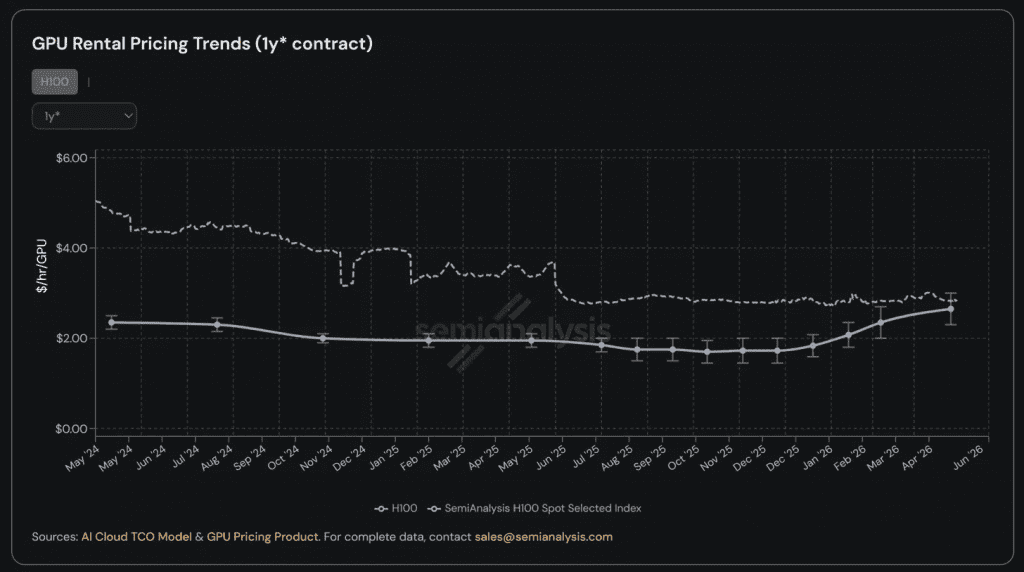
The interpretation SemiAnalysis offers is that serious buyers are moving out of the opportunistic spot market and locking in term capacity instead — which is what a company does when it’s running AI in production, not when it’s still figuring out whether AI is worth the investment. A business spinning up a chatbot POC buys spot. A business running customer-facing inference at scale signs a contract.
Falling spot prices under those conditions aren’t evidence that demand is weakening. They’re more consistent with a maturing market where the exploratory, experimental layer of demand is giving way to the kind of committed, production-scale deployment that shows up in contract pricing. The volatility in spot pricing is, in part, a reflection of how much of the early GPU land rush was driven by companies kicking tires rather than running real workloads.
This also fits with what’s been happening more broadly in the AI infrastructure space. GPU rental prices had more than doubled since January 2026 as the newest Blackwell-generation chips commanded increasingly steep rates, with demand from frontier model training and production inference both growing. The overbuilding narrative that circulated earlier in 2025 — partly fueled by DeepSeek’s efficiency claims — looks harder to sustain when the contract market is moving in the direction it is.
SemiAnalysis tracks these dynamics in their GPU pricing index and argues it’s the contract market, not the spot index, that reflects where durable AI workloads are actually going. For anyone trying to read the health of the AI compute market from a single price chart, that’s a useful corrective.