SemiAnalysis has reportedly slashed its AI accelerator forecasts, cutting its 2028 spending estimate by 28% and its 2029 estimate by 41%, with NVIDIA bearing most of the damage. The revision, which follows a slowdown in revenue growth at frontier AI labs and tighter financing for data centers, comes as some on Wall Street are still projecting trillions in AI infrastructure capex.
The update to the firm’s Accelerator & HBM Model is dated November 13 and is credited to analysts Myron Xie and Ivan Chiam. The model itself is sold to institutional subscribers only, and no public version of the note exists, so the figures below come from summaries shared on X. SemiAnalysis hasn’t publicly confirmed them.
The numbers
“Accelerator spend” here means unit shipments multiplied by average selling price, or what buyers pay chip vendors. According to the summaries, 2028 spending is cut by 28%, from about $1.054 trillion to $758 billion. The 2027 estimate falls 19% to $627 billion, and the 2029 estimate falls 41% to $796 billion, the steepest reduction of any year. The 2030 figure is cut by about 40%, though spending is still expected to top $900 billion. Across 2027 to 2030, the cumulative reduction comes to roughly $1.6 trillion.
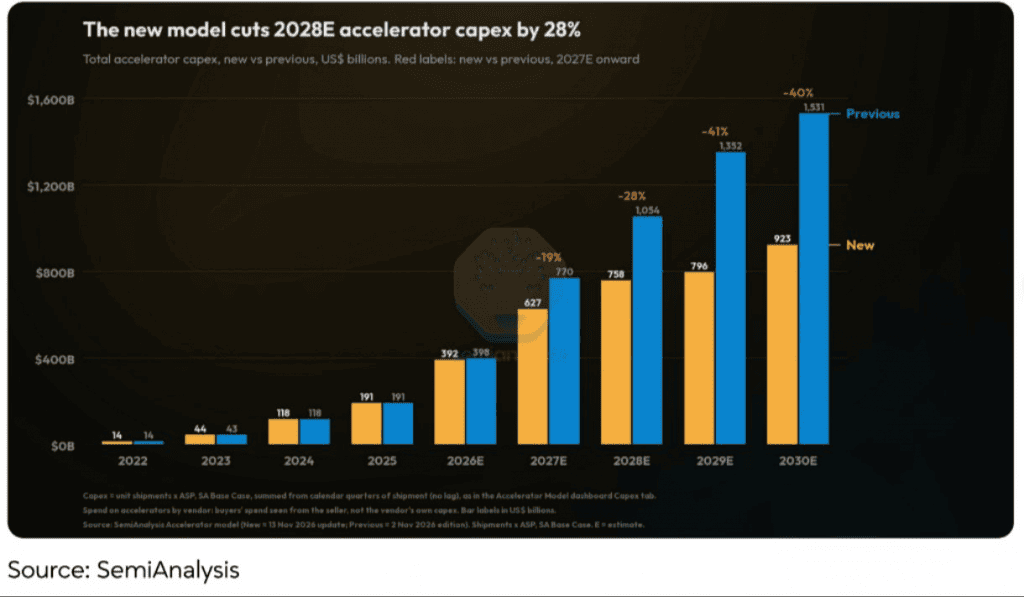
Growth hasn’t vanished, but the curve has flattened. The updated model has spending rising 60% in 2027 from $392 billion in 2026, then 21% in 2028, just 5% in 2029 and 16% in 2030. The previous model had growth of 37% in 2028 and 28% in 2029. 2026 estimates are essentially unchanged.
Why SemiAnalysis is cutting
Summaries list three reasons, with the first two weighted more heavily. The first is slower lab revenue growth: net new annualized recurring revenue at frontier AI labs decelerated in Q3 2026, so SemiAnalysis trimmed the compute additions that revenue can realistically support. It says it remains more bullish than consensus on lab monetization, but argues that average market expectations decide whether infrastructure gets financed.
The second is tighter financing. Debt and equity investors have become more cautious, particularly on projects without hyperscaler offtake agreements, which has slowed land, power and shell buildouts.
The third is midterm fallout. The election result delayed about 5.8 GW of US data center capacity that had been due online in the second half of 2027 and first half of 2028, with regulatory delays pushing 2028 capacity down further. SemiAnalysis treats this as an added headwind rather than the main driver.
The timing is notable. A Bernstein tracker published a day earlier put consensus 2028 capex at around $1.6 trillion and said its accelerator forecasts predated the election. Note that capex and accelerator spend aren’t the same measure, but the gap shows how far SemiAnalysis now sits from pre-election sell-side numbers. Earlier this month, the Nasdaq fell more than 5% in a selloff that hit memory and chip stocks hardest.