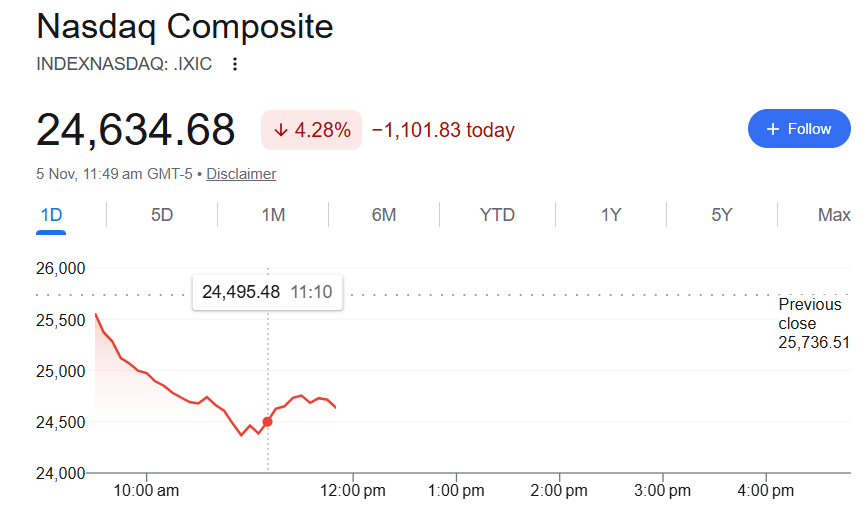
Tech and AI stocks were hammered on Wall Street on Thursday, with the Nasdaq Composite falling more than 5% in a session that wiped out the post-election relief rally from a day earlier. The slide extends a rout that had already pushed the Nasdaq 100 into correction territory earlier this week.
How Bad Is The Fall?
The losses deepened as the day went on. The Nasdaq was down about 3% in morning trading in New York before the selling widened to more than 5%, according to intraday figures. The S&P 500 was down roughly 3.5% and the Dow Jones Industrial Average was off by around 1,300 points. The Philadelphia Semiconductor Index fell about 7% in early trading. These are intraday readings and could change by the close.
It is a sharp reversal from Wednesday, when the Dow gained about 3% and the Nasdaq rose around 1.4% after the midterm results. It also comes on top of a brutal stretch for tech: the Nasdaq 100 entered a 10% correction on November 2, closing 10.4% below its October record, and tech stocks lost more than $1 trillion in value in a single session last Friday.
The Biggest Losers
Memory, AI cloud and chip stocks took the worst of it. Nebius fell more than 17%, while Micron and AMD were each down over 15%. CoreWeave lost over 14%. Reports also showed Sandisk down more than 20% intraday, with Astera Labs, Western Digital, Seagate and Lumentum all sliding by 16% or more.
| Stock | Price | Change |
|---|---|---|
| Nebius (NBIS) | $116.57 | -17.63% |
| Micron (MU) | $672.86 | -15.39% |
| AMD | $413.75 | -15.35% |
| CoreWeave (CRWV) | $41.50 | -14.30% |
| SoftBank (SFTBY) | $11.46 | -12.18% |
| Tesla (TSLA) | $344.16 | -10.65% |
| SpaceX (SPCX) | $121.94 | -10.29% |
| Broadcom (AVGO) | $297.04 | -8.74% |
| Oracle (ORCL) | $113.25 | -8.47% |
| ASML | $1,371.48 | -8.34% |
| Nvidia (NVDA) | $183.78 | -8.17% |
| Intel (INTC) | $53.70 | -7.84% |
| Meta (META) | $593.95 | -5.72% |
| Microsoft (MSFT) | $536.66 | -3.44% |
| Alphabet (GOOG) | $278.88 | -2.93% |
Prices and percentage moves as of intraday trading on November 5.
Nvidia, the poster child of the AI boom, fell more than 8%. SpaceX, which went public in June at $135 a share, is now trading about 10% below its IPO price. Even the biggest names weren’t spared, though Microsoft and Alphabet held up better than the rest.
Why Are Tech And AI Stocks Crashing?
There isn’t one trigger. Several worries hit at the same time.
Political risk for AI datacenters. Democrats swept to control of both the House and the Senate on Tuesday, and datacenters were an issue on ballots across the country, from local bans in Ohio to a Texas governor’s race fought partly over a moratorium. Datacenter-linked stocks had already slipped in overnight trading, with CoreWeave, Oracle and SpaceX among those falling, on fears that state-level restrictions could slow buildouts in key markets. Nothing has actually been enacted yet, and a federal moratorium remains a long shot, but investors are clearly pricing in a higher political cost for building AI infrastructure.
Doubts that AI spending will pay off. The October selloff was driven by questions over whether hundreds of billions of dollars in data center and chip spending will generate enough profit. That anxiety is now showing up in company decisions: Microsoft has offered buyouts to around 60,000 employees as it funds its AI infrastructure bets, and Google has expanded its own voluntary exit program to more countries while its heavy AI capital spending weighs on the stock. The economics of serving AI products are also under scrutiny, with Elon Musk admitting this week that the cost of serving Grok Bot is unsustainably high relative to revenue. Meanwhile, the commitments keep growing: Anthropic alone has disclosed $895 billion in compute commitments.
A weak Qualcomm report and the memory crunch. Qualcomm’s handset revenue fell 26% year-on-year to about $5.14 billion, below analyst estimates of $5.25 billion, with the company partly blaming memory-related dynamics hitting the smartphone market. That landed on a sector that has been the hottest trade of the year. Memory makers have ridden an AI-driven shortage that sent SK Hynix and Micron into the $1 trillion club, which also explains why memory stocks are now falling the hardest. The shortage has been a talking point all week, thanks to the backlash over Sam Altman’s comments on RAM.
Intel’s collapse as a warning sign. Intel fell 28.6% on October 30, its worst day since the 1970s, after guiding fourth-quarter revenue to $15 billion to $16 billion, well short of the roughly $17.1 billion analysts expected. It did so despite beating third-quarter estimates. The stock, which closed at $92.07 before the results, now trades around $54, down more than 40%. The episode showed how little room for error there is after a massive run-up.
A valuation reset. Good results are no longer enough. Several companies, including SiTime, MACOM and Coherent, fell on Thursday despite reporting better-than-expected numbers, a sign that investors are cutting exposure to anything tied to AI infrastructure, regardless of fundamentals.
What To Watch Next
The selloff does not mean the AI buildout is stopping. The labs and cloud companies have committed enormous sums, and demand for compute remains strong. But the mood has shifted from rewarding every dollar of spending to demanding proof that it pays off, and politics has now entered the equation. Investors will be watching how state governments respond on datacenter permitting, whether the Nasdaq holds its key technical levels, and what the next round of earnings says about returns on AI investment.