Chinese AI models are rapidly becoming the model of choice of many users, and this is being borne out in usage data.
A Bloomberg chart using OpenRouter and Exponential View data tells the story with unusual clarity. In June 2025, US models — Google, OpenAI, and Anthropic combined — held around 70% of token share on OpenRouter. By June 2026, that figure had fallen to roughly 30%. Chinese models from DeepSeek, Tencent, Xiaomi, and Minimax now account for the majority of tokens processed on the platform.
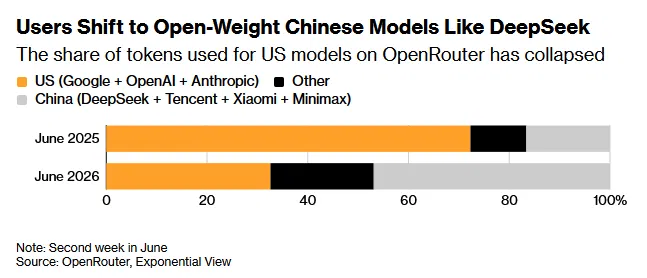
OpenRouter is one of the cleaner signals available for understanding real AI adoption. It’s a neutral marketplace where developers and enterprises route traffic across dozens of models with no vendor lock-in, which means the token volumes it generates reflect actual production usage rather than marketing claims or benchmark performance. When the share of tokens processed by US models drops by more than half in twelve months, that’s a structural shift.
The trajectory has been building for a while. DeepSeek’s R1 release in early 2025 was the inflection point — a model that matched OpenAI’s top offerings on reasoning benchmarks at a fraction of the training cost. That release didn’t just generate press coverage; it changed how developers thought about their defaults. Usage spikes following major Chinese model releases — DeepSeek V3, R1, Kimi K2, Qwen 3 Coder — weren’t short-lived experiments. The adoption stuck, which is what you see when models get wired into production pipelines rather than tested and discarded.
The June 2026 OpenRouter leaderboard reflects exactly that. DeepSeek V4 Flash leads all models by token volume, followed by Tencent’s Hy3 Preview. Chinese open-source models occupy six of the top ten spots, and the two at the very top saw close to 1,000% growth in a single month. DeepSeek alone commands 16.3% of all token volume on OpenRouter — more than any other single provider, ahead of Google, Anthropic, and OpenAI.
The cost argument is central to how this happened. Chinese models, particularly the open-weight ones, are substantially cheaper to run than their US counterparts. Tencent’s Hy3 Preview, for instance, is priced at $0.063 per million input tokens. For developers building at scale, that differential compounds quickly. When a capable open-weight model costs a fraction of a proprietary API call and performs adequately for the workload at hand, the switching logic becomes straightforward.
Anthropic has pushed back on the quality framing. Dario Amodei has argued that Chinese models are optimized for benchmarks and distilled from US labs, and that raw capability — not price — determines long-term adoption. That position has more credibility coming from a lab whose models are the exception in the current data: Claude Opus 4.7 holds the third spot on the OpenRouter leaderboard, the highest-ranked closed-source model, and the Claude family’s usage has proven durable across multiple cycles of Chinese model releases. But for the broader category of US models, the numbers don’t support Amodei’s optimism.
What the OpenRouter data captures is a shift in developer defaults. The market that formed around GPT-4 as the unambiguous choice for every serious AI application no longer exists in that form. OpenAI now sits fourth on the platform by company token volume, trailing DeepSeek by a significant margin. Combined Chinese providers — DeepSeek, Xiaomi, Tencent, MiniMax, Qwen — account for roughly 44% of token volume across the top 10. That concentration reflects choices made by developers worldwide, not just in China.
The trend is also showing up in enterprise spend data. Ramp’s June 2026 trending products report shows DeepSeek leading the foundational LLMs category — not just talked about, but paid for by real businesses routing workloads to its API. That’s meaningful because enterprise adoption tends to be sticky. When a team builds infrastructure around a model and the switching costs accumulate, they don’t necessarily come back to a more expensive alternative even when it improves.
The OpenRouter data from the past year is as direct a signal as the industry has produced. Token share tells you where developers are actually sending their traffic, and over the past twelve months, they’ve been sending significantly less of it to US models.