A chart doing the rounds this week, put together by economist and Wall Street veteran Steve Rattner and drawing on Financial Times reporting, makes a fairly stunning point: three companies — SpaceX, Anthropic and OpenAI — could soon IPO at a value more than that of every single US tech IPO of the last 45 years put together.
The numbers behind the chart are straightforward but jarring. SpaceX is valued at $2 trillion, based on its first-trade value when it went public in June. Anthropic is expected to be valued at $2 trillion when it lists later this year. And OpenAI, still private, is reportedly in talks for a valuation of $1.2 trillion. Add them up, and you get $5.2 trillion.
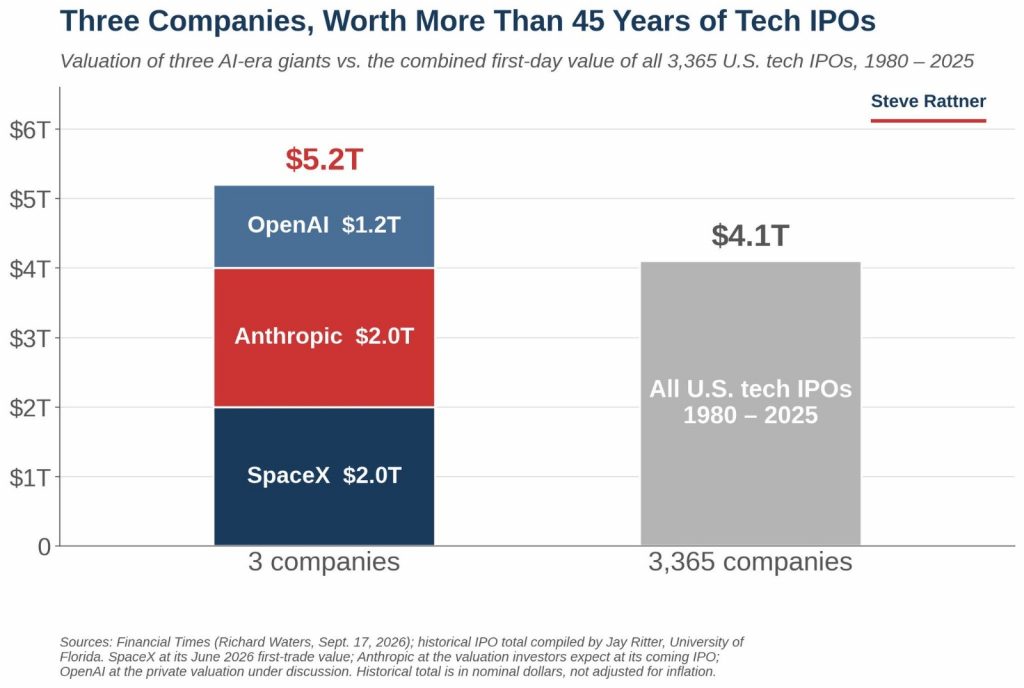
That figure is bigger than the $4.1 trillion combined first-day value of all 3,365 US tech companies that went public between 1980 and 2025 — a dataset compiled by Jay Ritter, a professor at the University of Florida’s Warrington College of Business who has tracked IPO activity for decades. In other words, three companies from the current AI boom are now worth more on paper than every tech IPO since 1980, from Apple and Microsoft to Google, Amazon and Meta, combined on their debut days.
SpaceX Already Made It Official
Of the three, SpaceX is the only one that’s actually gone public. Elon Musk’s company listed on the Nasdaq in June, pricing shares at $135 and closing its first day up 19% at $160.95 — a debut valuation north of $2 trillion that made it the largest IPO in history and made Musk himself the world’s first trillionaire. SpaceX hasn’t stood still since. Barely a week after listing, it used its newly-public stock to acquire the AI coding startup Cursor for $60 billion, a deal that pushed its market cap past $2.5 trillion.
Anthropic Is Racing Toward Its Own Listing
Anthropic is next in line. The Claude maker closed a $65 billion Series H round in May that valued it at $965 billion, and it’s now said to be targeting an IPO as early as October at roughly double that figure — a $2 trillion valuation that’s been cited in unrelated contexts too, including a music-industry lawsuit that pointed to the number to argue Anthropic could easily absorb a bigger copyright settlement than it’s currently facing. Not everyone is convinced the number holds up under public-market scrutiny; Anthropic’s valuation has been questioned as resting heavily on enterprise API revenue in a segment where buyers benchmark aggressively and switch providers when a cheaper alternative is good enough.
OpenAI’s Number Comes With An Asterisk
OpenAI is the odd one out on the chart, and it’s worth being precise about why. The $1.2 trillion figure reflects a private valuation under discussion, not a live IPO. In fact, Sam Altman has explicitly ruled out going public in 2026, telling Fortune that launching an IPO right now would be “ill-advised” given the current climate around AI safety, and that OpenAI will list only once the business — and society — is ready. That pushes any actual OpenAI debut into 2027 or later, even as its private-market price tag keeps climbing from the $852 billion it was marked at earlier this year.
Why The Comparison Still Matters
There’s an obvious caveat buried in all this: comparing SpaceX’s realized IPO valuation with Anthropic’s still-hypothetical listing price and OpenAI’s private-market chatter isn’t quite apples to apples. Two of the three companies haven’t actually sold shares to the public yet, and one of them has just said it won’t for at least another year. But even stripping out the imprecision, the scale is hard to argue with. These are three companies that didn’t exist in anything like their current form a decade ago, sitting on paper valuations that dwarf the combined debut-day value of every tech company — profitable or not, hyped or overlooked — that has gone public in the US since 1980.
It also fits a broader pattern in this AI cycle: the number of trillion-dollar companies in the world has gone from zero in 2017 to 17 today, and AI infrastructure — chips, compute, and now the labs themselves — is the single biggest reason why. Whether that concentration of value in a handful of companies is a sign of durable transformation or a very expensive bet on the future is still an open question. Anthropic’s October listing, if it happens on schedule, will be the next real test of whether public markets agree with the private ones.