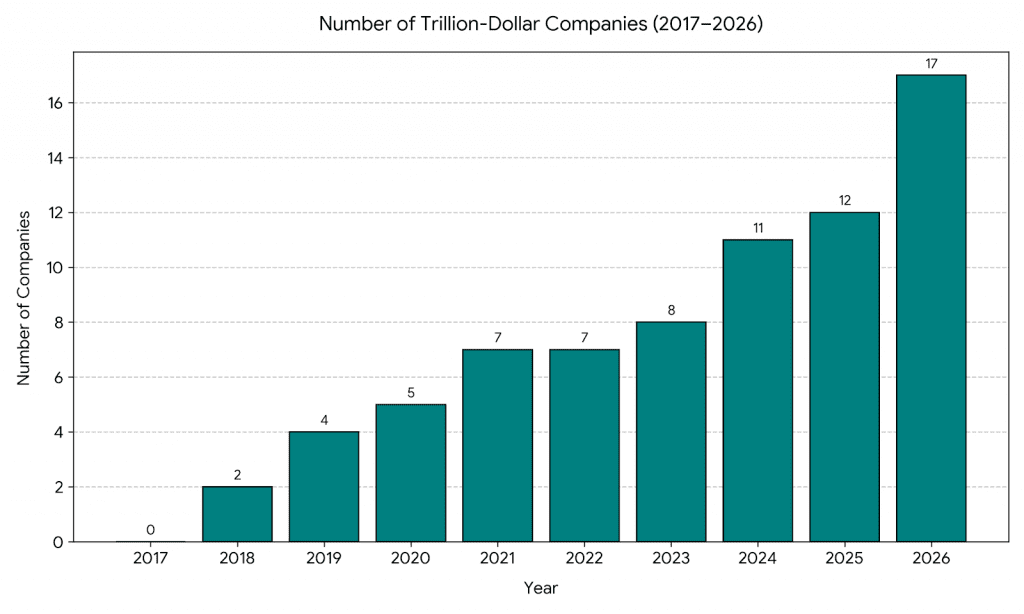
Nine years ago, there wasn’t a single company in the world worth a trillion dollars. Today there are 17.
That’s one of the more startling data points of the current era — not because any one company crossed the threshold, but because so many did, so quickly, and across so many sectors at once.
How the Club Grew
The first trillion-dollar companies arrived in 2018, when Apple and then Amazon crossed the mark within weeks of each other. The number climbed steadily from there: five companies by 2020, seven by 2021 and 2022, eight by 2023, eleven by 2024, twelve by 2025, and then a jump to 17 in 2026. Each year brought new entrants, but 2026 has been the most dramatic — five new names joined the club in a single year, and several of them were not obvious candidates even twelve months ago.
The original members of the trillion-dollar club — Apple, Microsoft, Amazon, Alphabet, and Saudi Aramco — were relatively predictable. Platform businesses with enormous moats, recurring revenue, and decades of compounding. What’s changed in 2026 is the profile of new entrants. They’re more varied, more recent, and in some cases, more surprising.
AI Is the Engine
Look at the 2026 list and the pattern is hard to miss: NVIDIA, Meta, Broadcom, TSMC, Micron, SK Hynix, and SpaceX have all either reached or significantly reinforced their trillion-dollar valuations on the back of the AI infrastructure boom. The hyperscalers — Amazon, Google, Microsoft, Meta — are collectively projected to spend roughly $715 billion on AI infrastructure in 2026 alone, and every dollar of that spend ripples outward through the semiconductor supply chain.
NVIDIA was the clearest beneficiary, having built what amounts to a near-monopoly on the GPUs that train and run AI models. But the AI boom has proven generous enough to lift the entire chip ecosystem. TSMC, the Taiwanese contract manufacturer that makes chips for Apple, NVIDIA, AMD, and essentially everyone else, crossed the trillion mark as demand for leading-edge fabrication capacity far outstripped supply. Broadcom, best known for networking and infrastructure chips, got there as data center buildouts created insatiable demand for connectivity hardware.
Then came the memory chip story. SK Hynix and Micron — companies that spent decades grinding through brutal commodity cycles — suddenly found themselves sitting on some of the most irreplaceable technology in the AI stack. High-bandwidth memory, or HBM, is required in large quantities in every AI accelerator, and the three companies that make it (Samsung, SK Hynix, Micron) have diverted so much capacity toward AI customers that they’ve essentially sold out their entire production through 2026. SK Hynix shares rose more than 200% year-to-date in 2026; Micron gained roughly 245%. Both crossed $1 trillion. Samsung, already a member of the club, stayed there comfortably.
SpaceX Changes the Math
The most dramatic individual story of 2026 belongs to SpaceX. When it went public in what became the largest IPO in history — raising $75 billion and surpassing Saudi Aramco’s 2019 offering — it immediately landed among the most valuable companies on the planet. Its market cap crossed $2.5 trillion within days of listing, which also made Elon Musk the world’s first trillionaire. SpaceX’s path to trillion-dollar status was arguably the least conventional of any company on the list: a private rocket company, founded in 2002 with the stated goal of reaching Mars, had become a $2.5 trillion publicly traded aerospace and AI entity.
The Older Guard Holds
Five of the 17 — Apple, Microsoft, Alphabet, Saudi Aramco, and Amazon — have been in the trillion-dollar club long enough that their membership feels unremarkable at this point. Apple, which started with Steve Wozniak selling his HP calculator and Steve Jobs selling his van to raise a few hundred dollars, now sits at around $3.77 trillion. Microsoft and Alphabet have remained fixtures at or above $2 trillion for the better part of three years.
Meta’s inclusion reflects a story of remarkable reinvention. The company was left for dead by many analysts in 2022 after a disastrous bet on the metaverse and a brutal year for its stock. It returned, aggressively, by refocusing on AI-driven advertising, cutting costs, and outcompeting rivals on inference efficiency. Berkshire Hathaway’s presence on the list is quieter — the product of six decades of Warren Buffett’s compounding, delivered through insurance, railroads, energy, and consumer brands.
Walmart and Eli Lilly round out the list in ways that say something about where value is being created. Walmart has used its physical infrastructure and logistics scale to resist the pressures that have gutted most traditional retail, while leaning into AI for inventory and operations. Eli Lilly’s valuation is almost entirely driven by GLP-1 drugs, where demand has so dramatically outpaced supply that the company’s revenue trajectory has reshaped how the market thinks about pharmaceutical companies.
What It Means
The composition of the 17 companies tells a story about what the world currently values, and it’s a narrower story than the diversity of names suggests. Roughly 10 of the 17 have significant revenue or valuation exposure to AI infrastructure, AI software, or AI-adjacent hardware. The others — Berkshire, Walmart, Saudi Aramco, Eli Lilly — are outliers from sectors that happen to have defensive or demand-driven moats.
That concentration creates a question worth sitting with. Ashwath Damodaran, NYU’s valuation authority, has warned that the AI buildout resembles the biggest infrastructure run-up he’s ever seen, and that the pain of any correction would be more intense than the dot-com bust, precisely because of how much real capital has been deployed. Goldman Sachs estimates hyperscaler capex from 2025 through 2027 at $1.15 trillion. That money is real. The question of whether the revenue will be proportionate remains open.
For now, 17 companies are worth a trillion dollars or more, and the number keeps growing. Whether the list looks the same in 2027 will depend on whether AI infrastructure spending produces the returns investors are currently pricing in. The growth of the trillion-dollar club over the past nine years is extraordinary by any historical measure. The pace at which it happens from here is the more interesting question.