A morning of X banter between rival AI labs has ended on the one topic OpenAI can’t easily laugh off.
A spat between a SpaceXAI employee and OpenAI’s Tibo Sottiaux started out as playful trolling over rival AI agents. By the end, it had landed on something far more consequential than a name: who actually has the computing power to run their ambitions.

How the exchange unfolded

It began on Tuesday morning when lauren (@poteto), a SpaceXAI employee, addressed Grok Bot directly. “Hey @bot help me think of some bangers to post about the temu knockoff of you,” she wrote, a reference to OpenAI’s newly launched always-on agents, which the company calls Dots. The post pulled in more than 1,400 likes and 142,000 views.
Sottiaux, who leads Codex and ChatGPT Work at OpenAI, replied with four words: “I smell fear.”
Lauren came back with a baby-meme GIF captioned “son” and a pointed question: “How did you know I was referring to dots.”
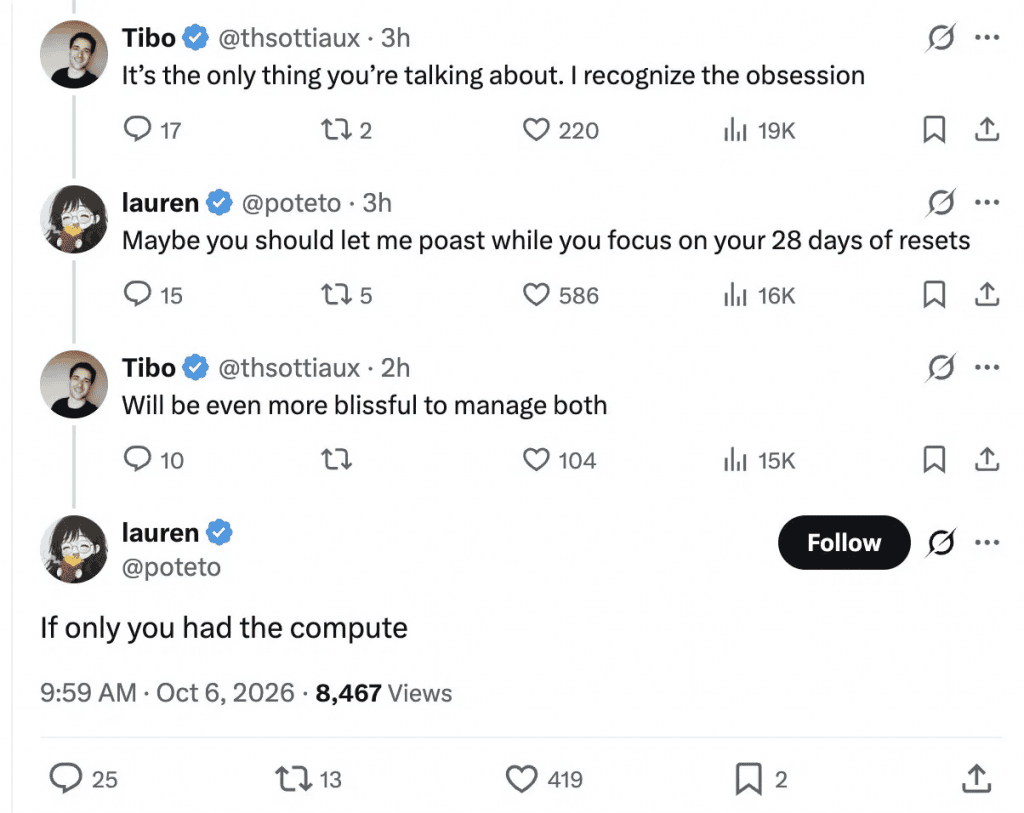
Sottiaux didn’t let it go. “It’s the only thing you’re talking about. I recognize the obsession,” he wrote.
Lauren’s reply shifted the target. “Maybe you should let me poast while you focus on your 28 days of resets,” she said, referring to Sottiaux’s regular resets to its Codex plans.
Sottiaux stayed light: “Will be even more blissful to manage both.”
Then came the closer. Lauren posted: “If only you had the compute.” This time Tibo didn’t respond.
The tweet had picked up more than 8,000 views and 400-plus likes shortly after it went up.
Why the compute jab lands
Dots and Grok Bot are close cousins. Both are persistent agents that get their own cloud computer and work on tasks while the user is away, and SpaceXAI got to market first, launching Grok Bot on August 11. The two products have been tangled together since OpenAI’s DevDay, when it emerged that the dot.com domain redirects to Grok Bot.
But the last line of the exchange wasn’t about branding. It was about the resource that increasingly decides what AI companies can ship, and who is able to keep shipping it.
SpaceXAI owns its compute. Elon Musk said last month that Colossus 1 runs 150,000 H100s, 50,000 H200s and 30,000 GB200s, while Colossus 2 holds 110,000 GB200s and 440,000 GB300s. He added that another 220,000 GB300s should come online in the coming weeks, with more waves planned through December that could take the total to roughly 1.44 million GPUs if things go well. SpaceXAI has even had spare capacity to rent out: Anthropic took all of Colossus 1, and Google and Reflection AI have signed compute deals of their own.
OpenAI, by contrast, still leans heavily on other people’s data centers. It rents capacity from Oracle (a deal reportedly worth about $300 billion over five years), Microsoft’s Azure, CoreWeave and Google. Earlier this year, the Financial Times reported that OpenAI had in practice sidelined building first-party data centers and now prefers to lease, with the company itself describing Stargate as an “umbrella for our compute strategy.” Microsoft ended up taking over a 900 MW Abilene site that Oracle and OpenAI walked away from.
OpenAI has the money to keep buying capacity. The company has raised $110 billion at a $730 billion valuation, framing the round around compute, distribution and capital. But renting is not the same as owning, and leasing means it has to fit its ambitions into whatever capacity it can contract for, at someone else’s pace.
OpenAI’s compute crunch
OpenAI executives have been open about the strain. Greg Brockman has said the company has big internal fights over compute because there are more things it wants to launch than it can support, and that the pain of allocating it keeps growing.
The consequences have been visible in OpenAI’s products, starting with its $200 plan. After demand for GPT-6 Astra overwhelmed its capacity, OpenAI paused new Pro $200 sign-ups on September 10. It reopened the plan on September 30 with roughly half the previous usage. From October 30, existing subscribers will also see included Codex and Work usage fall from 20x to 10x the Plus allowance, and weekly GPT-6 Pro messages drop from 200 to 100. A new $500 tier, at 25x Plus with a faster “Ultrafast” mode, now sits above it. Sottiaux has argued that more efficient models will let users get more done despite the lower allowance, but many developers weren’t convinced.
Sora was another casualty. OpenAI announced it was discontinuing the video app in March, wound down the web and mobile apps in April, and retired the API on September 24. The product was reportedly costing around $1 million a day in compute, and its closure killed a planned $1 billion deal with Disney.
Compute as the differentiator
For much of the AI race, the differences between frontier labs have come down to model quality, and those gaps have narrowed and flipped repeatedly. Compute is a harder advantage to copy. A lab with enough of it can train more experiments in parallel, serve more users without throttling, and give subscribers generous limits without wincing at the bill. A lab without enough has to ration: raise prices, cut allowances, and shelve products that don’t earn their keep.
That’s why the “compute” jab stings more than the “Temu knockoff” line that started it. A product name can be changed. A shortfall in capacity can only be closed by building or buying more of it, and OpenAI is doing both, at enormous cost. SpaceXAI is clearly betting that owning its infrastructure outright will pay off.