For about a hundred years, physics has run on two rulebooks that don’t agree with each other. Quantum mechanics describes the very small: atoms, electrons, light. Einstein’s general relativity describes the very large: planets, galaxies, black holes, and the bending of space and time itself. Each works astonishingly well in its own domain. But try to combine them, to describe what gravity does at the quantum level, and the maths breaks down. Calculations that should give sensible numbers return infinity.
Fixing this, building a working theory of “quantum gravity,” is widely considered the biggest open problem in fundamental physics. Sam Altman has gone as far as suggesting that AI will compress decades of theoretical physics progress into a couple of years, and quantum gravity has often been floated as the ultimate test of that claim.
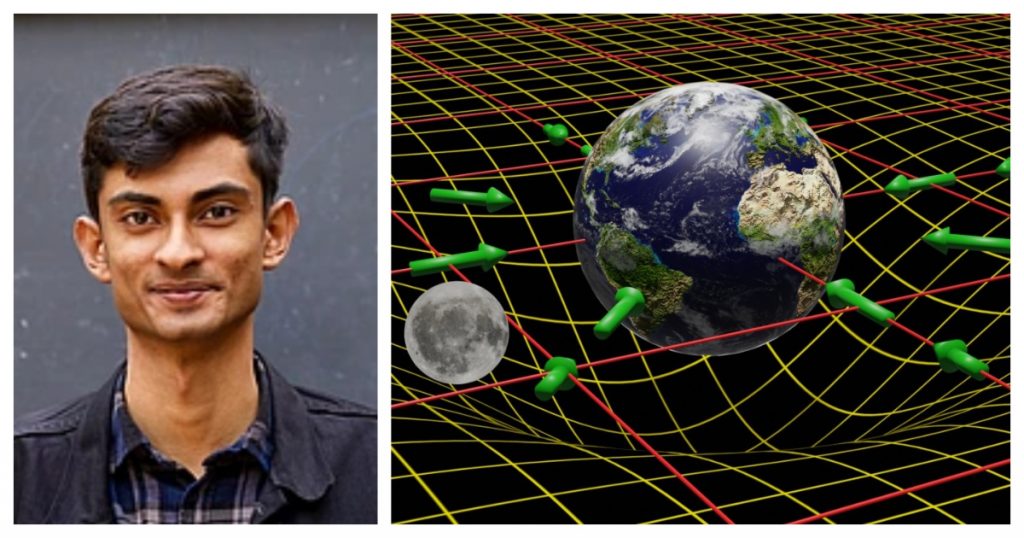
A paper posted to arXiv this week makes a serious attempt at it. In “An algebraic quantization of gravity from the null cone”, Venkatesa Chandrasekaran of Stanford’s Leinweber Institute for Theoretical Physics proposes a complete, mathematically controlled quantum theory of gravity in our four-dimensional universe. Several of the paper’s calculations and proofs were worked out in what the author describes as months of back-and-forth collaboration with OpenAI’s GPT-6 Astra, consuming roughly 400 million tokens.
Why quantum gravity is so hard
To understand the paper, it helps to know why previous attempts have struggled.
The infinity problem. The standard way physicists quantize a force is to start with a fixed, smooth background and study small ripples on top of it. For gravity, those ripples are gravitons, the hypothetical quantum particles of gravity. The trouble is that when you calculate how gravitons interact, the corrections keep producing infinities that can’t be cancelled out. Physicists call the theory “non-renormalizable,” which is a polite way of saying it falls apart at high energies.
The background problem. In general relativity, space and time aren’t a fixed stage; they’re part of the play. Gravity is the shape of spacetime. So a true quantum theory of gravity can’t assume a fixed background to begin with. Everything, including the geometry, has to be allowed to fluctuate. Physicists call this “background independence,” and it makes even basic questions like “where is this particle?” tricky, because there’s no fixed grid to measure against.
The main existing approaches each handle part of this. String theory removes the infinities by replacing point particles with tiny strings, but it doesn’t fully define itself beyond approximations. Loop quantum gravity is background independent but has trouble showing that ordinary Einstein gravity re-emerges at everyday scales. The AdS/CFT correspondence (often called holography) gives a precise quantum description of gravity, but only for a kind of universe that is curved differently from ours.
The new idea: build gravity out of light cones
Chandrasekaran’s approach starts from a different place: the light cone.
Picture a flash of light going off at one point in space. The light spreads outward as an expanding sphere, and if you draw that sphere’s growth over time, it traces out a cone. Physicists call this a “null cone.” It marks the boundary of everything that event can influence.
Now take two events, one earlier and one later. The light cone spreading forward from the earlier event and the light cone converging backward onto the later event intersect, enclosing a region shaped like a diamond. This “causal diamond” is the patch of spacetime that the two events can jointly see and affect.
The paper’s central move is to describe all the gravity inside such a diamond using only information recorded on its light-cone boundary. That turns out to be possible because light cones are special: the equations of general relativity, which are normally a tangle of constraints, become much easier to solve on them. Once solved, what’s left is a clean list of the independent “dials” that describe the gravitational field, including gravitational waves passing through.
Then comes the quantum part. The author takes those dials and applies the standard recipe for turning a classical theory into a quantum one, the same basic procedure used for quantum mechanics a century ago. Crucially, this is done without first assuming a fixed background, and without expanding in small powers of Newton’s gravitational constant (the step that usually triggers the infinities).
To keep track of where things are when spacetime itself is fluctuating, the theory anchors measurements to a reference frame built from gravity itself at the corner where the two light cones meet. There’s even a “gravitational clock”: how far light has travelled along the cone serves as a measure of time that comes from the geometry rather than being imposed from outside.
Finally, diamonds can be glued together. Stitching many of them along their shared boundaries builds up larger regions of spacetime, and summing over all the quantum possibilities at each seam produces what physicists call a path integral, the master formula for calculating probabilities in quantum theory.
What the paper claims to show
If the framework holds up, the results are striking.
The infinities go away. Each sum in the gluing process is shown to converge, which means it adds up to a finite number. As a concrete test, the paper calculates the probability for a pair of gravitons to pop into existence on a light cone and then vanish again. Done the traditional way, by first expanding in small powers of the gravitational constant, this gives an infinite (logarithmically divergent) answer. Done in the new framework, without that expansion, it yields a finite, exact formula. That is a vivid illustration of the long-held suspicion that gravity’s infinities come from the approximation method rather than from nature itself.
A finite region holds a finite amount of information. The paper argues that a macroscopic causal diamond of a given maximum size has only a finite number of distinct quantum states. In everyday terms: a bounded piece of the universe can only store so much information. This lines up with one of the deepest ideas in modern physics, the “holographic principle,” which suggests that the information content of a region is limited by the area of its boundary rather than its volume. One consequence the paper draws is that area itself comes in discrete steps at the quantum level, rather than varying smoothly.
It reproduces black hole entropy. In the 1970s, Jacob Bekenstein and Stephen Hawking showed that black holes have entropy, a measure of hidden information, proportional to the area of their event horizon. Any serious quantum gravity theory is expected to explain where that entropy comes from. The new framework recovers the Bekenstein-Hawking formula directly by counting the quantum states inside the relevant light-cone surfaces.
It goes further, computing the next, smaller correction to black hole entropy for large Schwarzschild black holes (the simplest, non-rotating kind). That correction had previously been calculated by Indian string theorist Ashoke Sen using a quite different mathematical technique based on “imaginary time” (known as Euclidean methods). The new paper gets the same coefficient using real-time, Lorentzian calculations. When two very different routes land on the same number, that is a meaningful consistency check.
Einstein comes back. Any quantum theory of gravity has to reduce to ordinary general relativity at everyday scales. The paper’s final section derives Einstein’s equations, along with the first layer of quantum corrections, as the low-energy limit of the theory.
The paper also touches on the speculative “ER = EPR” idea, which links wormholes to quantum entanglement, showing that a state prepared on a single connected slice of space can be represented as an entangled state on two disconnected pieces.
The AI angle
The acknowledgements make clear this was not a solo human effort in the traditional sense. Chandrasekaran thanks Sam Altman, Sébastien Bubeck and his OpenAI colleagues for encouragement, and says several of the calculations and proofs came out of a detailed collaboration with GPT-6 Astra spread over many months, using around 400 million tokens of compute provided by OpenAI.
That fits a pattern that has accelerated sharply this year. In October, a benchmark built by around 30 physicists found that GPT-6 Astra could solve 49 of 50 unpublished research-level theoretical physics problems, several of them in black hole physics and holography, the same territory this paper works in. OpenAI has also hinted that GPT-6.2 Astra was behind its claimed Navier-Stokes proof, and has announced an existence proof touching on the Yang-Mills problem, a claim physicists are treating with caution. Only a year ago, it was notable when Stephen Hsu published what he called the first theoretical physics paper whose main idea came from an AI.
What’s different here is the scale and the shape of the collaboration. This isn’t an AI cracking a single, well-posed puzzle in minutes. It’s an 80-plus-page research programme with a human physicist setting direction and the model doing sustained, months-long technical work alongside him. The 400 million token figure gives a rare public data point on what that kind of partnership actually costs in compute.
The caveats
It’s worth being clear about what this paper is and isn’t. It’s worth being clear about what this paper is and isn’t. It’s a preprint that hasn’t yet been peer reviewed, and quantum gravity has a long history of promising proposals that ran into problems once other experts dug in, so this one will need months or years of scrutiny. The framework is also built for “vacuum” general relativity, meaning gravity without matter such as electrons or quarks, and folding in the rest of physics is a separate challenge. There’s no experiment to settle the question either: quantum gravity effects show up at energies far beyond any particle collider, so results like the black hole entropy match are consistency checks against other theoretical work rather than observational confirmation. And while the paper says GPT-6 Astra helped develop several calculations and proofs, it doesn’t say which ones, which makes it hard to judge how much of the core insight came from the model and how much from the author.
Still, the paper ticks several boxes that physicists have long set for a credible theory of quantum gravity: it doesn’t assume a fixed background, it gives finite answers where older methods gave infinities, it explains black hole entropy, including a subtle correction found independently by other means, and it gives back Einstein’s theory at large scales. Whether it survives expert review is the real test. Either way, it’s another sign that the frontier of AI-assisted science has moved, in a matter of months, from benchmark scores to full-scale attempts at physics’ hardest questions.