When OpenAI said in September that an unreleased internal model had cracked one of math’s $1 million Millennium Prize Problems, it would not say which model that was. A chart the company has just published suggests the answer: the model it released to the public four days ago.
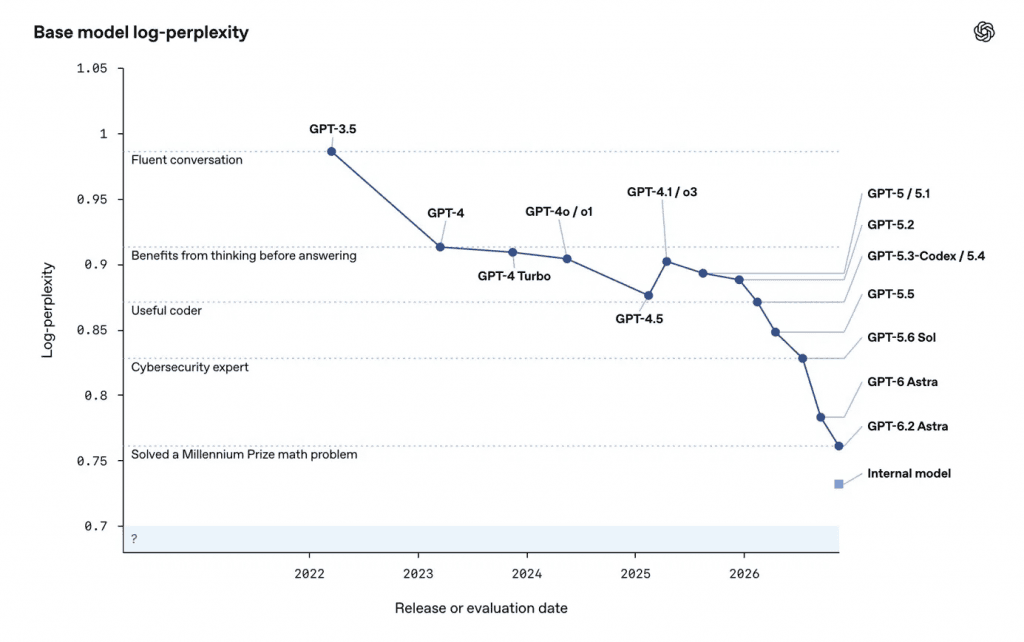
The chart
The chart comes from “Perplexity and Intelligence,” an essay published on Sunday by OpenAI Chief Scientist Jakub Pachocki. In it, Pachocki argues that perplexity should become the industry’s shared yardstick for AI progress and safety limits. Perplexity, or its close relative cross-entropy loss, measures how well a base model predicts the next token on a held-out dataset. OpenAI says it has tracked the number internally since GPT-3.5 and is publishing it for the first time. The dataset is drawn from OpenAI’s own codebase.
The chart plots every major OpenAI base model against that number, with lower being better. It also marks a set of horizontal capability thresholds:
- Fluent conversation, at about 0.99, where GPT-3.5 sits
- Benefits from thinking before answering, at about 0.91, which GPT-4 reaches
- Useful coder, at about 0.87, reached by GPT-5.3-Codex / GPT-5.4
- Cybersecurity expert, at about 0.83, reached by GPT-5.6 Sol
- Solved a Millennium Prize math problem, at about 0.76
6.2 Astra sits right on the Millennium Prize line.
Why this points to Navier-Stokes
On September 8, OpenAI published a proof resolving the Navier-Stokes existence and smoothness problem. The proof shows that a smooth three-dimensional fluid can develop a singularity in finite time. Roughly 10,000 agents running in parallel reached the result in about 88 hours. OpenAI said only that the work used an internal model “significantly more capable than GPT-6 Astra,” and that the model had begun training on August 28.
The perplexity chart fills in some of that gap. GPT-6 Astra sits at about 0.78, above the Millennium Prize line. GPT-6.2 Astra sits at about 0.76, exactly on it. OpenAI hasn’t claimed to solve any other Millennium Prize problems, so the threshold almost certainly refers to the Navier-Stokes result. Placing GPT-6.2 Astra on that line strongly suggests it was built on the same base model that produced the proof, or on one with the same pretraining quality.
Pachocki’s essay supports this reading, though it stops short of naming a model. He writes that once an internal model passed a log-perplexity of about 0.76, it began producing groundbreaking results on open math problems. He says the solutions came in one after another in a single internal Slack thread. That fits OpenAI’s later claim that the same internal model had resolved more than 100 long-standing open problems in addition to Navier-Stokes. It also fits the company’s release of over 300 mathematical results produced by an internal model.
Explaining GPT-6.2 Astra’s science lead
The hint also helps explain how GPT-6.2 Astra has performed since launch. The model, which OpenAI released alongside GPT-6.2 Sol, is pitched as the best model in the world for scientists. It is now the top-ranked model on the Vals Science Index, as well as on Terminal-Bench Science. Its general results are more mixed. It places second on the Artificial Analysis Intelligence Index with a score of 62, behind Claude Fable 5.2, and only seventh on the Vals Index overall. Some early testers have given it unusually harsh reviews, calling it uneven and hard to steer.
A model with a frontier base that is still rough in post-training would produce exactly this mix: excellent at deep technical and scientific work, less polished as an everyday assistant. GPT-6.2 Astra also replaced GPT-6.1 Astra, which OpenAI scrapped in October after internal testing found an alignment regression.
What the hint does not mean
There are caveats. The public GPT-6.2 Astra in ChatGPT did not solve Navier-Stokes on its own. The September result came from an orchestrated system of thousands of agents running for days on what reports put at millions of dollars of compute, and GPT-6 Astra handled the Lean formalization. The chart measures base-model perplexity, not the finished product, and Pachocki notes that perplexity does not capture gains from post-training or chain-of-thought reasoning. Sharing a base model with the system that found the proof is not the same as being able to reproduce it in a chat window.
The result itself is also still being examined. NYU mathematician Tristan Buckmaster accused OpenAI of trying to take credit for a related line of work he had pursued with Anthropic researcher Levent Alpöge. OpenAI’s Sebastien Bubeck has disputed that account. OpenAI has published a Lean formalization, but the proof has not yet been through formal peer review. Mathematicians have still taken it seriously: Fields Medalist Cédric Villani called it a cataclysm unlike anything math has known.
The more important dot
The most revealing point on the chart may not be GPT-6.2 Astra at all. Below it, at about 0.73, is a light-blue square labelled simply “Internal model.” That is a further drop beyond the model OpenAI ties to a Millennium Prize problem. Below that is a shaded band from roughly 0.68 to 0.70 marked only with a question mark.
Pachocki says that, extrapolating from recent progress, OpenAI expects further transformative capabilities to appear in that window. He admits he does not know what they will be, and that OpenAI may not be testing for them yet. The chart also shows a sharp acceleration through 2026: from GPT-5.5 to GPT-6.2 Astra, log-perplexity fell by roughly as much as it did from GPT-3.5 to GPT-4. Pachocki attributes most of this to long-term research and compute investment, and a smaller part to AI automating AI research.
That is why the essay ends with a proposal rather than a boast. OpenAI wants frontier labs to agree on common perplexity-based limits that none of them would cross until monitoring tools catch up. With GPT-6.2 Astra apparently sharing a base with a model that solved a 90-year-old math problem, and an internal model already well past it, OpenAI is clearly signalling that it thinks those limits are needed soon.