A new stealth model has popped up for testing, and it’s free for users for a bit.
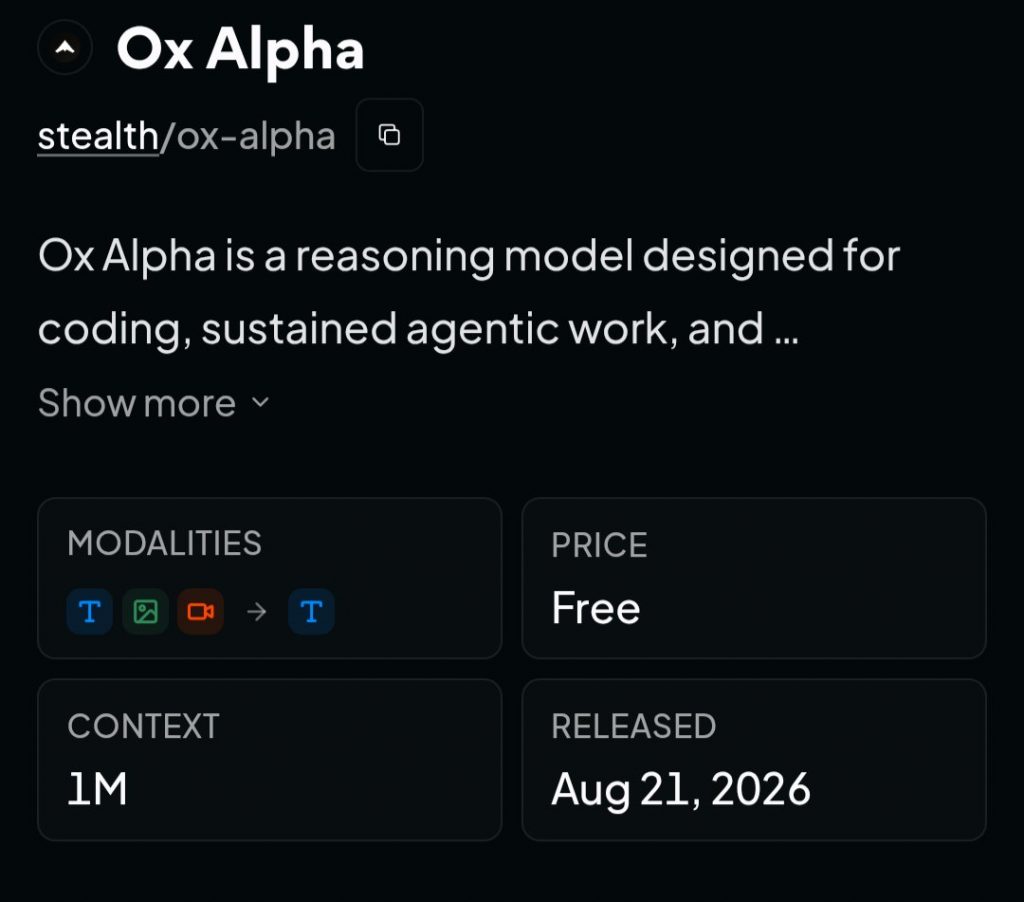
The model is called Ox Alpha, and it showed up on OpenRouter on August 21 under the provider name “stealth,” with no company attached to it and no confirmation from anyone about who actually built it. OpenRouter’s own listing describes it as a reasoning model aimed at coding, sustained agentic work, and production workloads, built to handle long-horizon software engineering and workflows that mix text with visual context. It ships with a 1,048,576-token context window, a maximum output of 131,072 tokens, and support for text, image, and video input. For now, it’s priced at zero on OpenRouter, and the provider has said it won’t train on prompts or completions submitted during the testing window, which is unusual for a stealth release — most of these arrangements come with an implicit understanding that the developer gets to keep whatever data flows through.
OpenCode, the open-source terminal-based coding agent, is running its own promotion around the same model. In a post on X, the OpenCode team said Ox Alpha would be free for the next week, with zero data retention and rate limits generous enough that they’re calling it “near unlimited usage.” The post claims capacity for 100 trillion tokens a day, which is the kind of number a provider throws around when it wants developers to actually stress-test a model rather than poke at it politely. Whether that capacity holds up once the free week gets real traffic remains to be seen — one reply to the OpenCode announcement was already someone complaining about getting rate-limited on their first prompt.
Stealth releases have become a fairly normal part of how frontier labs test new models before a public launch, and OpenRouter has hosted a fair few of them. What tends to happen is a lab ships a model anonymously, watches how it performs against real developer traffic instead of curated benchmarks, and either walks it back or unmasks it as the real product once it’s satisfied. The pattern with Ox Alpha looks familiar enough that the developer community immediately started trying to figure out who’s actually behind it.
Two names have come up repeatedly. The first is Xiaomi, whose MiMo team has run this playbook before — MiMo-V2-Pro spent time on OpenRouter under the alias Hunter Alpha before Xiaomi confirmed the connection at launch, and Ox Alpha’s spec sheet (a million-token context, native multimodality, an obvious lean toward agentic and coding tasks) matches the shape of what Xiaomi has been building. The second candidate is Z.ai, the company formerly known as Zhipu AI. A developer who goes by dax on X ran a tokenizer fingerprinting test across 25 different prompts and found that Ox Alpha’s raw token counts lined up almost exactly with GLM-5.3, off by a constant 75-token wrapper each time. Z.ai has been vocal about wanting to push GLM toward vision and multimodal capability, and image input on Ox Alpha would fit that ambition. A third post pointed out that Ox Alpha stumbles on the same “dirty token” that has previously tripped up Qwen and GLM-family models, which if accurate points back toward a Chinese lab regardless of which one it turns out to be. Nobody involved has confirmed anything, and until one of these companies puts its name on the model, the identity remains a matter of pattern-matching rather than fact.
The timing fits a broader shift that’s been playing out on OpenRouter for a while now. The share of tokens processed by US models on the platform has fallen from around 70% a year ago to roughly 30% today, with Chinese labs like DeepSeek, Tencent, Xiaomi, and Z.ai eating into that share month after month. Free, high-context, multimodal stealth drops are exactly the kind of move that accelerates that trend — developers get to run real workloads against a frontier-class model at no cost, and whichever lab is behind Ox Alpha gets a week of unfiltered usage data before it has to put a price tag or a name on the thing.
For anyone who wants to try it, Ox Alpha is reachable through OpenRouter’s API and playground under the model ID stealth/ox-alpha, or through OpenCode directly if you’re working in a terminal-based coding setup. Given the zero data retention promise and the free pricing, there’s little reason not to run it against a real coding task and see how it holds up against the models you’re already using.