There’s a fairly large gap between what the median company is spending on AI and the highest spenders.
New numbers from the Ramp AI Index, which tracks corporate card and invoice spend across more than 50,000 US businesses, put a precise figure on that gap. The median business spends $11.95 per employee per month on AI. The top 10% of spenders are at $650 per employee. The top 1% have pushed past $7,400 per employee, a level that would have looked absurd on this chart even a year ago.
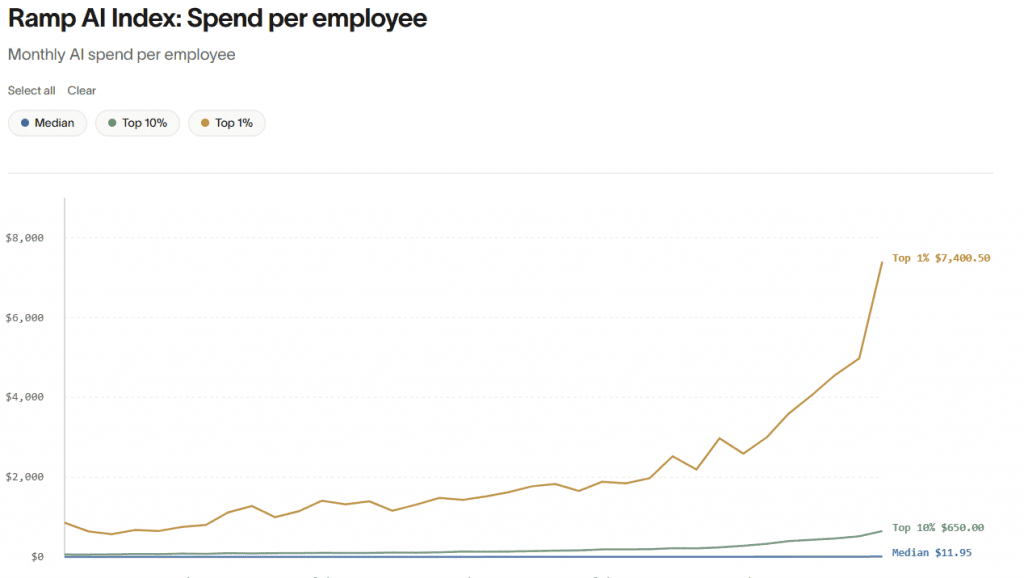
Run the comparison and the top 1% are now spending well over 600 times what the typical company spends, on a per-employee basis, every single month. That’s not a gap between early adopters and laggards anymore. It’s closer to two different economies operating under the same label.
Two lines that barely move, and one that doesn’t stop
For most of the period Ramp’s chart covers, all three cohorts moved together near the bottom of the graph, each one inching up in small increments that were easy to miss. Then the top 1% line breaks away. It climbs steadily through last year, dips and recovers a couple of times along the way, and somewhere in recent months it stops behaving like the rest of the chart entirely, turning almost vertical on its way to $7,400.
The median and top 10% lines, by contrast, have barely lifted off the floor. The median company’s monthly AI bill per employee is still under $12, roughly what a single seat on a mid-tier AI subscription costs. The top 10% figure of $650 suggests a meaningfully more serious commitment — enough to cover several premium seats or a genuine spend on API usage — but it’s nowhere close to the pace the top 1% has set.
Who’s actually pulling away
Ramp’s broader dataset offers some clues about who sits at that top end. Adoption has been heaviest in software, finance, and professional services — sectors where the work itself, drafting, coding, analysis, maps neatly onto what large language models do well. Those are also the industries with the deepest pockets and the most to gain from automating knowledge work, which lines up with a small slice of companies pulling the top 1% figure so far ahead of everyone else.
Some of that top-end spend is also coming from a shift in what businesses are buying. Ramp’s own product data shows companies moving well past basic chat subscriptions and into infrastructure-heavy categories like model serving, inference platforms, and domain-specific AI tools built directly into workflows. That kind of spend adds up fast in a way that a single Claude or ChatGPT seat per employee never will.
Adoption is broad, spend is not
It’s worth separating two different stories that tend to get collapsed into one. On adoption, AI has genuinely gone mainstream. Ramp’s data has shown that more than half of US businesses on its platform now pay for some form of AI, up from around a third a year earlier. That’s the headline most people remember.
Spend intensity is a separate question, and the answer there is far more lopsided. Most companies have adopted AI in the sense that someone in the building has a paid subscription. Very few have restructured their operating costs around it. The $12 median suggests AI is still, for most businesses, a line item rather than a strategy. The $7,400 top end suggests a small group of companies have already made the opposite bet, and are widening that lead month over month rather than settling into it.
Whether that gap closes as AI tools mature and prices come down, or widens further as the heaviest spenders find more ways to fold AI into their operations, is the question this chart will be worth revisiting for.