San Francisco’s office market has undergone a complete identity transplant since 2019. The list of the city’s biggest tenants today reads less like a cross-section of corporate America and more like a who’s-who of the AI race — and that shift is anything but accidental.
The Current Leaderboard
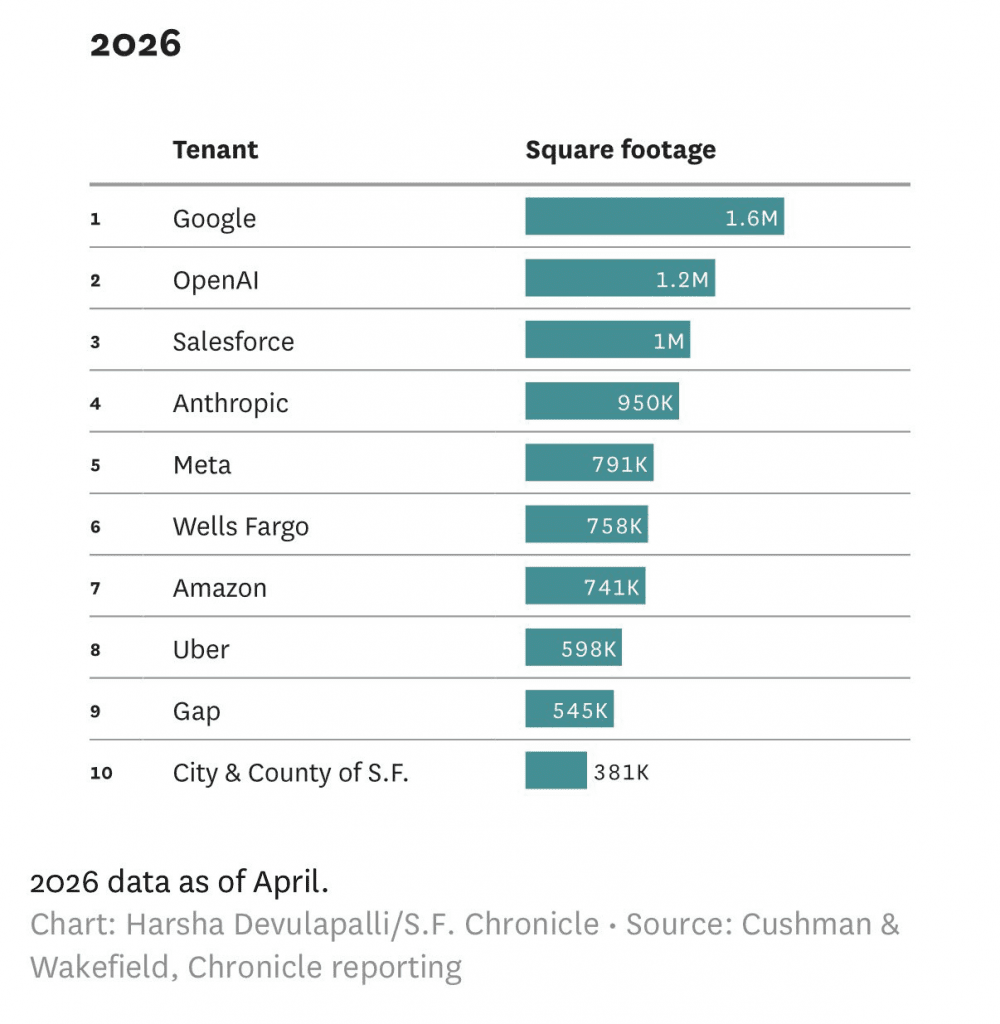
As per data shared by SFChronicle, Google sits at the top with 1.6 million square feet, followed by OpenAI at 1.2M and Salesforce at 1M. What makes 2026 remarkable is the fourth name on the list: Anthropic, at 950K sq ft — a company that didn’t even exist when the 2019 rankings were compiled. Meta (791K), Wells Fargo (758K), Amazon (741K), Uber (598K), Gap (545K), and the City & County of San Francisco (381K) round out the top ten.
Four of the top five tenants are now AI-native or AI-primary companies. That’s the headline.
How Different Was 2019?
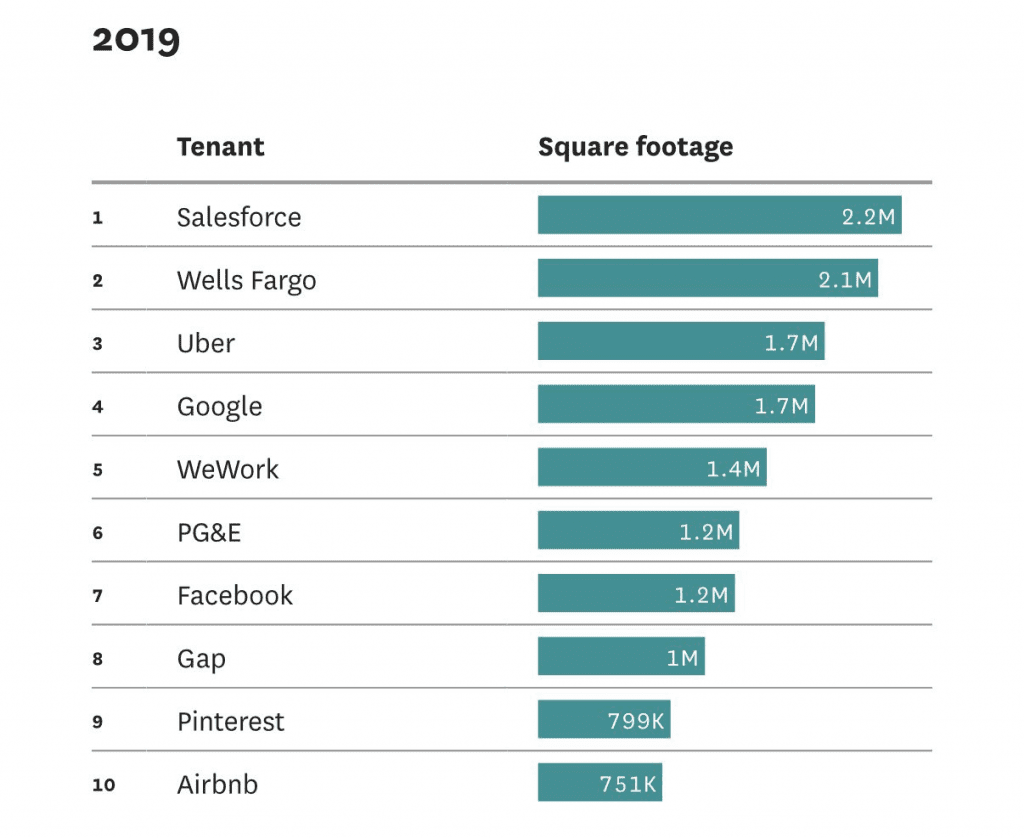
The contrast with 2019 is stark. Seven years ago, Salesforce led with 2.2 million square feet — more than double what it occupies today. Wells Fargo came in second at 2.1M, and Uber held 1.7M. Google ranked fourth at 1.7M. The top of the list was dominated by legacy enterprise software, financial services, and the gig economy. The five biggest tenants in 2019 collectively occupied around 9.2M sq ft; today’s top five account for roughly 5.55M — a signal of how dramatically overall office absorption has contracted even as some players have grown.
WeWork (1.4M in 2019) has effectively vanished from the rankings — the coworking giant’s collapse was one of the most consequential real estate stories of the decade. PG&E (1.2M) and Facebook/Meta (1.2M) have also shed enormous footprints. Pinterest (799K) and Airbnb (751K) — both of which went fully or partially remote post-pandemic — no longer appear at all.
The Trends Behind the Shift
Remote work crushed legacy demand. The pandemic proved that vast swaths of knowledge work could be done from anywhere, and companies like Salesforce, Wells Fargo, and Uber aggressively downsized their footprints in response. Salesforce shed over half its SF office space between 2019 and 2026. Wells Fargo went from 2.1M sq ft to 758K. These aren’t minor corrections; they’re structural retreats.
AI companies need people in the room. The irony of the AI boom is that the companies building tools that enable remote work are themselves insisting on dense, in-person collaboration. OpenAI’s rapid physical expansion — from a scrappy nonprofit spinout to the #2 office tenant in San Francisco — mirrors its explosive commercial growth since ChatGPT’s launch in late 2022. Anthropic’s appearance at #4, with nearly a million square feet, is arguably the most remarkable data point in the entire chart: the company was founded in 2021 and has scaled its physical presence at a pace that tracks its fundraising trajectory.
The capital is flowing differently. In 2019, the dominant office tenants reflected where venture and growth capital had flowed in the preceding decade — cloud software (Salesforce), fintech and banking (Wells Fargo), the gig economy (Uber), and social platforms (Facebook). By 2026, AI investment has eclipsed all of those sectors combined, and the office market reflects that reality directly.
Google re-centralized in SF. Google moved up from fourth in 2019 (1.7M sq ft) to first in 2026 (1.6M sq ft) — and actually shrank in absolute terms. But every tenant ahead of it in 2019 retreated far faster, leaving Google as the default anchor. Its sustained presence also reflects the company’s deepening AI focus, particularly after the integration of DeepMind capabilities and its aggressive response to OpenAI’s market inroads.
What It Means
San Francisco is still the capital of the AI industry, even if it is no longer the sprawling corporate campus city it was at peak 2019. The total office footprint of the top ten tenants is meaningfully smaller than seven years ago, but the composition tells a story about what the next decade of technology looks like: AI-first companies, flush with capital and competing for the same scarce talent pool, are betting that proximity and density produce breakthroughs faster than distributed teams can.
The old guard — banks, legacy SaaS, and gig platforms — is pulling back. The new guard is moving in. San Francisco’s office market didn’t die; it just changed who runs it.