OpenRouter’s latest usage data puts Google firmly at the top of the AI image generation market — and by a margin that’s hard to argue with.
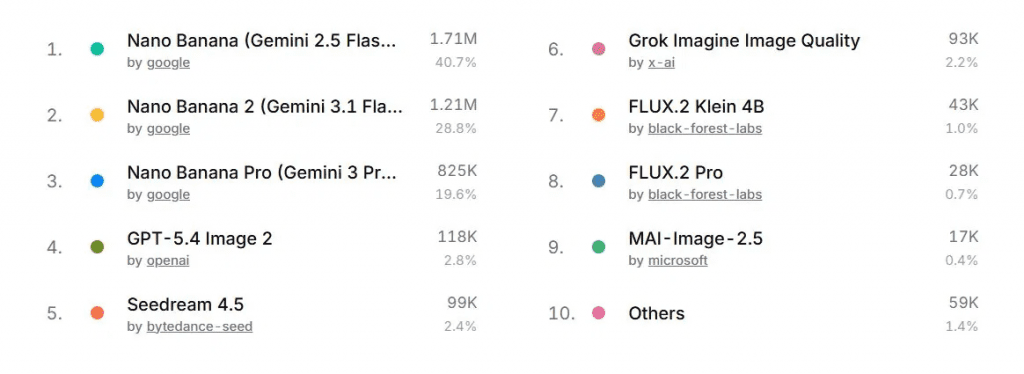
The three Nano Banana models collectively account for nearly 90% of all image generation traffic on the platform. For a company that was playing catch-up in consumer AI just a year ago, that’s a remarkable turnaround.
Google’s Clean Sweep
Nano Banana (Gemini 2.5 Flash Image) leads with 1.71 million requests and a 40.7% share. Nano Banana 2 (Gemini 3.1 Flash Image) sits second at 1.21 million requests and 28.8%. Nano Banana Pro (Gemini 3 Pro Image) rounds out the top three at 825K requests and 19.6%. Together, the three models account for roughly 89% of all image generation traffic on OpenRouter.
The dominance traces back to a single late-night decision. The Nano Banana name itself came from an impromptu 2:30 a.m. upload by a Google DeepMind product manager who needed a placeholder name for LMArena — and the model went viral almost immediately. Within days, it had shot to the top of the leaderboard on the strength of its image editing capabilities and character consistency. Google didn’t plan for a cultural moment; it stumbled into one, then built on it.
The three-model lineup now covers distinct use cases. Nano Banana handles high-volume, speed-sensitive tasks. Nano Banana 2, which topped Artificial Analysis’ Text-to-Image index on launch, is optimized for text-to-image quality at a lower price point than its Pro sibling. Nano Banana Pro remains the choice for high-fidelity commercial work — it’s integrated into Google Ads and Workspace, and carries SynthID watermarking for content authenticity.
OpenAI and the Rest
GPT-5.4 Image 2 comes in at number four with 118K requests and a 2.8% share. That’s a distant fourth, but the context matters. OpenAI’s image generation story over the past year has been one of playing catch-up. GPT Image 1.5 launched specifically to counter Nano Banana’s momentum, and while it eventually claimed the top spot on Image Arena’s editing leaderboard, it never matched Google’s cultural traction. GPT-5.4 Image 2 — now the newest iteration in OpenAI’s image lineup — brings improved instruction following, better text rendering, and a thinking mode that reasons before rendering. The OpenRouter numbers suggest that hasn’t yet translated into market share at scale, though it’s worth noting that OpenAI’s image products are primarily accessed through ChatGPT and the API directly, which may understate actual usage.
Seedream 4.5 by ByteDance-Seed holds fifth place with 99K requests and 2.4%. It’s a credible showing for a model that sits outside the established big three, and signals that ByteDance’s push into generative media is gaining ground with developers.
The Long Tail
Positions six through ten tell a different story — smaller shares, but meaningful signals.
Grok Imagine Image Quality by xAI ranks sixth at 93K requests (2.2%). Elon Musk’s AI company has been aggressive in integrating image generation into the Grok product on X, and some of that usage appears to be flowing through OpenRouter as well.
FLUX.2 Klein 4B and FLUX.2 Pro from Black Forest Labs take seventh and eighth with 43K and 28K requests respectively. Black Forest Labs has carved out a loyal following among developers who want open, customizable image models — FLUX.2 Klein 4B’s compact size makes it particularly attractive for on-device or cost-sensitive deployment.
MAI-Image-2.5 from Microsoft rounds out the ranked positions at ninth with 17K requests (0.4%). Microsoft’s image models have historically flown under the radar relative to its Copilot branding, and the low usage here reflects that. The remaining 1.4% sits in an Others bucket.
What the Numbers Say
The OpenRouter data reflects developer and API traffic, not consumer usage — so it skews toward builders, not casual users. That makes Google’s position even more striking. Nano Banana’s adoption at the API layer suggests it’s not just a viral consumer product; developers are actually shipping with it.
The broader context is worth noting. Anthropic’s internal data shows that AI-assisted coding has reached 8x the pre-2025 baseline at the company, reflecting how quickly AI tools are embedding themselves into professional workflows. Image generation is following a similar curve — usage on platforms like OpenRouter has compounded quickly, and the models at the top of the leaderboard are the ones developers are betting their products on.
For now, that bet is overwhelmingly on Google.