Technology and media companies remain the most AI-hungry businesses in America, but the gap between the front-runners and the rest of the economy is narrowing fast. New sector-level data from the Ramp AI Index — which tracks paid subscriptions to AI models, platforms, and tools across more than 50,000 U.S. businesses — shows that AI adoption is no longer confined to Silicon Valley. It’s climbing steadily across finance, manufacturing, retail, health care, construction, and even hospitality.
Here’s how the numbers break down by industry, and what’s driving the divergence between the leaders and the laggards.
Technology And Media Leads At 80.6%
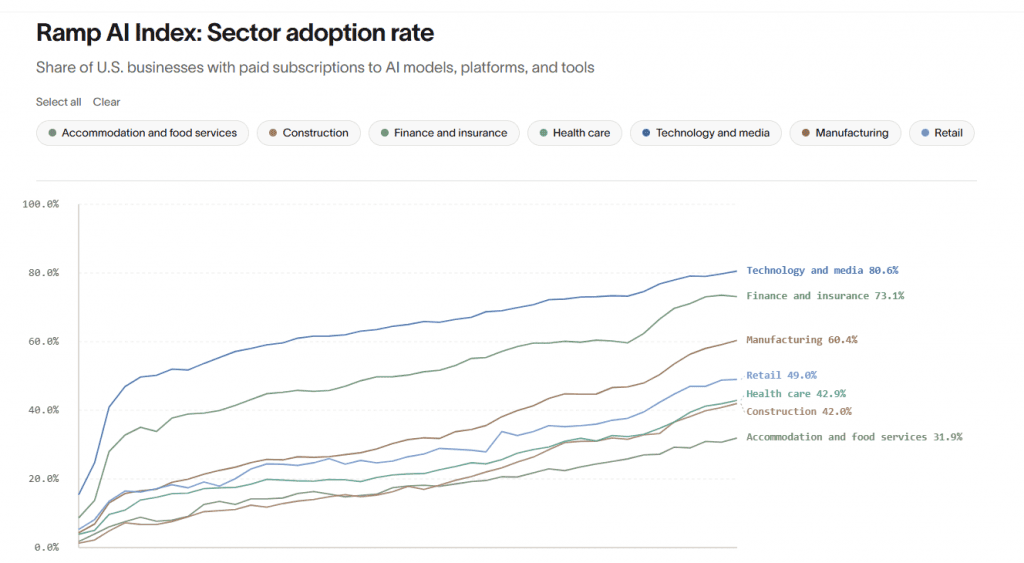
Unsurprisingly, the technology and media sector tops the Ramp AI Index sector chart, with 80.6% of businesses now holding a paid subscription to at least one AI tool. This sector shot up fastest in the earliest months of tracking, jumping from single digits to well past 50% within roughly a year, before adoption growth naturally began to plateau as it approached saturation.
That’s consistent with what has been reported on the broader AI vendor race: tech and software companies are also the businesses driving Anthropic’s rise in enterprise adoption, with industry-level Ramp data showing that the more deeply a sector uses AI, the more it tends to prefer Claude over ChatGPT. Software and information businesses were flagged in that analysis as one of the three highest-adoption, most Anthropic-leaning sectors — a pattern that tracks closely with what shows up here.
Finance And Insurance Is Closing The Gap, At 73.1%
Finance and insurance is the fastest-growing major sector on the index, climbing from roughly the same starting point as manufacturing and retail to 73.1% today — putting it within striking distance of technology and media. The line shows a particularly sharp acceleration in the past several months, suggesting banks, insurers, and financial services firms have moved well past pilot programs and into scaled deployment.
This lines up with what Ramp’s own economists have observed: finance is a knowledge-work-heavy sector where large language models map naturally onto tasks like drafting, summarizing, and analysis, which is likely why it’s converged toward tech-level adoption rates faster than other white-collar industries. Anthropic in particular has leaned into this, pushing Claude-powered workflows for valuation reviews, report generation, and month-end close into the finance sector.
Manufacturing Rounds Out The Top Three At 60.4%
Manufacturing has been one of the more surprising movers on the Ramp AI Index. While it started well below the white-collar sectors, it has climbed at a steady clip to 60.4%, overtaking retail and health care along the way. This suggests AI adoption in manufacturing is no longer limited to back-office functions like finance and HR — it’s increasingly touching supply chain planning, quality control, and logistics coordination as well.
Retail, Health Care, And Construction Are Bunched Together In The 40s
Retail (49.0%), health care (42.9%), and construction (42.0%) form a tight middle cluster. All three sectors show remarkably similar adoption curves for most of the tracked period, before retail pulled slightly ahead in recent months. That’s a notable shift for an industry long associated with thin margins and slower tech cycles — it now sits closer to manufacturing than to the sectors at the bottom of the list.
Health care’s relatively modest adoption rate, despite the sector’s obvious use cases in documentation, coding, and patient communication, likely reflects the regulatory and compliance hurdles that come with deploying AI tools around sensitive patient data — a constraint that doesn’t apply as heavily to retail or manufacturing.
Accommodation And Food Services Trails At 31.9%
At the bottom of the chart sits accommodation and food services, at 31.9%. It’s the slowest-adopting sector on the index by a clear margin, though it has still nearly quadrupled its adoption rate since tracking began. The lag likely comes down to the nature of the workforce: hospitality and food service jobs are disproportionately hands-on and customer-facing, with fewer of the desk-based, document-heavy workflows where AI subscriptions tend to get purchased first.
The Bigger Picture: A Widening Base, Not Just A Taller Peak
What stands out across the full Ramp AI Index chart isn’t just that technology and media is far ahead — it’s that every single sector tracked is now on an upward trajectory, with none showing signs of plateauing at the bottom. That’s consistent with Ramp’s broader finding that overall U.S. business AI adoption has now crossed 50% for the first time, a threshold that marks AI spend shifting from an experiment for early adopters to standard operating procedure across the economy.
If the current trend lines hold, the gap between the highest- and lowest-adopting sectors should keep narrowing over the next year, even if technology and media remains the sector to beat.