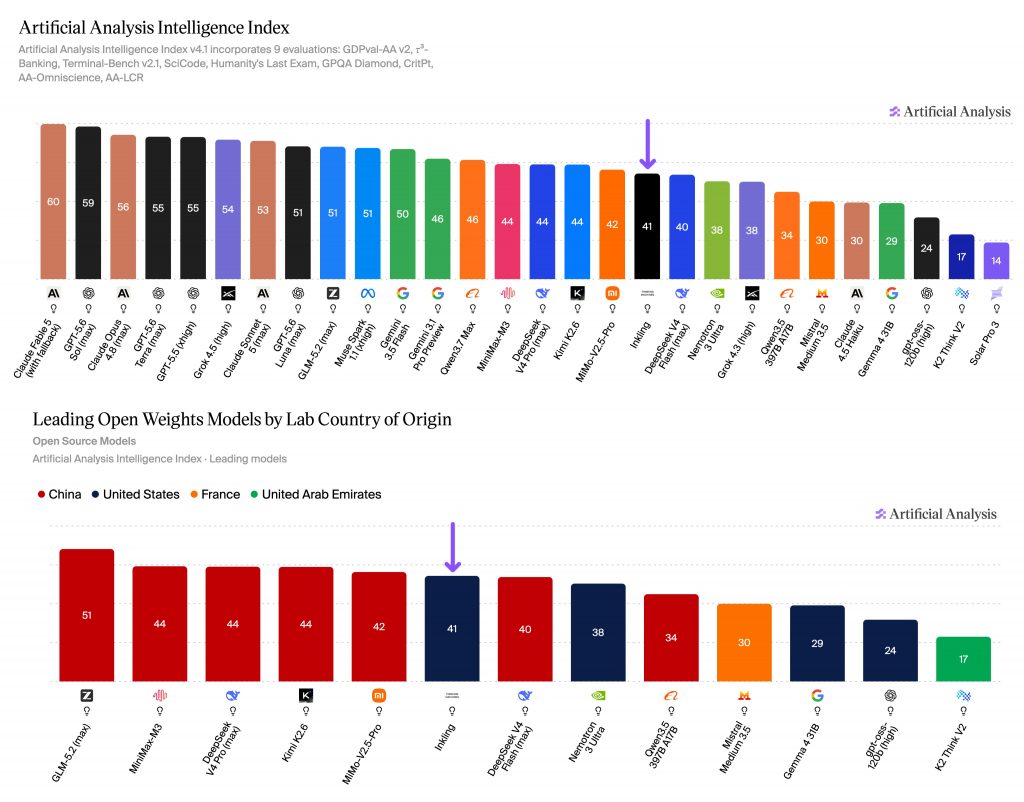
Thinking Machines has shipped its first production language model, and the company that once looked like it might skip the open-weights race entirely has walked straight into the lead of it. Inkling, released by Mira Murati’s lab, has debuted at 41 on the Artificial Analysis Intelligence Index, making it the highest-scoring open weights model to come out of a US lab.
That title previously belonged to NVIDIA’s Nemotron 3 Ultra, which scored 38. Inkling clears it by three points and also puts distance between itself and Gemma 4 31B (29) and OpenAI’s gpt-oss-120b (24). The broader picture hasn’t changed much — China’s open-weights labs still occupy the top of the chart, with GLM-5.2 (max) leading at 51, followed by MiniMax-M3, DeepSeek V4 Pro (max), and Kimi K2.6 all clustered at 44 — but for the first time in a while, a US lab has something credible to point to in that conversation.
A First Product, Not A Research Preview
Inkling matters partly because of what it represents for Thinking Machines itself. The company has spent much of the past year and a half putting out research write-ups and the Tinker fine-tuning API without a flagship model to its name, and it has done so through a stretch where three of its six founding leaders walked out the door and rejoined OpenAI. Inkling is the lab’s answer to the question of whether it could still ship something that competes at the frontier, and the numbers suggest the answer is yes.
The model comes in at 975 billion total parameters with 41 billion active, and it takes text, image, and audio as input, projecting all three into a shared hidden space before the decoder processes them jointly. That kind of native multimodal input is still rare among open weights releases, most of which remain text-only or bolt vision on as an afterthought. It’s available through Thinking Machines’ Tinker platform with a 256K context window, and the open weights on Hugging Face push that out to 1 million tokens.
Pricing sits at $1.87 per million input tokens and $4.68 per million output tokens at the 64K context tier, roughly doubling at the full 256K window.
Efficient, And Good At The Work That Pays
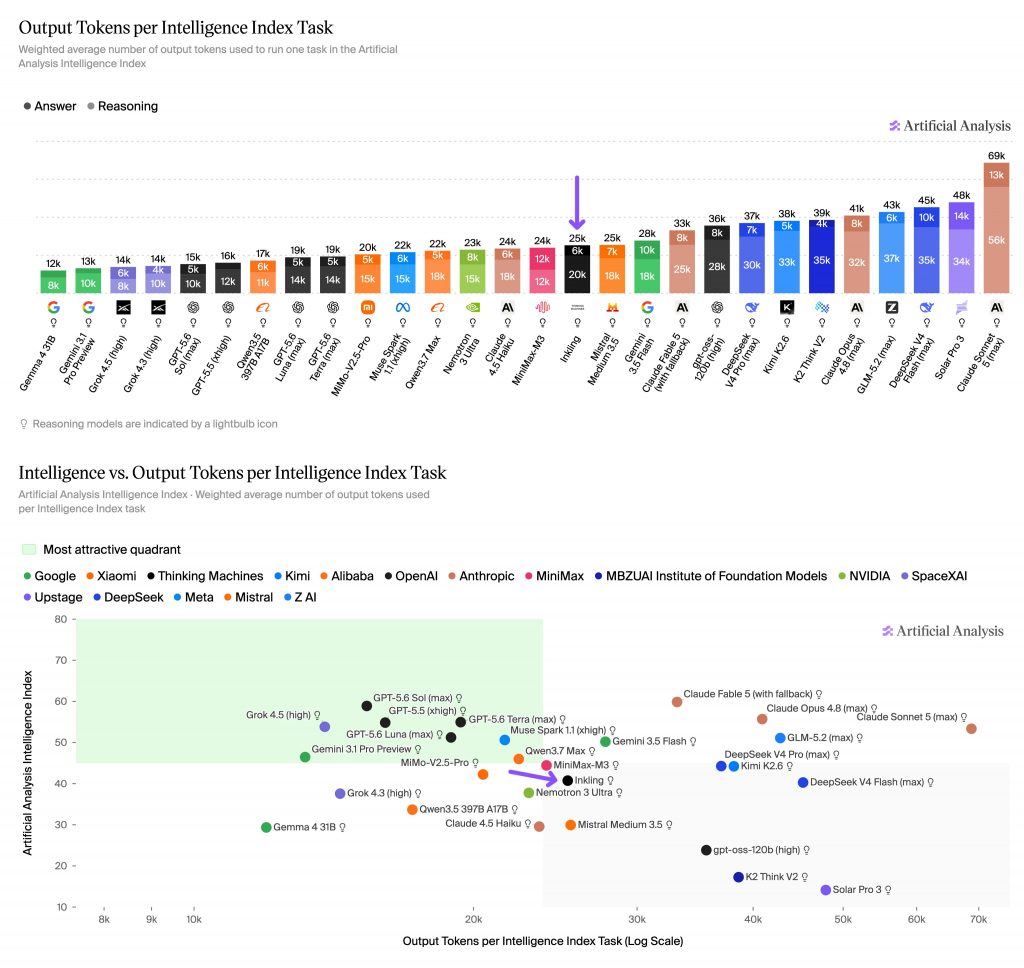
The Intelligence Index score is only part of the story here. Where Inkling separates itself from other open models is in how much it costs to actually run. Artificial Analysis measures a weighted average of output tokens burned per Intelligence Index task, and Inkling comes in at 25,000 — well below GLM-5.2 (max) at 43,000, Kimi K2.6 at 38,000, and DeepSeek V4 Pro (max) at 37,000. On a chart where intelligence tends to climb alongside token spend, Inkling sits in a pocket that plots reasonably high performance against comparatively restrained cost, a combination Thinking Machines will want to lean on as it pitches Tinker to enterprise customers watching their inference bills.
That efficiency shows up alongside genuinely strong agentic numbers. On GDPval-AA v2, which scores models on real-world work tasks, Inkling posts an Elo of 1238, ahead of Kimi K2.6’s 1190 and DeepSeek V4 Flash max’s 1189. On τ³-Banking, a benchmark built around financial services workflows, it scores 24%, edging out Kimi K2.6 (21%) and DeepSeek V4 Flash max (23%). Given that Thinking Machines has built its entire pitch around organizations owning and fine-tuning weights for their own workflows rather than renting intelligence through someone else’s API, doing well on tasks that look like actual enterprise work is close to the whole point.
Factuality is where the model is more of a mixed bag. Inkling scores +2 on AA-Omniscience, Artificial Analysis’s combined measure of accuracy and hallucination avoidance — better than Nemotron 3 Ultra’s -1, but still trailing the strongest open models on that specific metric. Its accuracy sits at 40%, while its hallucination rate runs at 63%, meaning the model is still fairly willing to guess rather than abstain when it isn’t sure. That’s a tradeoff Thinking Machines will likely tune in future releases, especially given how central abstention behavior has become to how Artificial Analysis ranks factual reliability across the industry.
The Bigger Picture
Inkling landing at 41 doesn’t close the gap between US and Chinese open-weights labs, which by Artificial Analysis’s own count still runs somewhere between four and six index points depending on the week. But it’s the first time a US lab has released something in this tier that competes on token efficiency and agentic performance rather than raw parameter count. For a company that spent its first year known mostly for a manifesto and a fine-tuning API, shipping a model that actually lands near the top of its category is the more convincing argument.