The death of coding jobs could’ve been greatly exaggerated.
New data from Indeed’s Hiring Lab shows that US software development job postings have climbed almost 15% since Claude Code launched in late February 2025, even as overall job postings across the economy fell 7% over the same stretch. For an occupation that was supposed to be first against the wall when agentic coding tools arrived, that is not the chart most people expected to see.
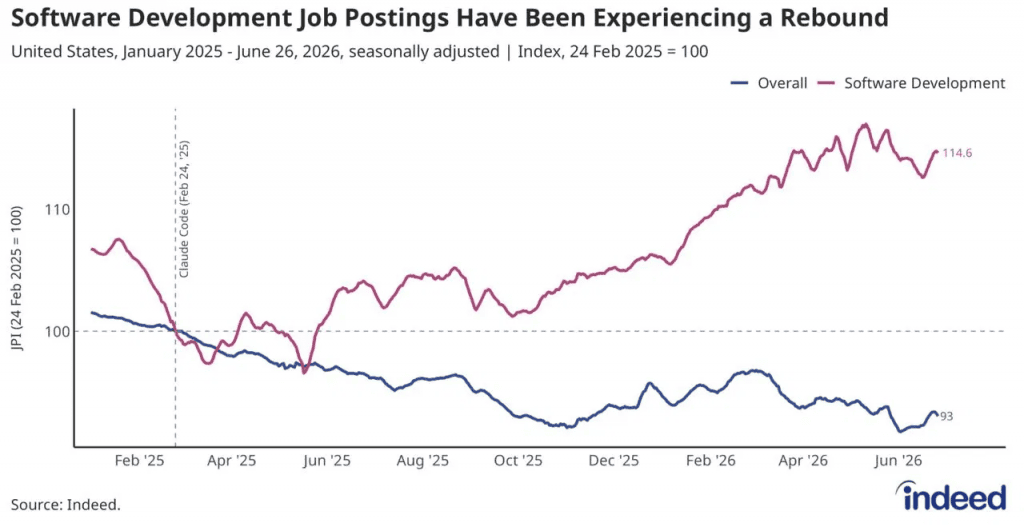
Indeed’s Chief Economist Svenja Gudell laid out the numbers in a post breaking down the trend, and the framing is deliberately careful: correlation isn’t causation, and plenty of macro forces have been pulling at the labor market over the last year and a half. But the timing lines up too cleanly to wave away. Claude Code arrived in late February 2025, the same month the term “vibecoding” entered the vocabulary, and software postings on Indeed bottomed out almost exactly on that date before beginning their climb.
A rebound with an asterisk
The recovery is real, but it comes off a depressed base. Software development postings remain roughly 27.5% below where they stood before the pandemic, while overall postings have essentially returned to their February 2020 level. So this is less a boom than a partial unwinding of a long slump — years of contraction in tech hiring giving back some, not all, of what it lost.
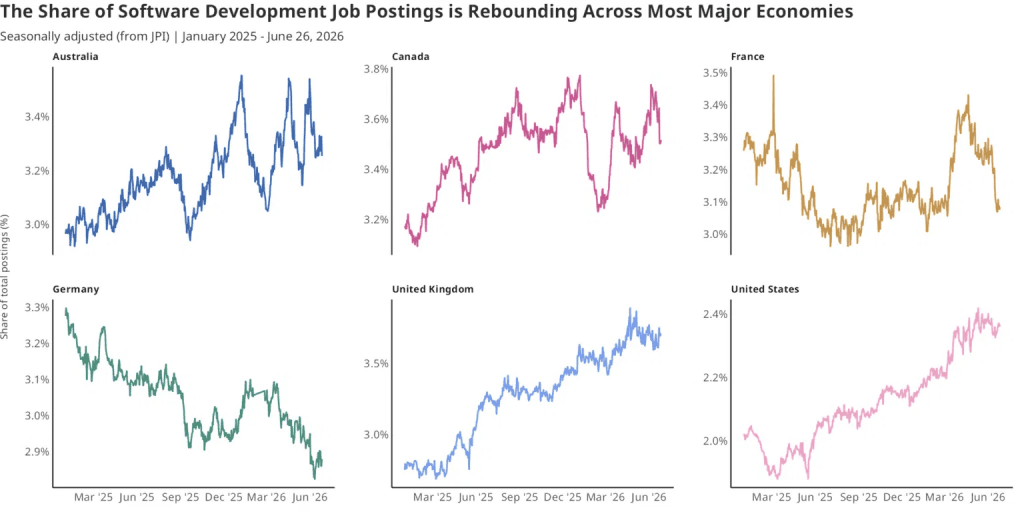
The rebound also isn’t confined to the US. Indeed’s data shows the share of job postings going to software development roles rising across most major developed economies it tracks, with Germany as the lone holdout still declining. English-speaking markets — the US, UK, Canada, Australia — show the steadiest upward trends, which tracks with where a lot of AI adoption and tooling has concentrated first.
Who’s actually getting hired
The more interesting story is in the composition of the rebound, not just its existence. Indeed found that 71% of the net increase in software development postings between May 2025 and May 2026 came from senior roles, and 37% came from postings that mention AI directly in the job title. That’s a narrow recovery aimed at experienced engineers who can direct AI tooling, not a broad reopening of the junior pipeline.
That pattern lines up with what other researchers have already flagged this past year. A Harvard study found junior employment falling sharply at AI-adopting firms while senior headcount kept growing, and a Stanford paper tracked a near-20% drop in employment for software developers aged 22-25 since the generative AI boom took off. Whether AI is actually the primary driver behind that junior squeeze is contested — an LSE paper published earlier this year argued that the shift to remote work explains a comparable chunk of the decline, since supervising and training junior staff gets harder and more expensive once everyone’s remote. Indeed’s own data doesn’t resolve that debate, but it does add a new wrinkle: even as junior hiring stays weak, senior demand is now rising fast enough to pull the whole category into positive territory.
The bigger flip
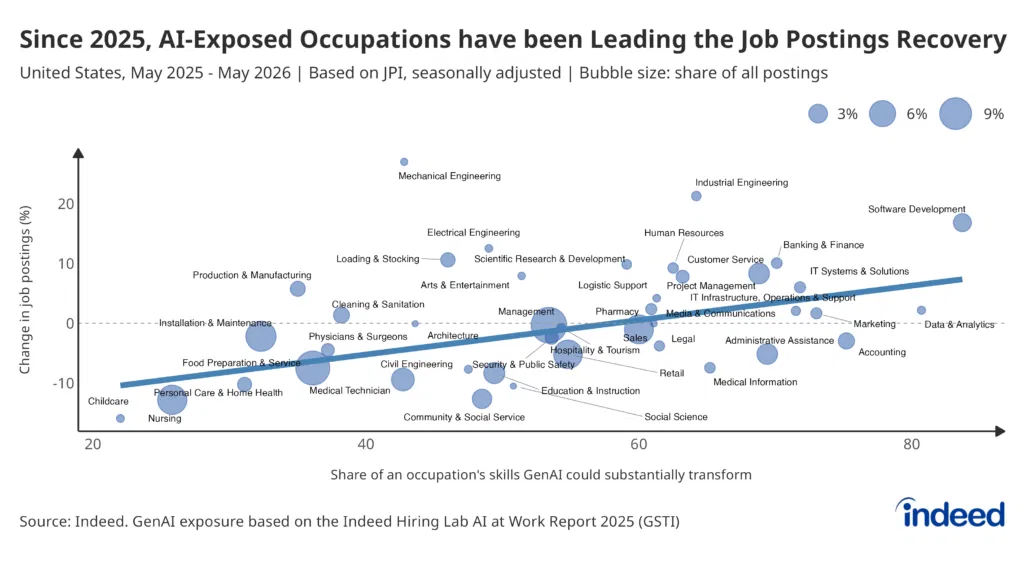
Zoom out from software specifically and Indeed found a broader reversal playing out. Between 2022 and 2026, the occupations most exposed to AI saw the steepest declines in job postings — a pattern researchers had already documented well before ChatGPT’s public release. But when Indeed reran the same analysis for the last twelve months, the relationship flipped: the more AI-exposed an occupation is, the more its postings have rebounded, on average. Software development sits at the extreme end of that flip, but the effect shows up across industrial engineering, banking and finance, and IT infrastructure roles too. AI mentions in job titles, Indeed notes, are spreading well beyond software into a range of white-collar postings.
The debate over whether AI nets out as a job creator or destroyer is still very much open, and the loudest voices on both sides keep talking past each other. NVIDIA CEO Jensen Huang has called the job-loss narrative “complete nonsense,” pointing to rising GitHub commit volume as evidence that AI is expanding engineering output rather than shrinking the workforce needed to produce it — commits made by Claude Code alone now account for roughly 4% of all public GitHub activity. Investor David Friedberg has made a similar case, arguing that AI’s real impact shows up on the revenue side of a business through expanded output, not through headcount cuts on the cost side.
Indeed’s take is more measured than either of those. Gudell’s own framing is that there is “certainly some job destruction, and definitely some job creation,” and that the relationship between AI exposure and hiring is still evolving as the technology itself keeps changing. Agentic tools like Claude Code may represent one structural shift in that relationship. Whether another one is coming, and which direction it points, is the question Indeed says employers, workers, and policymakers all need to keep watching.