For much of this year, the word “distillation” has been spoken in Silicon Valley mostly in the tone of an accusation — American frontier labs have described it as a form of theft, taken their complaints to Congress, and framed it as a national security problem. Google, though, appears to be taking a rather different view: its cloud documentation now has a section that walks developers through exactly how to distil one AI model into another.
The page, titled “Supervised and distillation fine-tuning for open models,” sits within the documentation for Google’s Gemini Enterprise Agent Platform. It explains that distillation lets users tune a smaller student model using the outputs of a larger teacher model. In practice, a developer specifies a teacher model, the teacher generates responses, and those responses are then used to train the smaller student. Google even notes that the training dataset can consist of prompts alone, since the teacher fills in the completions, and the tuning job returns a file containing the teacher’s labelled data along with model checkpoints that can be deployed or exported.
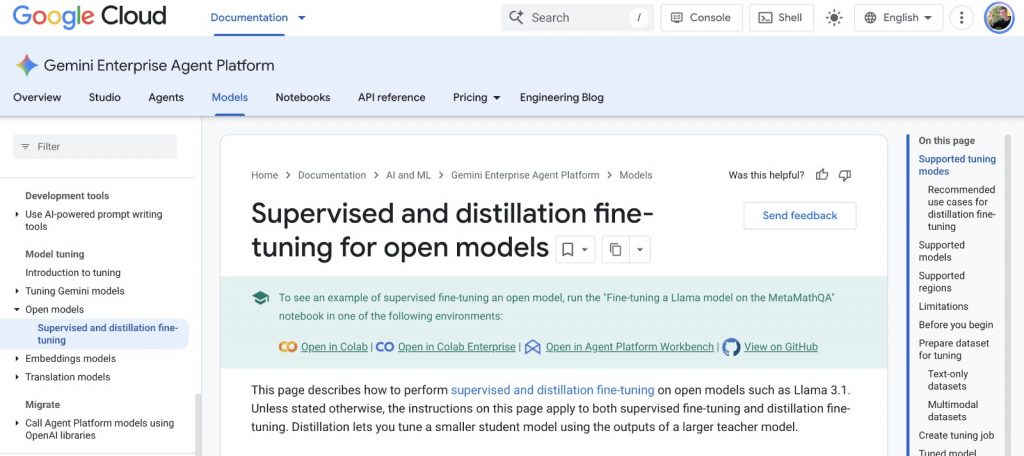
What makes the page particularly striking is the choice of models. The only supported teacher is GLM 5.2, the open-weight model from Beijing-based Z.AI, formerly Zhipu AI. The supported students are Google’s own Gemma 3 models in 1B, 4B, 12B and 27B sizes, and Alibaba’s Qwen 3 models in 4B, 8B, 14B and 32B sizes. In other words, Google is offering a managed pipeline that takes the reasoning of a frontier Chinese model and pours it into smaller models, including its own. Google says the technique works best for multi-step reasoning tasks such as maths, science and medical question answering, where a strong “thinking” teacher produces better answers than the student could on its own.
GLM 5.2 is a natural candidate for the job. When Z.AI released it in June, the model impressed the CEOs of Vercel and Box, and it posted a score of 62.1 on SWE-bench Pro. It also became the first Chinese open-source model to rank ahead of every Google model on the Artificial Analysis Intelligence Index. Crucially, it ships under the permissive MIT licence, which means using its outputs to train other models is entirely above board.
The contrast with Google’s rivals is hard to miss. In February, OpenAI sent a memo to the US House Select Committee on China accusing DeepSeek of “ongoing efforts to free-ride on the capabilities developed by OpenAI and other US frontier labs.” Less than two weeks later, Anthropic went further, publishing a detailed report alleging that DeepSeek, Moonshot and MiniMax created around 24,000 fraudulent Claude accounts and generated more than 16 million exchanges to extract its capabilities. Anthropic argued that illicitly distilled models are unlikely to retain safety guardrails, and tied the issue directly to the case for chip export controls. In June, it told the Senate Banking Committee that operators linked to Alibaba’s Qwen lab had run 28.8 million exchanges with Claude through roughly 25,000 fake accounts, calling it the largest distillation attack it had seen. It later also alleged that Kimi and DeepSeek had served Claude to their own users in order to harvest exchanges for training.
There is an irony worth noting here. Qwen, the model family at the centre of Anthropic’s largest distillation complaint, is one of the two student families Google now officially supports for distillation on its cloud.
To be fair to Anthropic and OpenAI, neither company has argued that distillation itself is illegitimate. Anthropic’s own report describes it as a widely used and legitimate training method, and notes that frontier labs routinely distil their own models into smaller, cheaper versions for customers. Their objection is to distillation carried out without permission, through fake accounts and proxy networks, in breach of terms of service and regional access restrictions. Google’s guide, by contrast, uses an openly licensed teacher whose makers have explicitly allowed this kind of reuse. The technique is identical; the consent is not.
Still, the optics are notable. At a time when distillation has been cast as one of the defining threats to American AI leadership, one of America’s biggest AI companies is quietly documenting how its customers can do it at scale, using a Chinese model as the source of knowledge.
The move drew applause from Hugging Face CEO Clem Delangue, who has long been one of the most vocal advocates for open AI. “Distillation is good and healthy in AI,” Delangue wrote on X. “It’s one of the few things limiting extreme concentration of power, capabilities and wealth (and very similar to how AI companies got successful distilling the web). Great to see Google promoting it!”
Delangue’s parenthetical goes to the heart of the debate. Critics of the frontier labs have pointed out that large language models were themselves built by training on vast amounts of web content, books and code, much of it used without explicit permission, and that complaints about others learning from model outputs sit somewhat uneasily alongside that history. Supporters of the labs counter that there is a meaningful difference between publicly available web data and outputs obtained by deliberately violating a company’s terms through tens of thousands of fraudulent accounts, particularly when national security concerns are involved.
Google’s page doesn’t take sides in that argument, but it does make one thing clear. Distillation is not going away, and for companies looking to build cheaper, faster and more specialised models, it is fast becoming a standard part of the toolkit. The question the industry is still working out is not whether models should learn from one another, but whose permission is needed before they do.