New data from SparkToro and Similarweb puts a precise number on something website owners have been feeling for years: the majority of Google searches now end without anyone clicking on anything.
In 2016, 45% of Google searches resulted in zero clicks — meaning the user either searched again, got their answer from the results page itself, or simply closed the tab. By 2019, that figure had crossed 50%. By 2024, it was at 60%. Today, in 2026, it stands at 68%.
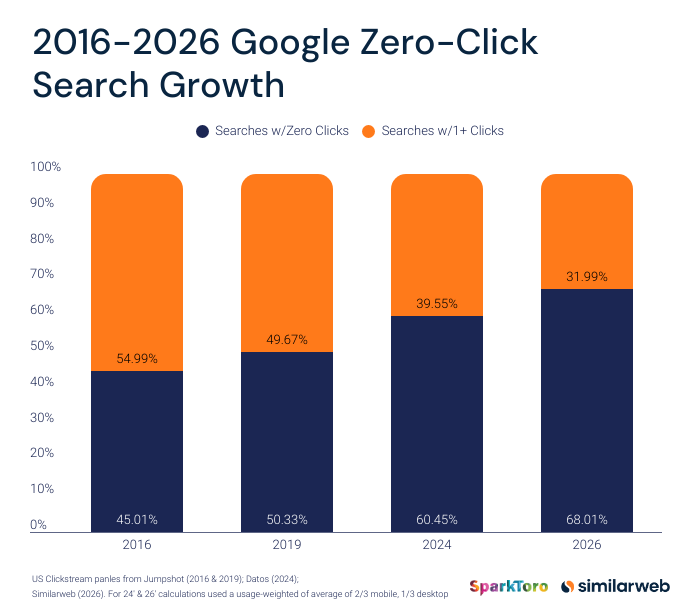
That’s more than two in every three Google searches producing no website visit at all.
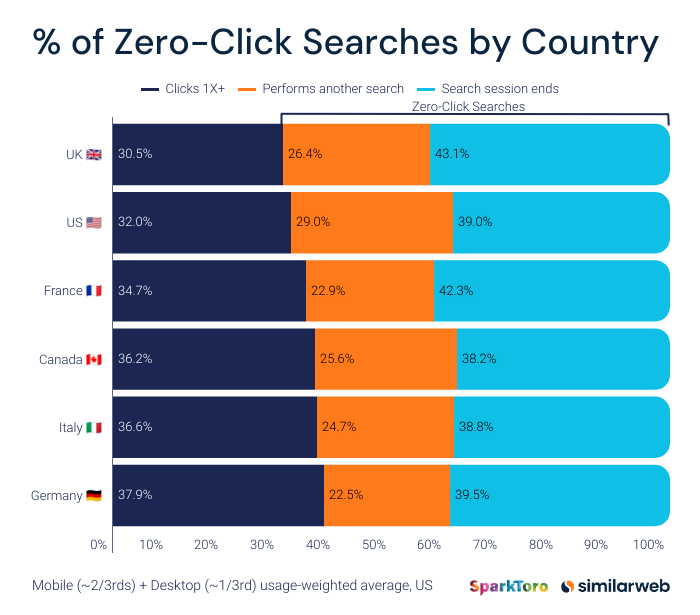
The trend cuts across geographies. In the UK, 69.5% of searches are zero-click. The US sits at 68%. France, Canada, Italy, and Germany all fall in the 62–65% range. The numbers vary, but the direction is consistent everywhere — the gap between “searched on Google” and “visited a website” keeps widening.
What’s Driving It
Zero-click searches aren’t a new phenomenon. Google has been surfacing quick answers — weather, sports scores, currency conversions, knowledge panel snippets — for over a decade. Every time it adds a direct answer to the results page, a certain number of clicks that would have gone to a third-party website stay on Google instead.
What changed more recently is the scale of that behavior. Google’s AI Overviews, rolled out broadly in 2024 and 2025, placed AI-generated answer summaries at the very top of the results page for a far wider category of queries than the old featured snippets covered. The effect was immediate and measurable. Search traffic to websites fell roughly 25% between mid-2025 and May 2026, per Ahrefs data cited by a16z, while every other traffic channel held roughly steady. The cause wasn’t mysterious — users were getting answers on the results page and leaving.
The irony is that Google’s own search usage numbers rose during this period. More people are using Google than before. The product is working, in the sense that users are getting what they came for. The question is who captures the value of that interaction — and increasingly, the answer is Google, not the web.
Not Just AI Overviews
It’s worth separating out the different components of zero-click behavior, because they point to different things. Roughly 25-30% of zero-click searches end in another search rather than a session ending entirely. That category reflects search refinement — users who don’t find what they want in the first query and try again. This has always existed and isn’t especially alarming on its own.
The more structurally significant category is search sessions that simply end. In the UK, 43% of all searches end with no click and no follow-up search. In the US, it’s 39%. In France, 42%. These are users who asked a question and considered it answered — by the results page itself, by an AI summary, or by a knowledge panel — without visiting any external source.
That category is the one that’s been growing fastest, and it maps directly onto the expansion of Google’s on-page answer features.
What It Means For Publishers
For websites that built their traffic models around organic Google search, the practical implications are significant. Google CEO Sundar Pichai has argued that AI enhances rather than replaces search, and that clicks following AI-assisted searches are more qualified. That may be true at the aggregate level, but it does little to reassure publishers watching their analytics decline while their Google Search Console impressions hold steady or rise.
The pattern — high impressions, falling clicks — is now common across news, informational content, and how-to publishing. It’s a structural reflection of what the zero-click data shows. Visibility on Google no longer translates to traffic in the way it once did.
This is also why AI as a traffic channel matters beyond just the question of whether people use ChatGPT or Perplexity instead of Google. Even if AI platforms generate less direct search traffic than Google, if they send a higher proportion of their users to external websites, they could become genuinely competitive as a referral source over time. For now, that hasn’t happened. AI tools account for a negligible share of web referral traffic despite their scale. The structural shift away from click-through hasn’t produced a corresponding structural shift toward a different referral source.
The Longer Arc
Looking at the 10-year span — 45% in 2016, 68% in 2026 — what’s striking is how consistent the direction has been, and how each phase of the acceleration corresponds to a Google product change. Featured snippets expanded clicks away from third parties around 2017-2018. The mobile shift, with its smaller screens and faster session endings, contributed through 2019. AI Overviews produced the steepest acceleration in the most recent period.
Each of these was, from Google’s perspective, an improvement to the user experience. Users get answers faster. Sessions complete more cleanly. Satisfaction metrics presumably improve. The downstream effect on the broader web publishing economy is real, but it’s a consequence rather than a goal.
The 68% figure isn’t a ceiling. Given the trajectory, there’s little reason to assume zero-click rates plateau in the near term. The more Google can answer directly on the results page, the fewer reasons users have to click elsewhere. That dynamic will keep moving in the same direction as AI answer quality improves.