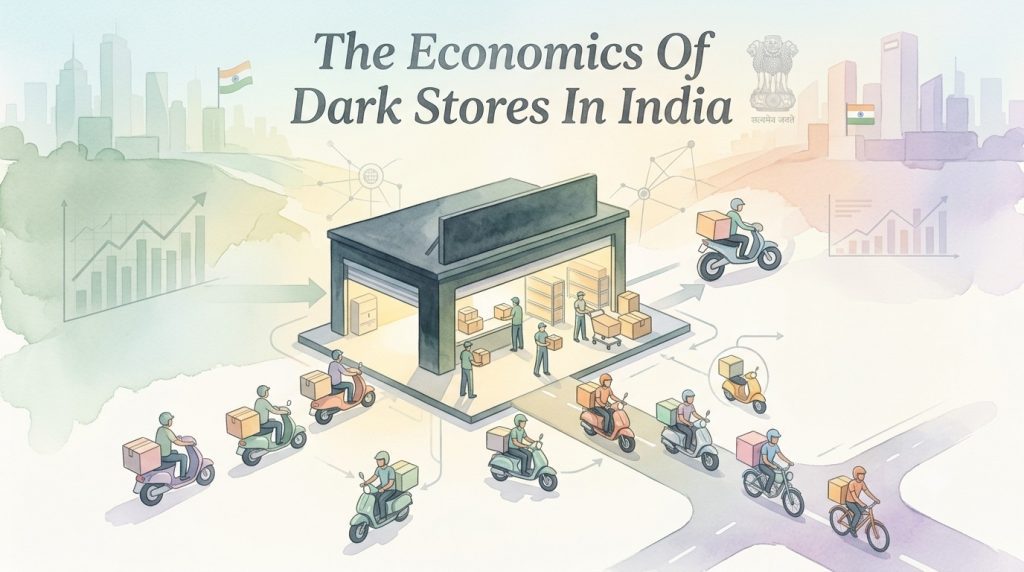
Quick commerce has turned the neighbourhood warehouse into one of the more interesting small business opportunities in India right now. Every time you order groceries and it shows up in ten minutes, that order was packed inside a dark store, a closed warehouse with no walk-in customers, stocked purely to fulfil online orders. Swiggy runs hundreds of these across the country, and so do its competitors, and a meaningful chunk of that network isn’t owned directly by the company at all. It’s run by individual operators and landlords who lease out space, hire staff, and effectively run a franchise-style warehouse on the platform’s behalf.
If you’re considering becoming one of those operators, or just trying to understand whether a dark store is a business worth getting into, the numbers that matter are all financial terms that sound intimidating the first time you hear them but are actually fairly simple once broken down. This piece walks through each one using real steady-state numbers from the industry, explaining what they mean and why they decide whether a dark store makes you money or quietly drains it.
What Is Capex Per Store
Capex, short for capital expenditure, is simply the money you spend upfront to get a store running before it takes its first order. This covers the racking and shelving, the cold storage or freezers if you’re stocking perishables, packing stations, computers and handheld devices for staff, security systems, and any interior fit-out the space needs. It doesn’t include rent, which is an ongoing cost, it’s the one-time spend to set the place up.
For a typical dark store, this figure runs between roughly ₹2.2 crore and ₹2.5 crore. That’s a serious number, well beyond what most small retail formats need to get going, and it’s the first filter that decides whether this is a business you can enter on your own or whether you need a partner, a loan, or backing from the platform itself. Some operators split this cost with the quick commerce company they’re partnering with, so it’s worth negotiating exactly who pays for what before signing anything.
What Is Working Capital
Working capital is the cash you need on hand to keep daily operations running smoothly, separate from what you spent building the store. It covers things like paying staff before revenue comes in for the month, restocking inventory, and covering the gap between when you pay a supplier and when you actually get paid for the goods you’ve sold.
In dark store operations, this is often measured in days, meaning how many days of cash the business needs tied up at any point to keep functioning without a hiccup. The industry figure sits between 12 and 15 days. A lower number is better for you as an operator, it means less of your money is sitting idle in the system and more of it is available to reinvest or pocket as profit. If you’re evaluating a partnership, ask what the working capital cycle looks like, because a business that needs 20 or 25 days of float is going to be a lot more stressful to run than one needing 12.
What Is NOV, Or Net Order Value
NOV stands for net order value, which is essentially the total value of all the orders a store fulfils in a year, after accounting for returns, cancellations, and any deductions. Think of it as the real, usable revenue passing through your store, not the inflated number you’d get by just counting every order placed before any of it gets adjusted.
A mature, well-located dark store can generate anywhere between ₹42 crore and ₹48 crore in NOV annually. That might sound enormous for a warehouse that’s typically only 1,500 to 4,000 square feet, but that’s the nature of quick commerce, a small footprint pushing through an extremely high volume of small-ticket orders throughout the day. This number is also the one most dependent on location. A store in a dense residential pocket with high smartphone usage and working professionals will comfortably beat a store in a quieter part of town, so site selection matters more here than almost anywhere else in the business.
What Is Asset Turn
Asset turn tells you how many times your revenue covers your original capital investment in a single year. You calculate it by dividing your NOV by your capex. If a store cost ₹2.5 crore to build and generates ₹48 crore in NOV a year, its asset turn is roughly 12x, meaning the store’s revenue is twelve times what it cost to set up.
The industry range here runs from about 10.5x to 12x, and this is genuinely one of the more attractive numbers in retail generally. A grocery supermarket or a clothing store rarely turns its assets over that fast. It’s the reason dark stores can survive on thin margins, because even a small profit on each order adds up quickly when the same capital base is being used ten or twelve times a year rather than two or three times, which is closer to what a traditional retail store manages.
What Is EBITDA Margin
EBITDA stands for earnings before interest, tax, depreciation, and amortisation. In plain terms, it’s what’s left from your revenue after paying for the actual running costs of the business, staff salaries, packing materials, electricity, basic maintenance, before you account for loan interest, taxes, or the gradual wear and tear on your equipment. It’s the cleanest way to look at whether the day-to-day operation itself is profitable, stripped of accounting and financing noise.
For dark stores, EBITDA margin typically lands between 4.0% and 4.5%. That’s thin by most business standards, and it means for every ₹100 of orders passing through your store, you’re keeping roughly ₹4 to ₹4.50 before the deeper costs kick in. This is why volume matters so much in this business. A dark store isn’t trying to make a large profit on each order, it’s trying to process enough orders that a small margin becomes a meaningful number by the end of the month.
What Is EBIT Margin
EBIT, earnings before interest and tax, is a step further down from EBITDA. Here you also subtract depreciation, which is the accounting cost of your equipment and fit-out losing value over time, and amortisation, a similar concept for any intangible costs. This gives a more honest picture of profitability because racking, freezers, and packing equipment do wear out and eventually need replacing, and that cost has to be accounted for somewhere.
EBIT margin for a dark store sits between 3.3% and 3.8%, a bit lower than the EBITDA figure as you’d expect, since it now includes the cost of your equipment ageing. If you’re doing your own financial planning for a dark store, this is the number to budget around rather than EBITDA, because it accounts for the fact that you’ll eventually need to spend money again on replacing worn-out infrastructure.
What Is ROCE, Or Return On Capital Employed
ROCE measures how efficiently a business uses the capital put into it to generate profit, expressed as a percentage. It’s calculated using your EBIT against the total capital employed, essentially your capex plus your working capital. This is the number that tells you, in a single figure, whether the money you put into this business was worth it compared to just parking that capital somewhere else.
Industry guidance for a mature dark store puts pre-tax ROCE between 35% and 45%, averaging around 40%. To put that in context, this comfortably beats most fixed deposits, mutual funds, and even a lot of small business formats in India. It’s the headline number that makes dark stores attractive as an investment despite the thin margins discussed above, because the combination of low working capital days and high asset turn means your money is working extremely hard for you even though the margin on any single order is small.
What This Actually Means If You’re Starting One
Put together, these numbers tell a fairly clear story about what kind of business a dark store is. It’s not a high-margin business, and anyone going in expecting to make a large cut on every order is going to be disappointed. It is, instead, a high-frequency, high-turnover business where a small profit repeated across tens of thousands of orders a year adds up to a genuinely strong return on the capital you’ve put in.
That also means the things that actually determine whether your specific store succeeds are less about the financial model, which is fairly standard across the industry, and more about execution. Location decides your order volume more than almost anything else. Staffing and packing efficiency decide whether you’re hitting delivery time targets consistently, which in turn decides how much order flow the platform’s algorithm sends your way. And discipline around your working capital, not letting inventory pile up or payments to suppliers stretch out, decides whether the business feels comfortable to run day to day or constantly tight on cash.
The ₹2.2 to ₹2.5 crore capex requirement is the real barrier to entry here, not expertise or experience. If you can arrange that capital, or find a platform partner willing to share the setup cost, the underlying quick commerce format has already proven it can deliver strong returns once a store matures, generally over a six to twelve month runway before it hits the kind of volume needed to justify these numbers. The first year is the hard part. After that, the maths above starts working in your favour.