When a rocket puts a satellite into orbit, its job is only half done. The satellite still needs to reach its precise operating orbit, hold position for years without drifting, dodge debris, and eventually burn up safely at the end of its life. All of that depends on propulsion — the small thrusters that nudge a spacecraft around once it’s in space. It’s a less glamorous business than building rockets, but it’s arguably a more durable one, and it’s the business Bengaluru-based Bellatrix Aerospace has built itself around.
Founded in 2015, Bellatrix has spent over a decade developing electric and “green” chemical propulsion systems for satellites, along with an orbital transfer vehicle that can ferry small satellites to different orbits after a rocket drops them off. In 2026, that decade of engineering work has started translating into flight heritage, government contracts, international partnerships, and serious capital — including a $20 million round closed in March and reported talks for a Series B of up to $100 million.
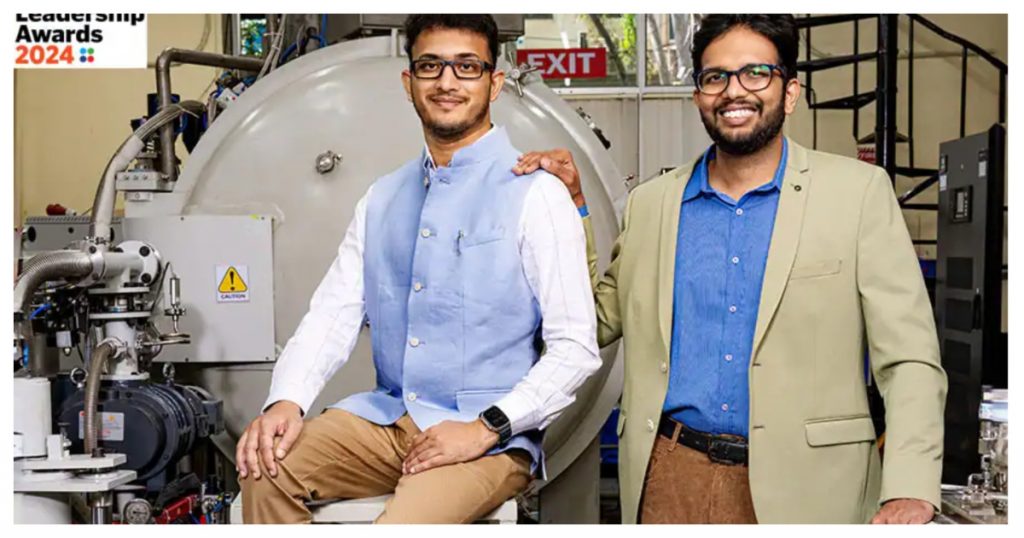
The founders
Bellatrix was started by three engineers: Rohan M Ganapathy, Yashas Karanam, and Nuthan Prasanna Kumar. Ganapathy, who studied mechanical engineering at Sri Jayachamarajendra College of Engineering in Mysuru and went on to work as a research fellow at the Indian Institute of Science (IISc) in Bengaluru, serves as CEO and CTO. Karanam, the other co-founder, has been the company’s public face on its propulsion and satellite technology roadmap.
The founding story has become something of a startup legend in Indian space circles: the young founders reportedly cornered a former ISRO chief as he was leaving a convocation ceremony to pitch their idea on the spot. That chance encounter led to an MoU with ISRO to build thrusters for small satellites, and the fledgling company set up its first workspace in a small room on the IISc campus, near the lab where they tested their early thrusters. A Rs 20 lakh grant from JSW in 2013 helped the founders — then in their early twenties — prove out their technology by the end of 2015.
Both founders were recognised on Forbes India’s 30 Under 30 list in 2018, and the company has since grown from a two-person lab setup to a team of roughly 70, having outgrown its IISc offices twice before consolidating its industrial operations at a factory in Peenya, on Bengaluru’s outskirts.
From rockets to propulsion
Bellatrix didn’t start out purely as a propulsion company. In its early years, it also worked on a small-lift orbital launch vehicle called Chetak, designed to be powered by liquid-methane engines, and in 2021 it announced a partnership with fellow Indian space startup Skyroot Aerospace. But by February 2022, Ganapathy announced the company was shelving its rocket ambitions to focus exclusively on in-space propulsion — a strategic narrowing that has defined Bellatrix ever since.
That focus sits across four thruster families. Arka is a line of Hall-effect electric thrusters spanning 50W to 5kW, covering everything from CubeSats to large satellites in geostationary orbit. Rudra is a green monopropellant chemical propulsion system built around a proprietary, non-toxic fuel blend positioned as a safer, easier-to-handle alternative to hydrazine, and comes in 1N, 5N and 100N variants. Jal is a microwave plasma thruster. And a line of nano thrusters is designed for station-keeping, controlled de-orbiting, and last-minute collision-avoidance manoeuvres for smaller satellites.
Sitting above the thrusters is Pushpak, Bellatrix’s Orbital Transfer Vehicle — essentially a “space tug” that can carry satellites weighing up to 750kg and move them into different orbits after deployment. The company argues this can meaningfully cut launch costs: it claims a dedicated small-satellite launch vehicle costs around $45,000 per kg to orbit, versus roughly $25,000 per kg if the payload rides on a Pushpak instead.
Flight heritage and government ties
Bellatrix’s propulsion systems have now flown, and fired, in space multiple times aboard ISRO missions. Its Rudra and Arka systems were tested on ISRO’s PSLV-C58 mission in January 2024, and Rudra was tested again on the POEM-3 orbital platform later that January and on POEM-4 in January 2025. In October 2024, Bellatrix signed a contract with NewSpace India Limited (NSIL), ISRO’s commercial arm, to integrate its Pushpak OTV into NSIL’s launch missions.
The bigger technical leap came in March 2026, when Bellatrix flew its first complete satellite, Harbinger, aboard SpaceX’s Transporter-16 rideshare mission — the company’s first time flying a fully in-house-built satellite bus, including its own attitude-determination-and-control system. The satellite reached a roughly 510km orbit and began returning data within its first orbital pass, which the company treated as validation of years of subsystem development done without outsourcing critical components.
Funding
Bellatrix’s capital raises track its shift from lab-stage experimentation to a commercial-scale manufacturer. Its first funding came entirely from Indian investors, with the founders targeting a Series A close by the end of 2020, and a Series A round of roughly $8 million eventually closed in mid-2022. That was followed by a $20 million Pre-Series B round closed in March 2026, led by Cactus Partners, with participation from Hero Investment Office, 35North Ventures, Indusbridge Ventures, and Monarch Holdings, alongside existing backers Inflexor Ventures, Pavestone VC, GrowX, StartupXseed, and Survam Partners.
Ganapathy has described the round as marking the company’s shift from “flight-proven to factory-ready” — money earmarked for scaling up manufacturing lines, cutting lead times to under six months, and building out its global supply chain rather than further R&D. Reports in mid-2026 suggested the company was in talks to raise a Series B of up to $100 million.
Going global
Bellatrix has been steadily building an international footprint alongside its domestic ISRO relationship. In April 2025, it opened a US subsidiary in Delaware, with plans for a domestic satellite-manufacturing facility, and it has said it signed an MoU with an undisclosed “prominent US satellite manufacturer.”
In 2026, the company also announced a partnership with South Korean optical-payload maker TelePIX to build a Very Low Earth Orbit (VLEO) demonstration satellite targeted for launch no earlier than 2028. Bellatrix will supply the satellite bus, an air-breathing electric propulsion (ABEP) system, and the power, thermal, and attitude-control systems, while TelePIX contributes its high-resolution optical payload — a category of propulsion technology Karanam has said very few companies worldwide are working on.
Why it matters
India’s private space sector has largely been defined by launch-vehicle startups chasing rocket milestones. Bellatrix has bet on the less visible layer underneath — the systems that let a satellite actually do its job once it’s in orbit — arguing that Indian space capability needs domestically built subsystems, not just rockets and satellites stitched together from imported critical parts. With flight-qualified thrusters, a working satellite bus in orbit, a government customer in ISRO/NSIL, and now international manufacturing and partnership deals, Bellatrix is positioning itself as one of the more commercially mature players to emerge from India’s space-tech wave — a bet that the real value in the new space economy sits in orbit, not just in getting there.