India’s startups are continuing to make their mark in the space race.
Bengaluru-based GalaxEye Space Solutions launched Mission Drishti aboard a SpaceX Falcon 9 rocket — putting into orbit the world’s first OptoSAR imaging satellite, and, in doing so, claiming the title of India’s largest privately built spacecraft with electric propulsion. It is a milestone that marks both a coming-of-age moment for the company and a broader signal of India’s rising ambitions in commercial space technology.
From a Hyperloop Team to Orbit
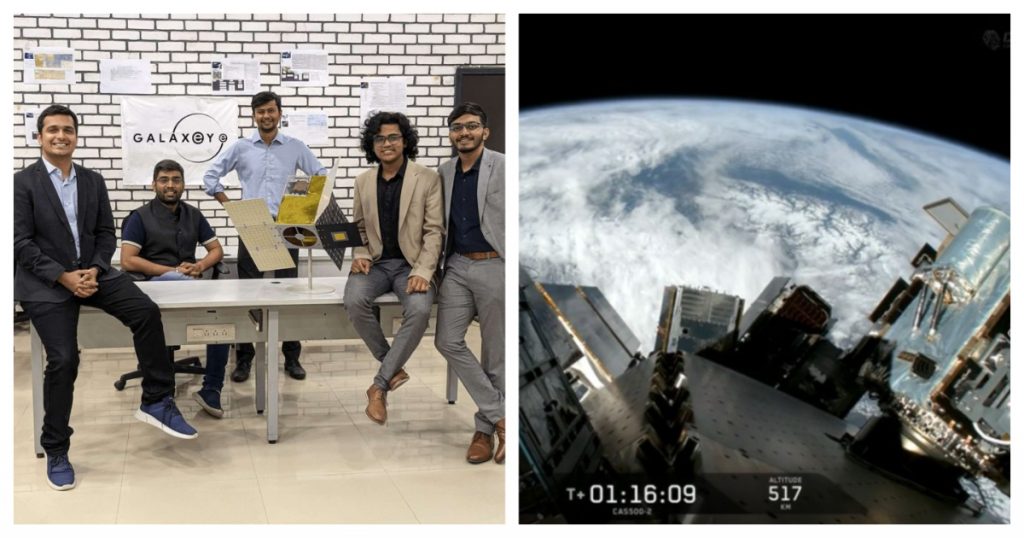
GalaxEye’s origin story reads like a startup fable. The company was founded in 2021 by five alumni of IIT Madras — Suyash Singh (CEO), Denil Chawda (CTO), Kishan Thakkar (VP Product Development), Pranit Mehta (VP Business Development), and Rakshit Bhatt (VP Computing) — who had previously worked together as part of Team Avishkar Hyperloop, a student team that competed in the global SpaceX Hyperloop Competition.
Incubated at the IIT Madras Incubation Cell, the company set out to solve one of the most persistent problems in Earth observation: cloud cover and darkness rendering optical satellites blind for large stretches of time. Their answer was OptoSAR — a proprietary fusion of optical and radar imaging — and they’ve spent four years building toward this launch.
What Is an OptoSAR Satellite?
Traditional Earth observation satellites typically carry either an optical camera (which captures detailed, photograph-like images but is useless through clouds or at night) or a Synthetic Aperture Radar (SAR) sensor (which can see through clouds and in the dark but produces coarser, harder-to-interpret data). Most operators deploy these as separate satellite systems.
GalaxEye’s SyncFused OptoSAR technology does something no satellite has done before: it combines both sensors on a single platform and fuses the data in real time. The result is imagery that is simultaneously all-weather, day-and-night, and rich in spectral detail — offering roughly three times more information than either sensor could deliver alone. The satellite can assess crop health, detect the chemical composition of land surfaces, map infrastructure, and support border surveillance even during monsoons or at midnight.
At 190 kg and orbiting at approximately 500 km altitude, Drishti captures imagery at 1.2–3.6 metre resolution and is equipped with an NVIDIA Jetson Orin AI chip that processes data directly in orbit — drastically reducing the time between capture and delivery to customers. Drishti also features electric propulsion and a deployable radar antenna that folds for launch and expands in space.
The Funding Journey
GalaxEye’s funding journey has been steady and well-supported. The company raised a pre-seed round led by Speciale Invest in June 2021, shortly after its founding, before closing a seed round of $3.5 million in 2022 — again with Speciale Invest at the helm.
As the Drishti mission took shape, the company raised a $6.5 million Series A round co-led by Mela Ventures and Speciale Invest, with participation from ideaForge, Rainmatter, Navam Capital, Faad Capital, and Anicut Capital. A subsequent Series A extension brought in Mounttech Growth Fund among others. Total funding raised has crossed $18.8 million over nine rounds from more than 50 investors, including Infosys and LetsVenture. Most recently, in February 2026, the company secured a venture debt of ₹5 crore from Indian government’s SIDBI ahead of the launch. India’s Prime Minister Narendra Modi — also in charge of India’s Department of Space — hailed the launch as a “major achievement” in India’s space journey.
The company’s advisory board spans DRDO, ISRO, Waymo, and Swiss Re — a sign of its ambitions across both defence and commercial markets.
The Road to Launch
Getting Drishti ready for orbit was no small feat. GalaxEye logged over 500 aerial test flights — using drones, Cessna aircraft, and high-altitude platforms — to validate their sensor fusion technology before ever attempting to build a satellite around it. The company also launched a payload on ISRO’s PSLV under the POEM mission, gaining early orbital experience.
The structural qualification model of Drishti was tested at ISRO’s U R Rao Satellite Centre (URSC) in Bengaluru, undergoing rigorous tests simulating the thermal extremes, vibrations, and vacuum of space. The satellite was shipped to the United States in March 2026 for final launch preparations.
GalaxEye also inked a deal with NSIL (NewSpace India Limited), the commercial arm of the Department of Space, which will resell GalaxEye’s entire product portfolio globally — a significant endorsement from the Indian space establishment.
What Drishti Will Do
Mission Drishti is the first of a planned 10-satellite constellation that will eventually offer a 2-day global revisit time — meaning any point on Earth can be imaged every 48 hours. Each satellite is designed for a 4–5 year lifespan.
The immediate customer base spans defence and intelligence agencies, disaster management authorities, agricultural monitoring bodies, and infrastructure companies. The satellite’s ability to image through cloud cover is particularly significant for a country like India, where the monsoon renders optical satellites nearly useless for months at a time.
At a broader level, Drishti competes with global players like Planet Labs, ICEYE, and Capella Space — but GalaxEye’s pitch is differentiation through data fusion rather than raw image volume.
India’s Private Space Moment
GalaxEye’s launch is part of a larger wave. India now hosts over 200 space startups, ranging from launch vehicle developers like Skyroot Aerospace and Agnikul Cosmos to Earth observation specialists like Pixxel — which itself launched its first satellite aboard a SpaceX Falcon 9 in 2022. The sector has been energised by policy reforms that opened Indian space to private players and initiatives like “Make in India” and “Atmanirbhar Bharat.”
What GalaxEye has done, however, is claim a genuine global first — not just an Indian one. No other satellite, from any country, has fused optical and radar data on a single platform at this scale. That is the kind of milestone that puts a startup on the world map.
For Suyash Singh and his IIT Madras team, the journey from a Hyperloop competition to orbit has taken five years, 500 test flights, and nine funding rounds. The hard part — building the technology — is done. What comes next is proving it works from 500 kilometres up.