Food delivery was thought to be a settled space in India, but there has been renewed activity in the last couple of years.
Flipkart has now become the latest big name to throw its hat into the ring, with Group CEO Kalyan Krishnamurthy telling Moneycontrol that the company will launch its food delivery service in the coming weeks. The plan, he said, is to start small — a single city pilot to test the value proposition, gather feedback, and only then decide on a wider rollout. “Once we find it to be a very good fit for the Indian customer, we’ll start scaling it,” he added.
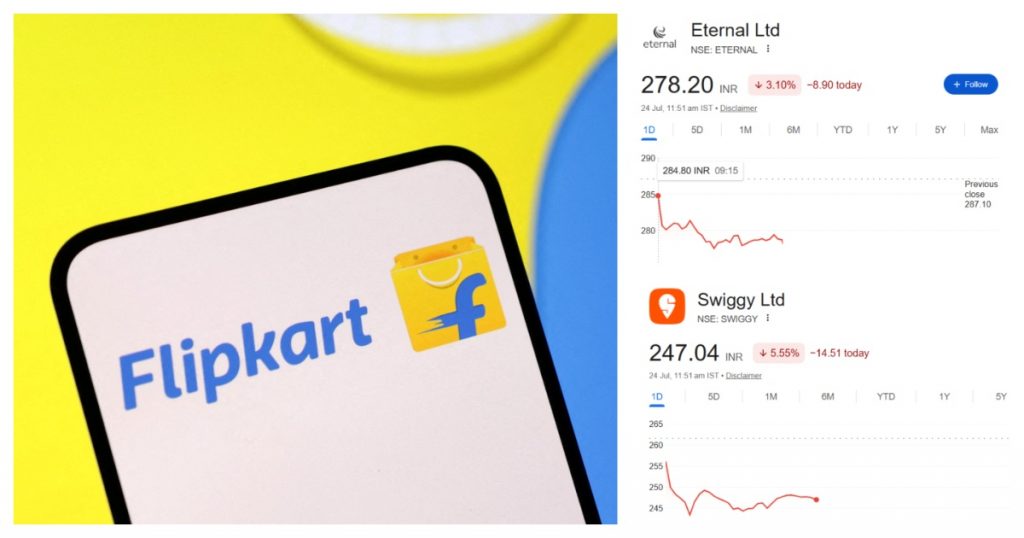
Markets reacted almost instantly. Shares of Eternal, formerly Zomato, fell nearly 3% in early trade, while Swiggy dropped as much as 5.55%. For two companies that have spent close to a decade building a duopoly in Indian food delivery, the announcement from India’s largest e-commerce player was enough to spook investors, even though Flipkart hasn’t delivered a single meal yet.
Krishnamurthy was careful to frame this as innovation rather than a pure pricing play. He said Flipkart wants to bring something genuinely new to the category rather than simply undercutting the competition, pointing to how the company has approached its quick commerce arm Flipkart Minutes — getting the product right in one market before expanding aggressively. The company is reportedly looking at a combination of its main app and a dedicated interface for the new service, and may also lean on the Open Network for Digital Commerce.
A crowded, and suddenly interesting, market again
For years, food delivery in India looked like a two-horse race that had already been decided. Zomato and Swiggy fought a long war of attrition through the 2010s, burned through enormous amounts of capital, and eventually emerged as the only two players anyone needed to think about. Take rates crept up to among the highest in the world — 24.4% for Eternal and 21.9% for Swiggy, compared to Meituan’s 16.1% in China — and growth had started to slow as a result, with Eternal’s food delivery gross order value growing just 16% year-on-year in the March quarter, missing its own guidance.
That comfort has been disrupted from an unexpected direction: quick commerce. Zepto pioneered ten-minute grocery deliveries in late 2021, and Blinkit and Swiggy Instamart followed close behind. The category grew so fast that it began eating into the economics of traditional food delivery itself, and eventually the players in quick commerce turned their instant-delivery muscle toward food. Zepto launched Zepto Cafe and Blinkit followed almost immediately with Bistro, both promising hot food in ten minutes rather than the usual thirty to forty five. Swiggy, already sitting on both sides of the fence, has had to defend its core business against products built by its own rivals.
Then came Rapido. The bike-taxi company, which had already chipped away at Ola and Uber’s grip on ride-hailing by competing hard on price, launched its own food delivery app called Ownly in Bengaluru. The pitch was zero commission for restaurants and a flat delivery fee instead, which let it undercut Swiggy and Zomato’s menu prices by as much as 15%. Rapido had built the business under a separate subsidiary, partly to sidestep the awkwardness of Swiggy holding a minority stake in the company. Restaurant owners, tired of commissions running as high as 30%, have reportedly been receptive — the National Restaurants Association of India had been pushing for exactly this kind of alternative.
Flipkart entering the fray is a different proposition altogether from Rapido or Zepto, though. It isn’t a startup looking for its first big win — it’s a Walmart-backed giant with hundreds of millions of registered users already transacting on its platform for everything from electronics to fashion. Krishnamurthy pointed out that Flipkart’s history has been one of continuous category expansion, moving from books to phones to apparel to travel, and food delivery fits that pattern. He also singled out Gen Z as a demographic where Flipkart already has outsized traction in fashion, beauty and electronics, suggesting the company sees food as another wedge into that audience.
The graveyard of Indian food delivery attempts
None of this is happening in a vacuum, and India’s food delivery history is littered with the wreckage of companies that thought they had a better idea. TinyOwl was among the most prominent of the early casualties. Founded in 2014 by a group of IIT-Bombay graduates, it raised over $27 million from investors including Sequoia and Matrix Partners and was briefly the fastest growing food ordering app in the country. But spiralling costs and a race to the bottom on discounts caught up with it — the company went through repeated rounds of layoffs, and in one particularly ugly episode a founder was held hostage for 48 hours by laid-off employees at its Pune office. TinyOwl eventually merged with logistics company RoadRunnr to form Runnr, which itself shut down its consumer food business within a year.
Foodpanda went through something similar under Ola’s ownership. Ola had acquired the company as a counter to Uber’s entry into Indian food delivery, and pledged to invest $200 million into it, but eventually pulled back sharply, delisting most restaurants and cutting 1,500 delivery contracts as it decided it couldn’t keep pace with the money Swiggy and Zomato were burning. Amazon tried too, launching Amazon Food in Bengaluru in 2020, but shut the business down within three years without ever marketing it aggressively. Even Google took a swing at the category, quietly launching an app called Areo in 2017 that let users order from restaurants and book home services in Bangalore and Mumbai — it went nowhere and was eventually wound down.
Zomato itself has walked back adjacent bets more than once, shutting its grocery delivery business twice and closing an intercity food delivery service called Legends after failing to find product-market fit over two years. The lesson repeated across all of these attempts has usually been the same one — logistics in food delivery are brutal, margins are thin, and even companies with deep pockets and strong brands have found the category harder to crack than it looks from the outside.
Whether Flipkart fares any differently will depend on execution far more than capital. It has an advantage that most past entrants didn’t — an existing high-frequency shopping app, a logistics network already built for last-mile delivery, and a fresh reference point in Flipkart Minutes, which Krishnamurthy has described as having scaled well. But Zomato and Swiggy know exactly what a well-funded new entrant looks like, having beaten several of them already, and Rapido’s Ownly is already running the low-commission playbook that Flipkart will presumably have to answer too. The single-city pilot suggests Flipkart itself isn’t taking the outcome for granted either.