India already has a thriving pharmaceuticals industry, but a Bhubaneshwar-based startup is taking pharmaceutical manufacturing the to skies.
Serendipity Space, a deep-tech startup headquartered in Odisha’s capital, is building satellites designed to manufacture medicines in microgravity and bring them back down to Earth. The company recently pulled off a milestone that puts it firmly on India’s space-tech map: it flew an autonomous pharmaceutical factory to the edge of space on a stratospheric balloon, crystallised drug compounds mid-flight, and recovered the payload intact.
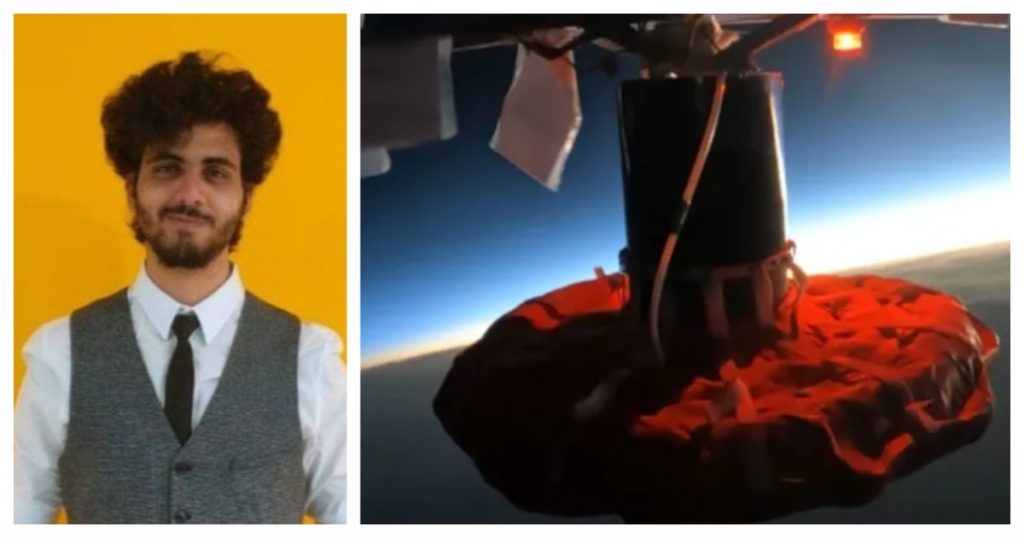
The Company And Its Founders
Serendipity Space was founded in 2024 by Antariksh Parichha, Jivitesh Debata, and Dr. Monica Ekal. The founding team brings together backgrounds in physics, engineering, computer science and space operations. Dr. Ekal, in particular, has prior experience at the German Aerospace Center (DLR) and NASA, giving the young company deep technical grounding in space systems.
For CEO Parichha, who has degrees from Shiv Nadar University and Technical University Munich, the mission is personal as much as scientific. His interest in space-based pharmaceuticals was shaped by a personal brush with cancer, which led him to study immunotherapies and their manufacturing limitations. He has repeatedly pointed to Keytruda, the blockbuster cancer drug, as an example of what is possible: an easier-to-inject version of the drug was developed using the microgravity lab aboard the International Space Station, in a collaboration between Merck and NASA. That single data point convinced Parichha that space could be a legitimate manufacturing environment for medicines, not just a research curiosity.
From Idea To Orbit-Class Prototype In Under A Year
Serendipity Space moved quickly. The startup raised pre-seed funding from Campus Fund in July 2025, had its technical team in place by October that year, and built a functional orbital-class satellite prototype in under four months. After roughly a month of testing, the company launched its near-space demonstration mission in March 2026, in partnership with the Tata Institute of Fundamental Research’s (TIFR) Balloon Facility in Hyderabad, which has decades of experience running high-altitude balloon launches.
As of May 2025, dealroom data placed the company’s post-money valuation at roughly ₹22.5 crore, still early-stage, but a sign that investors are willing to bet on Indian space-pharma before the technology has fully matured.
What Actually Happened On The Mission
The centrepiece of Serendipity Space’s recent test was Alchemy, its proprietary autonomous pharmaceutical factory module. Alchemy was carried inside a satellite prototype to the edge of space, where it ran core drug crystallisation processes on its own, without any human intervention, while also testing the satellite’s heatshield and avionics systems needed for eventual orbital re-entry.
The payload included commercial monoclonal antibody therapeutics and small-molecule drugs, categories that between them underpin multi-billion-dollar pharmaceutical markets, along with additional proteins meant for drug discovery research. According to the company, the system kept working through the harsh conditions of the flight, successfully running crystallisation and keeping the resulting crystals intact through descent, touchdown and recovery.
Why Space, Of All Places, Helps Make Better Medicines
The science behind Serendipity Space’s pitch is straightforward once you strip away the jargon. Many drugs work by forming crystals, either during manufacturing or as part of their final formulation, and the quality of those crystals determines how well the drug dissolves in the body, how stable it is on a shelf, and how effective it ultimately is.
On Earth, gravity gets in the way of this process. As liquid solutions cool and crystals start to form, gravity causes convection currents and sedimentation that make crystals grow unevenly, with defects baked into their structure. In microgravity, that interference largely disappears. Crystals can grow more slowly and uniformly, in every direction at once, producing purer, more ordered structures without changing the drug’s underlying chemistry at all.
This matters for two categories of medicine in particular. First, many existing small-molecule drugs are held back by poor bioavailability, essentially how much of a dose the body actually absorbs and uses, because of imperfect crystal structures. Better crystals could mean the same drug works better at the same dose. Second, protein-based therapies like monoclonal antibodies (lab-made proteins that mimic the immune system’s ability to fight off things like cancer cells) usually need to be delivered as long, hospital-based IV infusions. That is because concentrating these proteins into a smaller, more potent dose tends to make the formulation unstable when it is made under normal gravity. If microgravity manufacturing can produce more stable, high-concentration formulations, some of these treatments could eventually shift from hours-long hospital infusions to a quick injection a patient could take at home.
What’s Next
Serendipity Space’s near-space test was explicitly built as a stepping stone. The company’s roadmap moves from stratospheric balloon demonstrations to full orbital missions, where satellites would manufacture drug crystals in true low Earth orbit before returning them to Earth for use. The successful recovery of its prototype, with the heatshield, avionics and Alchemy module all functioning through the flight, gives the company a working technical base to build on for that next, much harder phase.
Space-based manufacturing is still a nascent field globally, with the space manufacturing market projected to cross $10 billion by 2030. If Serendipity Space can prove the economics of repeatedly launching, operating and recovering pharmaceutical satellites, it could give India an early foothold in a part of the space economy that very few companies anywhere are currently chasing.